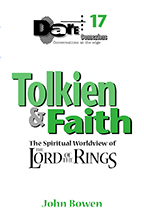
Tolkien and Faith: The Spiritual Worldview of The Lord of the Rings
Not everybody who enjoys The Lord of the Rings knows that J.R.R.Tolkien described it as “a deeply religious and Catholic work.” This booklet draws out the Christian underpinnings of the story. Timed to coincide with the release of the third movie in 2003, but intriguing wherever Tolkien’s work is loved. |
![]() |
This DARE Booklet is available for sale in print format. Purchase a print copy for $5 Plus HST and $1 Shipping: Email sales@institute.wycliffecollege.ca to order |
| This DARE Booklet is also available FREE in a fully formatted PDF file. |
What Sort of Tale?
John Ronald Reuel Tolkien was a professor of Anglo-Saxon studies and English literature at Oxford from 1925 to 1959. In 1937, Tolkien published a novel called The Hobbit, about a little creature, a hobbit by the name of Bilbo Baggins, who finds himself involved in an adventure with dwarves, elves, a wizard, trolls, treasure, and a dragon. Bilbo brings home from his adventure a mysterious Ring which has the power to make its bearer invisible.
Tolkien then began work on The Lord of the Rings, a three-part story about the Ring. The Ring becomes the property of Bilbo’s nephew, Frodo, who discovers that he is in mortal danger because he possesses it. The only answer is for him to leave his home in the Shire and embark on a quest to destroy the Ring. That quest is the heart of the three parts of The Lord of the Rings.
The first part of that story, The Fellowship of the Ring, was published in 1954, with the other parts, The Two Towers and The Return of the King following the next year. Together they constitute more than half a million words. Even before the first movie came out in 2001, more than 100 million copies of the books had been sold.
So what is it that makes this book, by an obscure professor of Anglo-Saxon, about a world inhabited by strange creatures, so popular? There are very few female characters. (Their role is expanded in the movies.) There is no sex. There are long periods in the book when almost nothing seems to happen. There are about 600 different personal names in the stories, and, to confuse things further, some people are called by two or three different names. The books are filled with references to events and places and people that happened long before the book opens, and of which we know nothing.
Why do these stories resonate so deeply for so many people? I believe that the main appeal of The Lord of the Rings lies in its spirituality. Not that the spirituality lies exposed on the surface. Few who read The Lord of the Rings think of it as a religious or spiritual work. But it is certainly there, in subtle and powerful ways. Tolkien himself certainly saw the book as spiritual: he once described it as “a fundamentally religious and Catholic work.”
Yet how can one look at the spirituality of a book that is over 1000 pages long? One way is by examining its worldview.
A worldview is, as the word implies, a way of viewing the world, an outlook on life, an explanation of the world. A worldview is by nature philosophical and spiritual and religious, in the sense that it offers answers to life’s big questions. We often use metaphors of seeing, such as That’s your point-of-view, or That’s how I see things, or Let’s take a look at the situation, or Try looking through their eyes, or You have a blind spot about that. Seeing is very important in our world. So our worldview is the big picture of how we see the world. It’s whatever big story we happen to believe about the world’s nature, and origin, and destiny.
Towards the end of The Two Towers, Frodo and Sam, the main characters of The Lord of the Rings, are discussing just such a story, and their role in it. They are puzzled about what kind of a story it might be:
“I wonder what sort of a tale we’ve fallen into?” [says Sam]
“I wonder,” said Frodo. “But I don’t know. And that’s the way of a real tale. Take any one you’re fond of. You may know or guess, what kind of a tale it is, happy-ending or sad-ending, but the people in it don’t know. And you don’t want them to.”
In fact, they find they can make connections with the stories they were told as children, of heroes from long ago. Sam, for example, realizes that the “star-glass” Frodo is carrying contains light from one of the Silmarils, the wonderful jewels created early in the life of Middle Earth, with light from the Blessed Realm.
Thus they come to understand that there is a constantly unfolding story about Middle Earth, and that in some mysterious way they are part of it. As a result, what they know about the heroes who came before them actually encourages them in their own trials. Sam even speculates that one day their story too may be “read out of a great big book with red and black letters, years and years afterwards.”
Yet Frodo and Sam have to accept that there is not much more they can know about the story they belong to. In Tolkien’s mind, however, Frodo and Sam were part of a much bigger story, a story that describes and explains their world from beginning to end. To put it another way, in The Lord of the Rings Tolkien expresses a very specific worldview. In fact, it is only when one sees this bigger perspective that the story of the Ring, and of Frodo and Sam, makes full sense. What I want to do in this booklet is to show how the stories we are told in The Lord of the Rings fit into this larger story, this worldview. The outline of this bigger narrative is provided by another book of Tolkien’s, The Silmarillion.
The framework I will use for thinking about the story in this way is provided by the writing of Brian Walsh and Richard Middleton on the subject of worldviews. They suggest that one way to analyze and compare worldviews is by asking four questions:
• Where are we? What kind of a world are we in?
• Who are we? Who are the inhabitants of this world? What do we know about them?
• What is the problem? What is fundamentally wrong with this world?
• What is the solution? How can the problem be put right?
I find it is often helpful to add a fifth question:
• Where are we going? What is the ultimate fate of this world and its inhabitants?
When we ask these questions of The Lord of the Rings, then, what kind of a worldview emerges?
WHERE ARE WE?
If we read The Lord of the Rings only, we would simply say that we are in the world of Middle Earth. We know nothing of where it came from, or where it will end, or indeed whether it was created or just happened, nor whether it came into being for a purpose. But, according The Silmarillion, Middle Earth is in fact part of a much bigger world, indeed, a whole cosmos, created by a supreme being whom Tolkien calls Iluvatar. This Iluvatar has created Middle Earth through the agency of spiritual beings, the Ainur, whom we might call angels. Iluvatar gives musical themes to the Ainur, and, as they sing, every theme, every note, every harmony, takes the form of something in the world of Middle Earth.
Thus, if we ask, Where are we? in The Lord of the Rings, the answer is that we are in a world made by Iluvatar. Iluvatar is good, and the world Iluvatar makes is good. At the same time, for reasons which are never explained, he allows evil to enter his good world. As a result, the world we meet in the book is still good, but it is now a flawed world. Middle Earth is not basically evil with strange touches of good, nor is it equally divided between good and evil: it is a good place to be, full of beauty and goodness, but frequently coloured by violence, corruption and sadness. We will see more of this in answering the question, What is the problem?
WHO ARE WE?
The inhabitants of Middle Earth are called the Children of Iluvatar, the creator, but they are of several different races. When the Nine Walkers, the “Fellowship of the Ring,” come together, they are said to “represent the . . . Free Peoples of the world”—that is, elves, dwarves and men. Hobbits, of course, are another race again: we are never told the story of their creation, but we presume they too are creations of Iluvatar.
All these Children of Iluvatar are amazing and beautiful. Even the Ainur, the great angels, who have seen so much of the wonders Iluvatar has made, are impressed and are immediately drawn to love them, not least for what they see in them of the endless creativity of Iluvatar.
So the inhabitants of Middle Earth are good and they are free and they are beautiful, but, as we shall see, they are also capable of great weakness and evil.
WHAT IS THE PROBLEM?
On one level, the problem of The Lord of the Rings is the Ring itself, and, behind the Ring, Sauron who made it. Sauron lusts for power, and it is the Ring which enables him to consolidate his power over Middle Earth.
But Sauron and the Ring are only the most recent manifestation of a larger and more ancient evil, and the war between the forces of Sauron and the Children of Iluvatar is a pale reflection of a much older conflict which takes place on a cosmic level. Occasionally there are hints of this in The Lord of the Rings. Aragorn, for example, refers to “the Great Enemy, of whom Sauron of Mordor was but a servant.” Yet Lord of the Rings never tells us any more of “the Great Enemy” whom Sauron serves. To understand this character we have to return to The Silmarillion.
Rebellion against Iluvatar
After Iluvatar gives the Ainur melodies and harmonies, we are told that one of the Ainur, Melkor, is dissatisfied with the part he is given, and introduces music of his own devising, music which serves only to draw attention to himself. The rest of the music is almost thrown into confusion, not least because others of the Ainur now adjust their part to harmonize with Melkor’s, rather than with Iluvatar’s.
Then, when Middle Earth comes into being, Melkor comes too. He pretends, even to himself at first, that his motivation is to limit the damage done by his music. Yet in fact he is envious of Elves and Men, and wants to have power over them.
The sin of pride
That is the fundamental flaw in Melkor’s character. It is not just that he rebels against Iluvatar: it’s that he wants to be Iluvatar. The way Iluvatar has created the world, however, is that it functions best when all the different kinds of being co-operate with Iluvatar and with one another, and each one does what it is created to do and be. Words like harmony and co-operation are not in Melkor’s vocabulary, however. In a word, his problem is pride.
There are actually two different kinds of pride. In fact, French has two words for pride. There is fier, the kind of pride that takes pleasure in being who you are. It has to do with dignity and self-awareness and joy. But there is another kind of pride—the French word is orgeuil—the pride that wants to be more than you are, and to do it at the expense of everyone else. This second is the pride of Melkor.
Melkor has disciples, and chief among these is Sauron, whose one redeeming feature, according to Tolkien, is the ironical one that for a long time he served someone else, even if that someone was Melkor, rather than himself.
Divide and conquer
One of the chief ways that Melkor and later Sauron get their way is by dividing those who oppose them. The world of The Lord of the Rings is a world where goodness draws people together; evil drives them apart. This makes sense, of course. If evil seeks for power for itself, and tries to enslave others by taking away their power, evil is hardly likely to nurture relationships of trust and vulnerability. We see this effect of evil in the way the Orcs, who are Melkor’s creation, are always fighting against each other.
Sauron’s Ring also brings the divisive power of evil into the midst of those who are normally on the side of good, the Fellowship of the Ring. The first occasion we see this is when Bilbo is leaving the Shire after his birthday party, and is reluctant to leave the Ring behind. As a result, he and Gandalf almost come to blows. Then, much later, after Sam has been carrying the Ring for a time, he tries to give it back to Frodo, and Frodo, like Bilbo before him, becomes angry and possessive about the Ring. Haldir the elf sums up this divisive power of the Ring by saying, “in nothing is the power of the Dark Lord more clearly shown than in the estrangement that divides all those who still oppose him.”
The corrupting power of the Ring
What is happening in these incidents is that the Ring tends to corrupt those who hold it. Those who are strong simply refuse it because they know the Ring would twist them to become evil and self-seeking like Sauron. For instance, when Frodo asks Gandalf if he will take Frodo’s place as the Ring bearer, Gandalf rejects the suggestion immediately, on the paradoxical grounds that he would have great need of it. The greater the need, presumably, the greater the dependence on the Ring, and ultimately the greater its ability to corrupt. Galadriel responds similarly when Frodo offers her the ring. Sam protests that she would use the Ring for good, and, though that is so, Galadriel knows that the temptation to abuse its power would in the end prove overwhelming, and so she refuses it.
Others, however, are taken in by the appeal of the Ring and are destroyed by it. Boromir, one of the Fellowship, is one of these. He pleads with Frodo to hand it over for the most altruistic of motives: he is a great warrior who could unite all the forces of Middle Earth to overcome Sauron. Yet his own words betray him as he fantasizes how “all men would flock to my banner!” Even as he plans what good he would do with the Ring, his own self-aggrandizement begins to take him over.
Unlike Gandalf and Galadriel, Boromir does not realize, or cannot believe, what harm the Ring would do to him. It takes the battle with the Orcs at the end of the first book to show him how wrong he was–and he pays for his error with his life.
One reason Frodo is qualified to be the Ring-bearer is that he seems to be small and weak enough that such temptations do not touch him. Yet by the time he arrives at the Cracks of Doom, he too finds that his desire to possess the Ring overwhelming, and he is reluctant to destroy it.
Gollum, of course, is the one in whom the destructive power of the Ring is most obvious. He has owned it for years, perhaps centuries, and it has sucked the life out of him. His desire to get the Ring back is not wrapped up in any altruistic language. He knows what the Ring is and what it can do, and he wants it. He has a naked desire for power, although the way he expresses it demonstrates how pathetic that desire is at bottom:
“If we has it, then we can escape, even from Him, eh? Perhaps we grows strong, stronger than the Wraiths. Lord Smeagol? Gollum the Great? The Gollum? Eat fish every day, three times a day, fresh from the sea.”
Abuse of the environment
The power of evil destroys not only community and individuals, however. Its effects spread out like ripples to touch even the environment. As the Fellowship prepares to leave Lothlorien early on their journey, Haldir warns that “The Dimrill Dale is full of vapour and clouds of smoke, and the mountains are troubled. There are noises in the deeps of the earth.”
As Frodo and Sam come closer to the Land of Mordor, the destructive power of evil on the environment becomes ever clearer. The Orcs destroy any living thing that gets in their way, whether animal or vegetable. Saruman unscrupulously cuts down trees in order to fuel his evil projects. Around the walls of Isengard, his stronghold, a pleasant valley has been turned into “a wilderness of weeds and thorns.” And Mordor itself is the scene of almost total devastation. Slag heaps, ash, mud, filth and refuse litter the landscape as far as the eye can see, “as if the mountains had vomited the filth of their entrails upon the lands about.” It is “a land defiled, diseased beyond all healing.”
The contrast with the Shire, where all is peaceful and fruitful, and where gardening is a highly respected profession, becomes ever more stark. Yet the difference is understandable. It is the inhabitants of the Shire, who have so little ambition that they may be trusted with the destruction of the Ring, whose modesty also allows them to live in harmony with nature. The self-centred ambition of Melkor, Sauron and Saruman, on the other hand, means all has to give way to their ruthless self-interest.
The limits of evil
In spite of all this, it is important to notice that the power of evil is limited–indeed, its power is infinitely less than that of the good. Evil cannot make anything of itself because it lacks powers of creativity. In particular, say “the wise”, evil cannot create life: only good can do that. The most that Melkor can do is to take something good, made by Iluvatar, and twist it to his own ends. Thus, according to Treebeard the Ent, trolls were made as a pale imitation of Ents, and Orcs are no more than a distorted form of elf.
WHAT IS THE SOLUTION?
On one level, the answer to the evil of Sauron and the Ring is in the hands of the inhabitants of Middle Earth. The Ring has to be destroyed, and then Sauron’s power will fail too. In the end, it is their courage, friendship and self-sacrifice which will overcome and destroy evil. As a result, one of Tolkien’s emphases is on people using their freewill to make wise choices.
The responsible use of freewill
For instance, when Frodo complains about the overwhelming responsibility he has been given, Gandalf offers him no consolation except that he must do his best to carry it out: “you have been chosen, and you must therefore use such strength and heart and wits as you have.”
It turns out that Frodo does indeed have great strength and heart and wits, not least to make good use of his power to choose. Even when he is directly up against the power of Sauron and the Ring, he still has the ability to choose the right. At the end of the first volume, when he has put the Ring on to escape Boromir, he becomes aware that Sauron’s eye can now see him, and is staring at him, and that Sauron’s voice is trying to command him. Suddenly he is aware of himself again, and that he is “free to choose.” He quickly chooses to take the Ring off his finger, Sauron can no longer find him, and the danger is past.
The power of mercy
But strong wills and good decisions alone are not enough to undermine the power of evil. The chief characters are also called on to exercise the “weak weapons” of mercy, forgiveness and pity.
Early on in the story, Frodo has not learned this, and so when he hears the story of Gollum and his evil, his spontaneous response is: “He deserves death.” Gandalf rebukes him for taking upon himself the role of judge and jury and so quickly pronouncing a guilty verdict. Gandalf still has hopes that Gollum may be changed. More than that:
My heart tells me that he has some part to play yet, for good or ill, before the end; and when that time comes, the pity of Bilbo may rule the fate of many—yours not least.”
This is a prophetic word. In fact, as the story unfolds, one after another the main characters show mercy to Gollum: Bilbo, of course (in The Hobbit), Gandalf, the elves (who are supposed to keep him in captivity but take pity on him), Aragorn, and eventually Frodo and even Sam, who hates him most of all. As a result, as Gandalf foretold, Gollum is alive at the end of the story to play a crucial role in the fate of Frodo and of the Ring.
The possibility of conversion
Mercy and pity may have other effects, however. After Frodo accepts Gollum as a guide (against the advice of Sam) and they journey together, it becomes ever clearer that there are two sides to Gollum’s character—Gollum (the “bad” side) and Smeagol (the “good” side—Smeagol was his name before he came under the influence of the Ring), or Stinker and Slinker, as Sam dubs them. From time to time, Gollum even talks to himself in these two different voices.
Frodo continues to be kind and generous to Gollum, even when Gollum is treacherous, and, as a result, Gollum comes close to what can only be called a conversion. On one occasion, he comes across Sam and Frodo asleep, and, as he watches Frodo, “A strange expression passed over his lean hungry face.” He reaches out to touch Frodo’s knee, and for the first and only time, he looks like what he truly is, or what he would have been had he never come across the Ring, “an old weary hobbit, shrunken by the years . . . an old, starved, pitiable thing.”
What seems to be happening is that Gollum is responding to the patient love that Frodo has shown him, day in and day out. He appears to have tired of his evil Gollum persona, and is about to be transformed from a monster into the hobbit which he once was. Just then, however, Sam wakes up, shouts angrily at Gollum, and the moment passes. Gollum is just Gollum again. In the next scene, he leads the hobbits into the lair of the monster Shelob, and we never hear of Smeagol again.
Strength in weakness
To some, this kind of mercy and pity may seem like weak virtues. Revenge and justice come more naturally to us. Yet this is indicative of a deep underlying theme throughout the whole book, that true strength is to be found in weakness. This is why Gandalf and Galadriel refuse the ring: while they know that it would grant them a certain kind of power, they know too that their true strength exists only while they are weaker. This is why Elrond is willing for Frodo and Sam to be the bearers of the Ring. He has learned that sometimes the greatest deeds are done most effectively by the smallest people: “small hands do them because they must, while the eyes of the great are elsewhere.”
Not everyone understands this, even on the side of good. In the third book, when Denethor learns of the decision of the council of Elrond, he protests to Gandalf that to trust “a witless halfling” with such a desperate mission is “madness.” Yet it is not madness: it is deep and mysterious sanity. This is a secret that Sauron does not and cannot understand. For him, strength is always strength, and he exercises his wisdom on the premise that others think as he does. He assumes that those who have the Ring will want to set up a rival leader, and use the power of the Ring against him. The idea of not choosing a counterpart leader, and of actually destroying the Ring, never occurs to him. Thus Gandalf calls him a “wise fool”, able to be overcome by those who reject his kind of power, and who find wisdom in what Sauron would consider folly.
The poet W. H. Auden said in reference to this passage:
[evil] has every advantage but one—it is inferior in imagination. Good can imagine the possibility of becoming evil—hence the refusal of Gandalf and Aragorn to use the Ring—but evil, defiantly chosen, can no longer imagine anything but itself.
That is evil’s weakness and what destroys it in the end. While Sauron is looking out across the plains to where the army of his enemies is gathering, expecting the greatest threat to emerge from that quarter, two insignificant hobbits are struggling up Mount Doom behind him to do the inexplicable—destroy the Ring.
But this conflict between the weak and the foolish on the one hand and the rich and powerful on the other takes its toll. To lay down your life for others, as Frodo does for his friends, is very costly. Frodo never fully recovers from the wound that the Dark Rider gives him at their first encounter, and when he returns home to the Shire after all his adventures, he is never really appreciated. He understands that one person’s loss is another person’s gain, and that this is the nature of reality.
A supernatural force
It’s not enough, however, to say that Middle Earth is saved by people who make good decisions and practice being brave and merciful, because that would not be the whole truth. There are hints through the book that something more is work here. For example, when Frodo asks why he has to be the one to bear the Ring, Gandalf implies that some sort of cosmic plan is being worked out in the story of the Ring: “Bilbo was meant to find the Ring, and not by its maker. In which case you also were meant to have it.” Elrond has a similar philosophy. He tells the council that will decide the future of the Ring that they have not met by chance; indeed, it is “ordered” that they should meet and consult.
Clearly there has to be a mind to create the “meaning” that Gandalf discerns, and an authority to “order” the meeting of the council. So what power or force was it that meant Bilbo and then Frodo to have the Ring? Who or what is behind the coming together of the council? Is it just good luck that everybody has had pity on Gollum so that he is there at the end?
The answer, of course, is Iluvatar. Early in The Silmarillion, Iluvatar warned Melkor at the beginning of his rebellion:
“And thou, Melkor, shalt see that no theme may be played that hath not its uttermost source in me, nor can any alter the music in my despite. For he that attempteth thus shall prove but mine instrument in the devising of things more wonderful, which he himself hath not imagined.”
In the end, evil will be made to serve the good. This is because it is Iluvatar’s world: Iluvatar is ultimate reality, and Iluvatar’s desire for good and for life and for beauty will prevail.
One writer, Kenneth Pearson, points out that it is in the scene where the Ring is finally destroyed that the invisible hand of Iluvatar is most powerful. The drama of this ending, when Frodo fulfils his mission, and then he and Sam are snatched away from certain death by an eagle, is what Tolkien calls elsewhere a “eucatastrophe,” a good catastrophe. It is as though the creator has intervened to reward those who have showed pity on Gollum by showing pity to them in turn. Tolkien actually wrote about this scene in a letter:
Frodo . . . spent every drop of his power and will and body, and that was just sufficient to bring him to the destined point and no further. . . . The Other Power then took over: the Writer of the Story (by which I do not mean myself), “that one ever-present Person who is never absent and never named” (as one critic has said).
In Tolkien’s mind, behind all the efforts of the human characters to defeat evil is the hand of Iluvatar, without whom there is no guarantee of success, guiding events and causing things to work out for the best.
WHERE ARE WE GOING?
As the story unfolds, there are glimpses of a happy ending. One of the most beautiful is when Sam, unable to sleep because he is overwhelmed by the difficulties he and Frodo are going through, suddenly notices a star. Somehow the constancy of the star speaks to him of the fact that good and beauty are finally indestructible. The Shadow which is Sauron is just that—a shadow—and will pass away. With this reassurance he is able to fall asleep, even though the immediate circumstances have not changed at all.
Once more, The Silmarillion explains what is going on in the bigger picture. All Sam knows is that evil will pass away, and that light and beauty will triumph in the end. Yet is there any guarantee that this is not just wishful thinking on Sam’s part? There is an intriguing note in The Silmarillion which explains the reason for Sam’s intuition. The narrator explains that in the end the power of Iluvatar will overcome all evil, and the Ainur will once again make music, this time even more wonderful than that they made at the creation of Middle Earth. What will make the music greater at the end is partly that the Children of Iluvatar will be present this time, which they were not at the beginning. But also, now, because of all that has taken place in Middle Earth and all they have gone through, they will have a much deeper understanding of themselves and of one another and of the music–and of Iluvatar himself.
So there are really two happy endings in the world of Middle Earth. The first is the defeat of Sauron, but that is really just a foretaste of the joy that is to come at the end of time when Melkor too is destroyed. When Sam hears the news that the Ring has indeed been destroyed and the power of Sauron has been broken, his absolute delight is a pale shadow of that final happy ending yet to come:
“How do I feel?” he cried. “Well, I don’t know how to say it. I feel, I feel”—he waved his arms in the air—“I feel like spring after winter, and sun on the leaves; and like trumpets and harps and all the songs I have ever heard!”
Frodo and Sam may not know how the story will work out in the end, but we know, and, in fact, Frodo and Sam have experienced something which is a sort of dress rehearsal for the end, though they do not know it yet.
CONCLUSION
As I have thought about these ideas, I have realized that one reason The Lord of the Rings appeals to me as a Christian is that it is built around themes that resonate very deeply with Christian faith. Tolkien was himself a devout Christian of Roman Catholic persuasion, and he explained the connection between The Lord of the Rings and Christian faith like this:
The Gospels [the stories of Jesus Christ] contain a fairy-story, or a story of a larger kind which embraces all the essence of fairy-stories. . . . But this story has entered History . . . This story is supreme; and it is true. Art has been verified. God is the Lord, of angels, and of men—and of elves. Legend and history have met and fused.
In a sense, for Tolkien, the Christian story “embraces” the essence of The Lord of the Rings. In light of this, it should not surprise us that all the themes that we have looked at in The Lord of the Rings are to be found in the stories and teachings of Jesus Christ and his followers: the fact that the world is created and is created good; the fact that we choose to do wrong; the destructiveness and alienation caused by pride; the answer to the world’s pain and confusion in self-sacrifice and courage and mercy and solidarity.
The stories don’t talk explicitly about any religion: it wouldn’t be appropriate within the world of the story. But they do point beyond themselves. They seem to yearn for a greater fulfillment. It is surely no coincidence that the destruction of Sauron takes place on March 25th, which in Anglo-Saxon Christianity of 1800 years ago was held to be the date of the crucifixion of Christ.
If, therefore, you find that you are drawn by the story of the The Lord of the Rings, if you find that these themes resonate for you—finding strength when you feel weak, valuing the qualities of mercy and pity, using your freewill wisely, turning evil to good–you owe it to yourself to check out the source from which Tolkien drew all those themes—the classic Christian faith, and especially the life and teaching of Jesus Christ.
Notes:
- The Letters of J.R.R.Tolkien, ed. H. Carpenter with C. Tolkien (Boston: Houghton Mifflin 1981), 82. Cited in The Philologist, the Fairy Story and the Faith: Christian Morality and Meaning in J.R.R.Tolkien’s The Lord of the Rings, by Kenneth N. Pearson (unpublished paper, Regent College 1994). I am grateful to Kenneth Pearson for permission to make use of several of the insights discussed in this paper.
- The Two Towers, IV:VIII, 739. (Roman numerals refer to the Book and Chapter; Arabic numbers are the pages in the one-volume edition of Unwin Paperbacks (1968). Even at the end of the three stories, Sam is still musing about the nature of their story: “What a tale we have been in, Mr. Frodo, haven’t we? . . . I wish I could hear it told! . . . And I wonder how it will go on after our part.” The Return of the King, VI:IV, 986-987.
- J.R.R.Tolkien, The Silmarillion (Allen and Unwin 1977; HarperCollins 1999), 67.
- Brian Walsh and Richard Middleton, The Transforming Vision: Shaping a Christian Worldview (Downers Grove: IVP, 1984), 35.
- The Silmarillion, 15. This singing of creation into being is reminiscent of C.S.Lewis’ picture of the creation of Narnia in The Magician’s Nephew, chapters 8 and 9.
- The Fellowship of the Ring, II:III, 293.
- The Silmarillion, 18.
- The Fellowship of the Ring, I:XI, 210.
- The Silmarillion, 16.
- The Silmarillion, 18.
- The Silmarillion, 31-32.
- The Fellowship of the Ring, I:I, 45-47.
- The Return of the King, VI:I, 946.
- The Fellowship of the Ring, II:VI, 366.
- The Fellowship of the Ring, I:II, 75.
- The Fellowship of the Ring, II:VII, 385-386.
- The Fellowship of the Ring, II:X, 418.
- The Return of the King, VI:III, 981.
- The Two Towers, IV:II, 659.
- The Fellowship of the Ring, II:VIII, 391. See also Pearson, 10.
- The Two Towers, III:II, 440.
- The Two Towers, III:VIII, 577.
- The Two Towers, IV:II, 657.
- The Two Towers, IV:V, 708.
- The Silmarillion, 50.
- The Two Towers, III:IV, 507, cf. The Return of the King, 948. In fact, The Silmarillion (50) says that Orcs were made by Melkor out of elves whom he managed to capture and torture.
- The Fellowship of the Ring, I:II, 74-75, cf. 64: “All we have to decide is what to do with the time that is given us.”
- The Fellowship of the Ring, II:X, 421.
- The Fellowship of the Ring, I:II, 73, cf. “Even Gollum was not wholly ruined” (68).
- The Two Towers, IV:IX, 741.
- The Two Towers, IV:VIII, 742.
- Gandalf says of Gollum’s family, “I guess they were of hobbit-kind.” The Fellowship of the Ring, I:II, 66.
- The Fellowship of the Ring, 287 cf. “Help oft shall come from the hands of the weak when the Wise falter.” The Silmarillion, 301.
- The Return of the King, V:IV, 845.
- The Two Towers, III:V, 518 cf. The Fellowship of the Ring, II:II, 287.
- Cited by Pearson 13, quoting T. Shippey, The Road to Middle Earth (London: Allen and Unwin 1985), 131.
- The Return of the King, VI:III, 981.
- The Return of the King, VI:IX, 1067.
- The Fellowship of the Ring, I:II, 69.
- The Fellowship of the Ring, II:II, 259.
- The Silmarillion 17.
- On Fairy Stories in Tree and Leaf (London: George Allen and Unwin 1964), 60
- Tolkien, Letters, 252-253.
- The Return of the King, VI:III, 957.
- The Silmarillion, 15-16.
- The Return of the King, VI:IV, 988. Shortly afterwards, Sam’s desire to hear a story about himself is granted: a minstrel of Gondor sings “of Frodo of the Nine Fingers and the Ring of Doom.” Sam, we are told, “laughed aloud for sheer delight.” (990)
- On Fairy Stories, 62-63.
- The Return of the King, VI:IV, 988. Shippey points out that this was also recognized as the date of the annunciation and of the last day of creation, but in this context Christ’s victory over evil through the crucifixion would seem to be the primary reference. Shippey, 151.
- These are to be found in the four oldest biographies of Jesus, known as the Gospels, which are in The New Testament, the second part of The Bible.
![]() |
This DARE Booklet is available for sale in print format. Purchase a print copy for $5 Plus GST and $1 Shipping: [quickshop:Tolkien and Faith:price:5.00:shipping:1:end] |
| This DARE Booklet is also available in a fully formatted PDF file. |
Intelligent Design: Beyond Creationism vs. Evolution
A well-known Toronto journalist, and author of Science@Faith (Shillingworth 2001), O’Leary sets out the case for “intelligent design” in the universe, summarising the work of such writers as Michael Behe, William Dembski, Philip Johnson and Jonathan Wells. She contrasts intelligent design theory with both creationism and evolutionism and responds to criticism of the theory. Finally, she shows both how ID theory is attractive to believers in God and how it raises new questions for all, whether they believe or not. A great stimulus for conversations between friends who believe differently. |
![]() |
This DARE Booklet is available for sale in print format. Purchase a print copy for $5 Plus HST and $1 Shipping: Email sales@institute.wycliffecollege.ca to order |
| This DARE Booklet is also available in a fully formatted PDF file. |
Part 1: What Is Intelligent Design (ID) Theory? — An Overview of the Controversy
Is the universe intelligently designed? Or is it a product of chance that only gives the appearance of design? Scientific discoveries in recent decades, far from putting this debate to rest, have actually intensified it.
Here are the key questions:
• Can science even consider the possibility that the universe was designed by an intelligent creator? Or is the idea intrinsically outside the definition of what science can consider?
• Is there evidence for the universe being designed by an intelligent creator–evidence, that is, as distinct from proof?
• Is it possible to prove that the universe was designed by an intelligent creator?
• Is there evidence that the designer of the universe is a being such as the God described in the Bible?
This booklet can do no more than introduce a growing controversy. Its intention is to help readers understand what the controversy is about, and to move towards their own conclusions.
Intelligent Design (ID) theory postulates that the weight of evidence suggests that life on Earth cannot have had a random origin, that is, an origin by chance alone. It must have been intelligently designed. Current evolution theories, on the other hand, propose that the universe was not designed, but is rather the product of undirected chance. Therefore, ID theory is on a collision course with the theory of undirected chance evolution (hereafter referred to simply as “evolution”).
ID proponents argue that, for life to originate by chance, the building blocks of life–cells–must be quite simple. However, the development of the electron microscope and the resulting growth of biochemistry since the 1930s show that the building blocks of life are in fact very complex. 1 ID proponents argue that the relevant degree of complexity could not and does not develop by chance. An Intelligent Designer must have provided some organization.2 Proponents of evolution argue that the evidence for design is only apparent, not real. Only one of these two positions can be right.
My intention is to focus on the arguments regarding the structure of life on earth. There are many other arguments for design that concern the structure of the universe itself. However, the biological arguments are currently the more controversial ones.
ID theory does not clash with evolution theory on the question of whether evolution occurs. ID proponents do not argue that evolution does not occur. They argue rather that the processes of life, including evolution, show evidence of design.
“Design” is a loaded word in science today. At one time, scientists recognised three categories of causation: chance, necessity, and design. Evolution theory was supposed to have simplified the forces of causation by eliminating the concept of design, leaving only chance and necessity (what could possibly happen and what must necessarily happen). Thus evolutionary biologists argue that life shows only apparent design, that in reality the organisation we see is the result of random mutation and natural selection.
Key ID proponents such as William Dembski, Michael Behe, Philip Johnson, and Jonathan Wells argue that the evidence is real. I will be offering a brief overview of their arguments in Part 3.
However, one misunderstanding is worth clearing up at the outset. ID theory is not the same as biblical creationism. Biblical creationism argues that the Bible’s account of creation must be accepted as literal or factual, even if scientific evidence appears to contradict it. ID theory relies on evidence rather than any sacred scripture. It stands or falls on scientific evidence.
Thinkers who oppose ID theory start from a variety of positions. Some defend naturalistic evolution–evolution by chance. Others, Christian evolutionists, believe that the God portrayed in the Bible created the universe, but allowed it to unfold using the processes of evolution.4 They oppose ID because it implies that God did not work entirely through evolution. A third category, biblical creationists, oppose ID theory because they do not accept any theory that depends entirely upon the validity of scientific evidence, apart from the interpretation of the Bible.
Some thinkers have wanted to avoid the whole discussion of ID on the grounds that it might appear to lead to the vindication of—or opposition to—a religious tradition. In reality, however, everyone contributing to the discussion is speaking from a religious tradition, including the tradition of 19th and 20th century atheistic naturalism, itself a religious standpoint. So there is no escape from religion. But, we must ask, what religion is most in tune with the way the universe really is?
Part 2: Why Do Intelligent Design Theorists Challenge Current Evolution Theory?
Although evolution is typically presented as a single theory, there are actually two competing versions, and these two versions are quite different. One was championed by Charles Darwin and is still held by his supporters and the other, newer, one is not. This distinction is not always made clear.5
Darwin and his supporters argue that life originates and new species evolve by a very slow process of mutation in which only the fittest members of an ancestor species survive. The members best able to cope with the challenges of life leave more and fitter offspring. The objections that are raised against Darwinism include the following:
1. If “fitness” is the criterion of survival and survival is the proof of fitness, the criterion of fitness is tautological. It amounts to saying that “the survivors survived,” and tells us nothing specific about fitness. If fitness is a real category, as opposed to a synonym for survival, there must be an extraneous standard of fitness to which we can refer.
2. Available evidence suggests that major life forms did not evolve slowly over vast periods of time, as Darwin thought they must have done. They often appeared quite suddenly, in a process that evolutionist Stephen Jay Gould calls “punctuated equilibrium”. For example, the Burgess Shale at Field, British Columbia, has been found to preserve evidence of most major modern animal groups from 570 million years ago.6
If fitness is not an independent criterion and evolution is not necessarily a slow process of mutation, how are we to understand evolution? Stephen Jay Gould is one writer who takes a different tack from Darwin. He argues that new species can appear comparatively suddenly. He believes that the sudden appearance is caused by the chance survival of a characteristic in an isolated group of life forms. The characteristic turns out to be useful later but was not “fittest” at the time. It may even have been a useless or undesirable characteristic that did not happen to be lethal.
Thus, even though we sometimes hear in the media that there is no debate in the scientific community about evolution, the original theory of evolution, Darwinism, has been strongly disputed for decades. Despite that, Darwinism is the form of evolution theory that most lay people know. Deeply embedded in modern folklore is the notion that evolution always means an ascent to higher forms of life. Hence, an unfashionable old person is called a “fossil” or “dinosaur.” Such folklore assumptions are not well supported in modern evolution theory, but Darwin regularly triumphs over Stephen Jay Gould around the dinner table. The historical Darwin, from what we know of him, would have deeply regretted this victory.
Intelligent Design theorists take a different tack from evolutionists. They do not necessarily dispute that evolution happens. They ask two questions:
1. Can simple life forms occur by chance, leading to more complex life forms? Biochemist Michael Behe has refocused the question, away from animal or plant behaviour to biochemistry, that is, the chemical processes within cells that make life possible. The cells that make up our bodies are extremely complex.7 Before the development of the electron microscope, scientists like Darwin assumed that cells would be simple little jellies that could somehow arise naturally from the six organic elements.
In fact, Thomas Huxley, one of Darwin’s strongest supporters, believed he had found an organism so simple that it was halfway between life and non-life, which he named bathybius haeckelii, according to a letter he wrote to embryologist Ernst Haeckel in 1868. The substance created considerable excitement at first but turned out to be a mixture of exoskeleton, preservative, and mud. Clearly, nineteenth-century scientists were not expecting the complexity that we now know to exist in life forms.
Here is the nub of the problem: cells are what Behe calls “irreducibly complex.” He means that there are no “simple” cell systems that could arise just by chance and then evolve into complex systems. That is because there is no simple way of doing the jobs these systems do, and few if any possible variations. A creature with a simpler arrangement could not live at all. And there is little room for random variation. A little malfunction here or there and the cell does not evolve to a higher form of life: it dies. One reason for this complexity is the fact that the processes that life forms need to engage in, in order to live, are often contrary to the regular behaviour of the elements used.
Scientists now believe that the universe has not existed forever, but perhaps for fifteen billion years. Therefore we can reasonably ask, within the age of the present universe, does chance produce the complex molecular machines that form the building blocks of life?
2. Do new species really originate in the way that evolutionary theory claims? The issue in dispute is not natural selection. If some animals die without breeding and others live and breed, some sort of natural selection obviously takes place, even if it is only a random selection. The key questions are rather: Does chance explain the complex information that enables an ancestor species to arise? Does the survival of the fittest ancestor (or any ancestor, however chosen) lead to the development of new species? The evidence for these propositions is surprisingly thin.
To see how some of the issues play out, consider the saga of the beaks of Darwin finches in the Galapagos Islands.8 In the 1970s, naturalists discovered that in dry seasons the average beak size of finches increased slightly. This finding was widely hailed by prestigious science organisations as evidence of evolution in action, and duly written up in textbooks. It was assumed that new species would result within 200 years.
In reality, the finch beaks returned to their normal size during subsequent rainy seasons during the 1980s. This fact was not widely publicised. The most reasonable explanation for the phenomenon is not really evolution in action. Rather, variation in beak size is a survival mechanism of an existing species. It has not been demonstrated as a means of producing a new species. In an ironic twist, some species of Galapagos finches appeared to be merging rather than diverging, which is pretty much the opposite of what evolution theory predicts.9 But the textbooks continued to cite the finch beaks as an example of evolution in action.10
The issue of the finches’ beaks is not simply a difference of opinion about the natural history of disputed bird groups. The chief virtue of Darwinian theory and all of its modern successors is that they purport to explain how life can arise and change by pure chance, for example, through differing environmental conditions. For example, evolutionist Ernst Mayr writes:
The real core of Darwinism … is the theory of natural selection. This theory is so important for the Darwinian because it permits the explanation of adaptation, the ‘design’ of the natural theologian, by natural means, instead of by divine intervention.” 11
But is chance the best explanation for the complex world of life forms that we see around us?12
ID theorists offer an alternative answer. They argue that the design we see is real, not merely apparent. They argue that ignoring design creates more problems than it solves. For example, time is wasted looking for explanations of how complex organisms can arise by chance. Arguments that appeal to chance get far more credit than they deserve, with the result that textbooks frequently feature discredited or questionable examples.13 We will look at their arguments in more detail in the next part.
Part 3: What Are the Arguments for Intelligent Design and Who Is Making Them?
Michael Behe
As a Roman Catholic, Behe was comfortable with the idea of evolution, because the Roman Catholic Church does not oppose it in principle. However, as a professor of biochemistry at Lehigh University in Pennsylvania, he began to doubt that the bewilderingly complex machines that drive every cell of a living body could arise by chance. When he surveyed the literature on evolutionary biology, he did not find satisfactory answers. In 1996, he argued in Darwin’s Black Box that natural selection by chance does not account for the complexity of cellular machines. He argued that life is more appropriately seen as a product of Intelligent Design.
Behe introduced the concept of “irreducible complexity” to the public. Irreducible complexity describes a system that cannot work if any part is missing or malfunctioning. He argues that, without directed design, no irreducibly complex system arises. Behe challenges evolutionists to show rigorously how such a system can originate by chance.14
Behe’s conclusions and challenges were widely denounced at first in the scientific establishment, but his position as a respected biochemist has enabled him to continue to make his case.
One significant aspect of Behe’s work is that, as a biochemist, he is arguing from existing organisms. Most arguments about evolution have depended on data from long-extinct organisms. Sometimes the data that survive apparently support Darwinian evolution (the whale series, for example) and sometimes they don’t (the Cambrian explosion). No one knows what difference the lost evidence would make. By contrast, if we are talking about existing organisms, then all information is either present or potentially achievable. Therefore, we can ask, what view does the current organism support?
William Dembski
Dembski is associate research professor in the conceptual foundations of science at Baylor University. He argues for a method of detecting design in the universe, which is important to the argument for Intelligent Design. Behe’s observations may be interesting, but in science observations go nowhere unless they become a testable theory.
Dembski argues that it is possible to determine whether the design of the universe follows the logic of principles of design as we understand them. We can usually identify artefacts made by a human being. The situation is more complex, however, when we encounter an object such as a living cell. The level of complexity invites the interpretation of design, but obviously human beings did not design it. How can one speak about the situation scientifically? Assume for a moment that we find Richard Dawkins’s claim that the cell only “gives the appearance” of being designed to be unconvincing. How can we describe what we sense is true without saying more than we know?
Dembski proposes the concept of specified complexity, which he sees as an improvement on Behe’s concept of irreducible complexity:
An object, event or structure exhibits specified complexity if it is both complex (i.e. one of many live possibilities) and specified (i.e. displays an independently given pattern).15
For example:
A long sequence of scrambled Scrabble pieces is complex without being specified. The sequence doesn’t relate to anything outside itself and could have arisen by chance.
A short sequence of Scrabble letters that appears to mean something, such as “When,” is specified but not complex. “When” could be information, but the arrangement could also be accidental, and there is no way to tell the difference without more information.
But consider the sequence, “When my love swears that she is made of truth, I do believe her though I know she lies.” That sequence, spelled out in Scrabble letters, would not likely be an accident.16 It is both complex and specified.
Dembski has developed a collection of mathematical theorems that, in his view, prove that theories of evolution by chance do not work mathematically. In his words, they cannot provide “a computational justification for the Darwinian mechanism of natural selection and random variation as the primary creative force in biology.”17 By developing theorems that require a response, he has raised the debate to a new level of intensity.
Phillip Johnson
Johnson is the Jefferson E. Peyser Professor of Law at the University of California, Berkeley. He has argued in many writings and debates that the true discoveries of science—as opposed to a materialist philosophy that has (in his view) been imposed upon science—point clearly towards Intelligent Design in biology. He is best known for combating the theories of evolution by chance in public forums. Indeed, Johnson is the person mainly responsible for forcing a debate on the subject. In his book, The Wedge of Truth, he also argues that many Christian academics have tried to accommodate materialistic science theories and evolution by chance, in order to avoid ridicule.18
Jonathan Wells
Wells, who has a PhD from Berkeley in molecular and cell biology, is best known for his book, Icons of Evolution, which demonstrates that many of the common examples cited in textbooks for the processes of evolution are false, misleading, or questionable.
For example, Haeckel’s oft-reproduced drawings of embryos claim to show that embryos of vertebrate species are very similar to one another, which suggests that they descended from a common ancestor. But Haeckel altered the appearances of embryos to make them look more alike. He also left out those that did not fit his theory. More important, he assumed it is in the early stages that embryos look most alike. In fact, they look quite different in the early stages, develop superficial similarities only in middle stages, and diverge again later. The true representation of embryos would not provide nearly so much support for the textbook theories.
Wells identified a number of similar “icons of evolution” that appear repeatedly in biology textbooks, but not necessarily in nature. He proposes grading textbooks by the number of errors, a suggestion that has produced considerable controversy. In some circles, evolution by chance seems to have become a religion, to be defended against unbelievers in the face of contrary evidence.
There are, of course, Intelligent Design advocates who proceed from different positions. The four above are profiled because they have had—and continue to have—a major impact on the debate in North America. Perhaps because there is no ready solution available to the problems raised by Intelligent Design theorists, the debate, which was once a staple of church basements, is increasingly heard at academic levels. But what do the opponents of Intelligent Design say? We will consider that next.
Part 4: What Do Key Opponents of ID Theory Argue?
The idea that the universe was intelligently designed has come under attack both from atheists and from theists. But they proceed from very different positions and end up in very different places.
Atheists: Naturalistic Evolution
Objection 1: Proponents of naturalistic evolution argue that design is not evident in nature. We infer design because of our own prejudices as human beings. In reality, chance and natural selection account for all the complexity that we actually see.
Presently, there is no clear explanation of how the complex biochemistry of cells could arise from random processes. However, naturalistic evolutionists strongly believe that they will be able to demonstrate these steps one day. Time will tell whether they can or not.
Objection 2: Science must proceed as if we know that the universe is not intelligently designed.
Harvard biologist Richard Lewontin provides an example of this view when he asserts that “materialism is absolute, for we cannot allow a divine foot in the door.”19
Lewontin means that scientists must reject Intelligent Design in principle. In his view, the purpose of science is to explain all phenomena by “naturalistic” assumptions. Science must assume that time and chance account for everything in the universe. His fear is that, if Intelligent Design were accepted, science would become a branch of religion and cease to progress. Thus Keith B. Miller writes: “Using an Intelligent Design approach, the inference of Intelligent Design would be made, and any motivation for further research would end.” 20
Suppose Lewontin is right about the facts. If indeed time and chance account for everything, then any model of the universe that assumes another starting point would be illusory. But–and this is a point frequently overlooked–if he is mistaken, then his starting point is illusory. If there is indeed evidence for Intelligent Design, considering that evidence is critical to the future of science. One approach or the other is a waste of time. But which one?
Objection 3: Science cannot in principle know whether the universe was intelligently designed, or if it can, the subject is in principle of no interest to science. How do we know that science can never know?21 A proof that information cannot be obtained must be a mathematical one. The Intelligent Design proponents claim that they have evidence, principally through physics, mathematics, and biochemistry. Surely, their case must be heard on its merits. It is hard to see why the question is of no interest if it can actually be answered.
Objection 4: Intelligent Design theory is just biblical creationism. This argument is widely used in political forums, but, as we saw in Part 1, it is factually wrong. Biblical creationists differ from one another on many points but one characteristic unites them: they must reject any account of creation proposed by scientific research that differs from the account in the opening chapters of the Bible. Thus, the scientific account must always give way to the biblical one in matters of fact.22 The Intelligent Design debate concerns the interpretation of the scientific evidence, not its relation to the Bible.23
Theists: The Diminishing God of the Gaps
Many Christian thinkers are committed to the theory of evolution as the explanation for the origin of species. They oppose the concept of Intelligent Design. Denis Lamoureux and Howard van Til and are orthodox Christians in this camp.
In the words of Denis Lamoureux of the University of Alberta, Intelligent Design is just another version of “the God-of-the-gaps” theory. He is referring to a historical tendency to attribute natural processes we do not yet understand to direct, miraculous interventions by God. Lamoureux warns that:
once natural processes are discovered to account for the creation of a once acclaimed irreducibly complex structure, God’s purported intervention is lost to the advancing light of scientific research. A serious consequence of filling these gaps (once believed to be the sites of God’s active hand) is that God appears to be forced further and further into the dark recesses of our ignorance; and yes, the dangerous notion arises that maybe human ignorance is in effect the ‘creator,’ a resident only of our minds.24
One difficulty with Lamoureux’s approach is that ID theorists are not arguing from ignorance. Their position is that actual findings–for example, the complexity of biochemistry–are better explained by design than by chance. Lamoureux assumes that the “advancing light” of scientific research will confirm current theories. But if further understanding leads to more specified complexity rather than less, his anticipated outcome may not happen. The gap could widen dramatically instead of narrowing. It is worth recalling that the complexity of biochemistry was itself an unexpected find.
A greater difficulty with this point of view is that it is sometimes hard to distinguish the position of Christian theists from that of naturalistic evolutionists in practice. For example, Howard Van Til, professor emeritus of physics and astronomy at Calvin College, has often argued against Intelligent Design. This is a characteristic statement:
if the universe is a creation, as . . . Christians profess, then its natural capabilities are part of its God-given nature. That being the case, I am more inclined to look for the Creator’s signature in the generosity with which the creation’s formational gifts have been conferred. 25
He believes that God gifted the universe in advance to create the life forms we see. It only looks as though they arise by chance. Essentially, he is saying the opposite of Richard Dawkins who, as we have seen, argues that the universe arises by chance and only appears to be designed.
In practice, van Til’s view means that we must accept on faith that God intentionally gifted the universe, in the same way that Richard Dawkins accepts on faith that there is no God and no design.
Quite apart from actual objections such as those listed above, many scientists are uncomfortable with the controversy and wish it would just go away. However, that is unlikely to happen. The dispute between the proponents and opponents of Intelligent Design theory is a dispute about how to interpret unexpected facts. Proponents argue that Intelligent Design best explains the evidence. Opponents argue that it doesn’t.
So far, Intelligent Design advocates have mainly detracted from the evolutionists’ case. What would they need to do to strengthen their case?
Part 5: Key Questions Intelligent Design Theory Must Answer
• Can ID proponents establish that the universe is intelligently designed?
In scientific terms, that does not mean that the ID proponents must “prove” Intelligent Design. Outside mathematics, it is very difficult to prove anything. Most scientific theories are not proven in the mathematical sense. Major scientific theories (relativity, quantum mechanics, and evolution, for example) are accepted because they are judged to explain observed phenomena better than other theories do. The predictions that scientists make using these theories come true. The theories do not create more problems than they solve. They are also useful, in that they lead to advances in knowledge, insight, and technique.
Incidentally, relativity and quantum mechanics clearly demonstrate that a theory must not be rejected simply because it is contrary to most people’s intuitions or most scientists’ opinions—or because groups have formed to support or oppose it or pass laws about it. Albert Einstein’s relativity theory was rejected in his native Germany because Germany had come under the control of the Nazis, who opposed it. Einstein himself refused to accept quantum theory because it ruled out determinism.26 In the end, both relativity and quantum theory were accepted by scientists. The reason they were accepted was not because they were popular with all scientists but because they explained the behaviour of natural phenomena better than other theories did. Theories in science are not won or lost on polls, but on evidence.
The questions a scientist should ask about Intelligent Design are these:
• Can Intelligent Design explain an observed phenomenon better than undirected evolution?
• Does ID lead to advances in knowledge, insight, and technique?
If ID is true, it should explain some phenomena better than undirected evolution. As a result, a scientist who predicts an outcome on the basis of Intelligent Design should be more successful than one who predicts it on the basis of randomness or survival of the fittest.27 If that happens, ID will be accepted, no matter what kind of trouble it causes for other theories.
ID theorists are beginning to construct testable theories. For example, William Dembski’s new book, No Free Lunch, offers a mathematical proof. Obviously, his proof will be rigorously sifted by his critics, but it is a start on a scientific discussion. What happens to ID as a theory will likely depend on whether that trend extends to arguments in biology.
One strength of Dembski’s analysis is his insistence on addressing the subject in a scientific way. For example, many critics have attacked Intelligent Design on the grounds that the design of life on earth is not perfect. Dembski responds:
To exclude design from biology simply because not all examples of biological design live up to our expectations of what a designer should or should not have done is an evasion. The problem of design in biology is real and pervasive, and needs to be addressed head on and not sidestepped because our presuppositions about design happen to rule out imperfect design. Nature is a mixed bag. . . . Nature contains evil design, jerry-built design, and exquisite design. Science needs to come to terms with design.28
Similarly, whether ID coincides with current Christian theology, current science curricula or the aims of important pressure groups is finally irrelevant. Dembski deserves credit for focusing discussion within science—a discussion that frequently goes off the rails—on the true science issue:
• Does the weight of the evidence support Intelligent Design?
However, this prompts another key question:
• If science accepted Intelligent Design, what would be the implications for religious beliefs such as Christianity?
Part 6: Is This a Conflict Between Science and Religion?
The Intelligent Design controversy is a conflict about how to interpret unexpected findings in science. Some scientists are concerned that acknowledging “intelligent designership” will stall the progress of science. How valid is this concern? Is it more of a concern for science or for theology?
To deal adequately with the question of whether the Intelligent Design controversy hinges on a conflict between science and religion, we need to clarify what kind of science evolutionary biology is and what kind of religion Intelligent Design conflicts with.
Is biology a form of mathematics or history?
Some sciences, like physics, can be seen as a form of mathematics. Physics deals with inanimate objects that do not have individual stories. Evolutionary biology, however, is a lot messier than mathematics. It is really a hybrid of science and history. Theories about the origins of life or prehistoric life are a form of “prehistory.” “Prehistory” is, after all, just the history of a time before written documents.
Evolutionary biology is the study of specific events in the history of life that we reasonably believe to have happened. The trouble with any type of history is that it refers to specific people, animals, places and events. Therefore, it cannot usually be deduced backwards from general laws. For example, there is no law that we can state in the present time which would enable us to deduce that (say) the rise of Egypt or the fall of Rome must have taken place or could not have taken place. For any type of history, we have evidence, sound or flimsy. Showing that something “might have” happened a certain way is not proof; it merely transfers one’s thesis from the realm of unfounded speculation to the realm of speculation founded on some (perhaps flimsy) basis.
Unfortunately, many evolutionists have assumed that, because they can identify a way, however improbable, that their speculative history may have occurred, they have solved the problem of understanding what happened in the creation of life. They have not solved the problem. They have merely provided an explanation that needs to be evaluated against other explanations. If their explanation is only very remotely possible (as opposed to very probable), perhaps it should not receive special weight simply because it leaves Intelligent Design out of the picture.
The famous “Occam’s razor,” for example–the principle that the most economical statement of events is the best one–is useless in dealing with any kind of history. Historical events such as the divergence or coalescence of groups of finches (see Part 2) may not occur in a straightforward way. The job of the historian or prehistorian is to record, insofar as is possible, the way in which the events actually occurred and to make some sense of it. Often, there is not enough documentation to do the job properly. Hence there is a tendency to rely on grand theories such as evolution and to posit them as “laws” that must come true. But the grander the theories, the further removed they may be from the desperate messiness of individual facts.
The historian does not discover order, he imposes it. As a result, the writing of history, including natural history, is at least part literature as well as part science. The most any historian can hope for is that later historians will judge his lifetime’s work to have been more non-fiction than fiction.
As Jonathan Wells’s Icons of Evolution demonstrates, many false depictions of evolution arise from a need for a “simple” explanation that fits an existing theory. Often, that simple explanation does not really explain what happened. In such cases, one might say that a line has been crossed from messy non-fiction to escapist fiction.
Therefore, we cannot avoid the implications of the Intelligent Design controversy simply by appealing to “laws of science,” as many have tried to do. These laws turn out, on examination, to be a collection of facts and decision-making tools that form a pattern. Sometimes the pattern enables us to predict events, sometimes it doesn’t. At any rate, they are not laws that require us to interpret events in only one way.29
What kind of religion does Intelligent Design conflict with?
As we have seen in Part 4, many vocal opponents of Intelligent Design theory are theistic evolutionists or “old-earth creationists”30 who argue that Intelligent Design introduces inappropriate ideas about God.
However, if Intelligent Design has a future as a scientific theory, it must succeed or fail on its ability to interpret the scientific evidence in a convincing way. It will not succeed or fail on its ability to support existing opinions about the nature of God or God’s work in the universe.31 If the only reason that Intelligent Design is controversial is concern over its effects on theology, then we must ask, what effect would Intelligent Design have on theology? Assuming that theology accepts that God’s design in the universe is detectable in the same way that human design is detectable, what then?
Although the opponents of Intelligent Design typically rush to defend science, it seems to me that theology has more to fear. Science will get on just fine with any explanation that consistently sheds light on findings. Traditional Christian theology is typically concerned with a different question: Does a proposed explanation offer support for the way in which God is portrayed in the Bible?32
Intelligent Design does not necessarily offer such support. Here are some of the ways in which it does not:
1. Intelligent Design is not perfect design. People who argue against the concept of Intelligent Design frequently assume that they have refuted it simply by demonstrating that the design of life on earth is not perfect. They are mistaken. Design does not need to be perfect in order to be intelligent. However, if proponents of Intelligent Design wanted to use design in the universe as irrefutable proof for an omnipotent creator, as portrayed in the Bible, they could reasonably be expected to show that the design was perfect. But it is not perfect. There is much wastage of life in the world. The whole complex structure of life forms that we see around us is built on the destruction of other life forms, many of which were just as complex or more so.
2. Intelligent Design is not moral design. The amount of suffering that is part of the natural lot of the higher animals of our planet raises questions about the moral nature of the designer.33 Christian theology has traditionally offered the explanation that these animals are affected by God’s punishment of human beings for the sins they have committed. It is expected that they will be restored to perfection at the end of time when God creates a new heaven and a new earth. But even if that is the eventual outcome, a great deal of suffering has been visited on many generations of dumb animals for no purpose that could be apparent to them.34
3. Intelligent Design does not require an omnipotent or omniscient creator. This may be the single thorniest problem that Intelligent Design theory poses. The problem is often obscured by the fact that many opponents of Intelligent Design argue that ID is just a way of “sneaking in the Judaeo-Christian God.” They are mistaken. Remember that Nobel Prize winner Francis Crick has proposed that space aliens designed the universe. While his supposition is easy to ridicule, his reasoning is worth considering. As it exists, the universe shows intelligent but not perfect design. The easiest explanation is that the universe is the product of a lesser god, a demiurge such as Plato proposed in the Timaeus. An Intelligent Designer, yes, but not a perfect one.35 Space aliens are an obvious modern candidate for the role because they are gods only in terms of superior technology. They need not be thought of as morally superior, and certainly not as commanding obedience to a higher moral code.
None of this is meant to suggest that theology cannot rise to the challenge, but only that the concept of Intelligent Design may raise unfamiliar and uncomfortable questions for theology.
The arguments of old-earth creationists and theistic evolutionists against Intelligent Design, as set out in Part 4, strike me as confused and wrong-headed in many cases. However, I suspect that underlying their arguments is a desire to defend the character of God by separating the Creator from direct involvement in the evil, chaotic, or otherwise unsatisfactory aspects of life on this planet.
The Intelligent Design controversy does not represent a struggle between science and religion at the present time. That is because science has not adopted Intelligent Design. The natural sciences were embarked on the project of demonstrating that the universe was constructed without any design at all. But what if that project fails? If science does adopt Intelligent Design, a serious controversy may develop between science’s understanding of the “designer” and the Judaeo-Christian understanding of the morally perfect and omnipotent God as portrayed in the Bible.
Part 7: Must We Believe in Any Creation Theory?
Does it matter what you believe about the development of life on earth? What are the options? First, let’s look at two extremes, atheistic evolution and literal biblical creationism. These are the two extremes that clashed in the famous Scopes “Monkey” Trial in 1925, regarding the teaching of the theory of evolution in schools in the state of Tennessee.37
Atheistic or non-directed evolution? If you believe in any kind of God, you won’t believe the basic message that everything came to exist by meaningless chance. You may, of course, believe that God arranged for the universe and life to come into existence as a result of randomness. In that case, you would reject the concept of Intelligent Design. However, you must still accept that the order that you see in the cosmos is both real and intentional38, not merely an “appearance” of order, as (for example) Dawkins who professes atheism, claims.
Literal biblical creationism? This view assumes that the account of creation given at the beginning of Genesis, the first book of the Bible, must be taken literally. Some Christians, often called “fundamentalists,” insist on this view, but many other Christians do not agree with them.
There is no simple way to reconcile the account in Genesis with the evidence from the sciences or even from common observation. For example, the story speaks of God creating light, day, and night, “so the evening and morning were the first day”–but the sun and moon are not created until later in the story.39
The difficulty that biblical literalism presents for a scientist is not simply the fact that the biblical account is at odds with the scientific one. That does not, in principle, prove the biblical account wrong. Scientific accounts have often been wrong, and the biblical account might be right. There are different ways of interpreting scientific data just as there are different ways of interpreting the Bible.
The difficulty is this: the biblical literalist demands not only that the Genesis account be accepted as literally true but that a massive body of scientific evidence that contradicts it must, as an act of faith, be set aside. The biblical literalist essentially leaves no role for science except to “prove” what has already been accepted anyway as an article of faith. In that case, science has no important role at all. Thus, while the biblical literalist view can be embraced by a Christian, the Christian might be very uncomfortable if she then tried to function as a scientist in a discipline relevant to the issues, such as biology.
Theistic Evolution? Believing in evolution does not rule out belief in the Bible. Many Christians, those sometimes called old-earth creationists, believe in both and do not see a conflict between them. They do not take the account in Genesis of the creation of the universe and life on earth as a literal description. They read these chapters as a foundational way to understand the world. In their view, the account of creation in Genesis points out key facts for human existence, but does not function as a scientific document. For example, the opening sentence of Genesis (and therefore of the entire Bible) states: “In the beginning God created the heavens and the earth.” That one sentence makes a number of key statements at once: 1. there is a beginning; 2. there is only one God; 3. God created everything out of nothing; and 4. God is outside the creation. This one single statement opposes the notions of an eternal universe, polytheism, dualism, atheism, and pantheism all at once. The further story of sin and salvation told by the Bible rests on that foundation.
In the Bible’s account of creation, we read that God intentionally created both living and non-living nature and that God considers the human race to be the most valuable work of creation because we are capable of having a loving relationship with our Creator and with each other. The details in the text are a poetic elaboration of these central ideas.
This view, in a variety of forms, is generally held by Christians who accept evolution. Most Christians who are scientists accept this view because it does not require them to ignore the implications of their work when approaching Scripture. In fact, as long as literalism is not insisted on, there is a high degree of congruence between the biblical account of creation and conventional scientific beliefs such as the Big Bang theory.40
It is also important to realise that there are many questions people ask about God on which the natural sciences cannot shed any light. These would include, for example, questions such as why God should love human beings, or care what happens to us, or consider us the crown of creation. Christians believe that God does feel this way, on account of personal experience, the experience of others, the Bible or tradition, but there is no means of proving it. We should not be surprised by our inability to prove things about a relationship with God, because we cannot prove things about relationships with other human beings either. We must rely on a reasonable interpretation of our own experience and the experience of others.
Intelligent Design? Right now, Intelligent Design is still only a hunch, a possible way out of the problems created by dogmatic contemporary insistence on unIntelligent Design in the face of mounting evidence of complex systems in microbiology. The concept presents no problems in principle for a Christian because Christian teachings clearly identify Jesus Christ as the agency through whom God created the universe and life on earth.41 But the notion of lesser creators, demigods, Gaia, space aliens, or various intelligences to whom credit should be given and honour paid would certainly conflict with Christian beliefs.
People who are concerned with the question of how the world originated should watch the Intelligent Design controversy closely because it clearly signals an important shift in ways of thinking about that question. We need to remember, however, that if we think that the design is intelligent, we must consider who should be given the credit and, above all, how we should understand the Designer’s purposes for our own lives.
Resources for Further Reading
A Brief History of Time by Stephen Hawking (New York: Bantam, 1988) is a good introduction for the lay person to issues about the origin of the universe, Big Bang Theory, and current philosophical positions on these subjects.
The Battle of Beginnings: Why Neither Side Is Winning the Creation–Evolution Debate by Del Ratsch (Downers Grove: InterVarsity Press, 1996) provides a useful introduction to philosophy of science and ways of thinking in science. It does not really deal with the Intelligent Design controversy but it does provide a good introduction to biblical creationism.
Darwinism Defeated? The Johnson-Lamoureux Debate on Biological Origins ed. Phillip E. Johnson and Denis O. Lamoureux (Vancouver: Regent College Publishing, 1999) features papers by supporters and opponents of Intelligent Design. These papers also provide a good introduction to Christian and theistic evolution.
Darwin’s Black Box: The Biochemical Challenge to Evolution by Michael Behe (New York: Free Press, 1996) argues that the many essential molecular machines of the living cell suggest design rather than the gradual effects of chance and necessity.
Icons of Evolution by Jonathan Wells (Washington: Regnery Press, 2000). In this book, Wells shows how much outdated or questionable stuff is regularly trotted out in biology textbooks in support of the theory of evolution.
Nature’s Destiny: How the Laws of Biology Reveal Purpose in the Universe (New York: Free Press, 1998) by Michael J. Denton is an informative look at the ways in which our universe and our planet seem to be “fine-tuned” to permit the origin of life.
No Free Lunch by William Dembski (Lanham: Rowman & Littlefield, 2002). This is Dembski’s complete mathematical case for design in biology.
Summer for the Gods by Edward J. Larson (New York: Basic Books, 1998) is a Pulitzer Prize-winning account of the Scopes Trial (the “monkey trial” made famous by the movie Inherit the Wind). The book provides an excellent introduction to the question of how evolution vs. creation became so controversial in North America.
Notes:
1 See, for example, Darwin’s Black Box : The Biochemical Challenge to Evolution by Michael J. Behe (New York: Free Press, 1996) for an explanation of the underlying complexity of the mechanisms that “simple” cells use.
2 ID theory does not necessarily argue that the Intelligent Designer is God, as understood in the Jewish, Christian, or Muslim tradition. This topic will be taken up in Parts 6 and 7.
3 Michael J. Denton’s book, Nature’s Destiny (New York: Free Press, 1998), provides a useful overview and defence of many so-called “anthropic” arguments from the structure of the universe.
4 “Theistic evolutionists”, as opposed to Christian evolutionists, believe in God, but not necessarily God as portrayed in the Bible or Judaeo-Christian or Muslim tradition. For space reasons, the many interesting viewpoints on this spectrum cannot be examined within the scope of this booklet.
5 For example, in a recent book, Darwinism Defeated? The Johnson—Lamoureux Debate on Biological Origins (Phillip E. Johnson and Denis O. Lamoureux, eds., Vancouver: Regent College Publishing, 1999), evolutionist Michael Denton publicly regrets that he did not make clear that in his 1986 book Evolution: A Theory in Crisis? (Bethesda: Alder and Alder), he was criticizing Darwinism in particular, not all evolution theories. See pp. 141-2 of Darwinism Defeated? If this level of confusion plagues experts, it is no wonder if the lay public is baffled.
6 See Wonderful Life: The Burgess Shale and the Nature of History by Stephen Jay Gould (New York: WW Norton & Co., 1985), p.24.
7 Behe (1996).
8 The finches are often called Darwin finches and science folklore credits Darwin with discovering the variation. Actually, according to Jonathan Wells, Darwin was not particularly interested in the finches and, contrary to his usual practice, contributed only confusion to their study because he kept less accurate records of them than his shipmates did. For a detailed account of the finch-beak controversy and Darwin’s true role, see Jonathan Wells, Icons of Evolution (Washington: Regnery Press, 2000).
9 There is a real possibility that the explanation for the mergers is that some bird groups were assumed to be separate species because a slight difference in appearance and calls prevent them from mating. However, if they are varieties of the same species, they could perhaps begin to mate if circumstances threw them together in such a way that they ignored their differences. Thus, there is a very real question how many species of finch live on the islands in the first place.
10 According to Wells in Icons of Evolution, the following standard texts claim that the beaks provide a good example of the origin of species by natural selection (adaptive radiation), and don’t mention the seasonal reversals: Alton Biggs, Chris Kapicka & Linda Lundgren, Biology: The Dynamics of Life (Westerville, OH: Glencoe/McGraw-Hill, 1998 ; Sylvia Mader Biology, Sixth Edition (Boston: WCB/McGraw-Hill, 1998); Kenneth R. Miller & Joseph Levine, Biology, Fifth Edition (Upper Saddle River, NJ: Prentice-Hall, 2000); William D. Schraer & Herbert J. Stoltze, Biology: The Study of Life, Seventh Edition (Upper Saddle River, NJ: Prentice-Hall, 1999); Cecie Starr & Ralph Taggart, Biology: The Unity and Diversity of Life, Eighth Edition (Belmont, CA: Wadsworth Publishing Company, 1998).
11 Foreword to M. Ruse, Darwinism Defended (Reading, Mass. Addison-Wesley, 1982, pp. xi-xii)
12 One of the many confusions in this debate is that evolutionists often use language that implies “design” in an organism. But they do not mean design in the usual sense. They do not believe that complex organisms were designed; they believe that the organisms arose by chance and only give the appearance of having been designed. For example, evolutionist Richard Dawkins writes “Biology is the study of complicated things that give the appearance of having been designed for a purpose.” (in The Blind Watchmaker (London: Longman, 1986, p.1.)
13 Wells (2000) cites a number of examples from recently published textbooks. See also “Butterfly Tales” in Faith@Science by Denyse O’Leary (Winnipeg: J. Gordon Shillingford, 2001), p. 29.
14 Some argue that our cells originated from other cells that themselves originated by chance far back in prehistory. This argument pushes the problem back in time but does not change it.
15 William A. Dembski. No Free Lunch: Why Specified Complexity Cannot Be Purchased without Intelligence (Lanham: Rowman & Littlefield, 2002), xiii
16 No accident! It is Shakespeare, Sonnet 138, from The Complete Oxford Shakespeare, Volume I, p. 393.
17 Dembski (2002), xix.
18 Cited in Johnson and Lamoureux, p.32.
19 In “Billions and Billions of Demons”, a review of The Demon-Haunted World: Science as a Candle in the Dark by Carl Sagan in The New York Review of Books (January 9, 1997)
20 Keith B. Miller, “Design and Purpose Within an Evolving Creation” in Johnson and Lamoureux. In his essay “Comments on Special Creationism,” in the same book, Michael J. Denton writes, “the fundamental aim of science to reduce all phenomena to purely natural explanations.”
21 The methods that scientists use to test theories are discussed in Part 5.
22 This position is spelled out clearly in, for example, The Battle for the Beginning by John MacArthur, (W Publishing Group, 2001).
23 For example, Robert Pennock, author of Tower of Babel: The Evidence Against the New Creationism (Cambridge, Mass: MIT Press, 2000), who is sharply critical of the Intelligent Design theory, treats it as a variety of biblical creationism that is merely concealing its real nature.
24 Johnson and Lamoureux, p. 19.
25 Howard J. van Til, “What Good Is Stardust?” Christianity Today August 6, 2001.
26 In science, determinism means that if you had all the data about a phenomenon, you could infallibly predict what would happen. Many scientists of Einstein’s generation strongly favoured this view. However, the behaviour of subatomic particles, as described by quantum mechanics, is random. As a result, predictions can only be based on probability, not certainty. This was bad news for determinists, and they did not take it lying down.
27 The experiment need not involve a laboratory setting. It could involve data from life forms that have not yet been investigated.
28 Dembski (2002), xvi
29 For example, many truisms of television specials on biology are in fact contested within the academy. Current biology fads in the popular media assume, for example, that dinosaurs were warm-blooded and that birds descended from dinosaurs, but many paleontologists question these claims. See, for example, “Longisquama insignis,” Science, June 23, 2000, which argues for a non-dinosaur ancestry for birds.
30 “Old-earth creationists” refers to Jews or Christians who believe that the Bible’s account of creation is intended to underscore God’s central role in creation but is not intended to be taken as a technical account of the events.
31 For an excellent summary of the different philosophies of science that are at issue in this debate, see Del Ratzsch, The Battle of Beginnings: Why Neither Side Is Winning the Creation-Evolution Debate (InterVarsity Press, 1996).
32 There are, of course, radical theologies whose aims are very different from the traditional aims of theology, but they do not fall within the scope of this booklet.
33 The expression “higher” animals is used here because there is a legitimate question whether animals that do not have a brain or the equivalent of a brain actually suffer. Unfortunately, there is no question that many warm-blooded vertebrates have the mental equipment needed to experience pain.
34 This discussion leaves human suffering out of account. That is not because it is unimportant. Christian theology offers a variety of ways to account for and respond to suffering in a world made by a loving God. (See, for example, Dare Booklet #4: Does God Care? A Christian Response to Evil and Suffering, by John Bowen (Vancouver: Digory Designs).) However, the “built-in” nature of animal suffering is more of a conundrum for the purpose of the discussion of Intelligent Design.
35 From The Catholic Encyclopedia Online, “ . . .according to Greek philosophy the world maker is not necessarily identical with God, as first and supreme source of all things; he may be distinct from and inferior to the supreme spirit, though he may also be the practical expression of the reason of God, the Logos as operative in the harmony of the universe . . . a world-maker distinct from the Supreme God. ” The demiurge, whatever else may be said about him, was intelligent but free to make mistakes. For example, according to L.P.Gerson in The Oxford Companion to Philosophy, “ Plato, in the Timaeus, uses the word for the maker of the universe. Plato says of this maker that he is unreservedly good and so desired that the world should be as good as possible. The reason why the world is not better than it is is that the demiurge had to work on pre-existing chaotic matter. Thus, the demiurge is not an omnipotent creator.”
36 Traditional theology assumed a creationist position. Modern theologians avoided the problem described here by accepting evolutionary theory. If neither creationism nor evolutionary theory is completely convincing, then the problem of intelligent but not perfect or apparently moral design becomes a pressing one.
37 For an account of this trial and its consequences, see Summer for the Gods by Edward J. Larson (New York: BasicBooks, 1998).
38 See, for example, Psalm 8:3, “When I look up at your heavens, the work of your fingers, at the moon and the stars you have set in place …” or Psalm 139:13, “You it was who fashioned my inward parts; you knitted me together in my mother’s womb.” The analogy to craftsmanship suggests that randomness, if used at all, operates only under strict guidance.
39 Biblical literalists have responded to these problems by creating alternative scenarios for creation. MacArthur (2001), for example, explains the discrepancy regarding the creation of light as follows “What form this light took is not clear. Whether it was merely an ethereal glow or a light that emanated from a specific place is nowhere stated.” (p. 79) He asserts that God himself kept time according to 24-hour days prior to putting the sun and moon in place on Day Four.
40 This congruence has not always existed. In the 19th century, for example, many scientists believed in an eternal or “steady state” universe; according to their theories, there was no need for a creator. The 21st century understanding of the universe seems to require a beginning.
41 See The Gospel of John, chapter 1, verses 2 and 3: “Through [Jesus] all things were made; without him nothing was made that has been made.”
God and The Simpsons: The Spirituality of Springfield
“The Simpsons” is arguably the most religious as well as the most popular show on television. Gerry Bowler looks at spiritual themes from the show, and illustrates what the Simpsons have to teach us about such things as faith, prayer, hypocrisy, belonging, church going, and figuring out the meaning of life. |

![]() |
This DARE Booklet is available for sale in print format. Purchase a print copy for $5 Plus HST and $1 Shipping: Email sales@institute.wycliffecollege.ca to order |
| This DARE Booklet is also available in a fully formatted PDF file. |
In 1987, when the producers of Fox Television’s The Tracey Ullman Show asked cartoonist Matt Groening to contribute some animated segments to their program, they had in mind using the characters from his popular strip Life in Hell. Groening, however, realized that he would lose control over creations that had been profitable to him, and so he created new characters: the Simpson family. In dozens of short interludes over the next two years, this dysfunctional clan proved to be so popular that they were deemed to be ready for prime time. On December 17, 1989, Fox broadcast Simpsons Roasting Over an Open Fire, a Christmas special that introduced a wider audience to the world of Springfield and its cartoon inhabitants. Since this first episode, The Simpsons has proven to be a television phenomenon – pleasingly lucrative for its network, having generated over $1 billion in revenue, and an enduring hit with a wide audience.
Though it has won millions of viewers, the show has also made countless enemies. It has been preached against from pulpits, castigated by educators, worried over by parents and denounced by the President of the United States himself: in a speech to religious broadcasters, and again in his 1992 State of the Union Address, George Bush called for a society which more closely resembled The Waltons than The Simpsons. (Bart’s reply was, “Hey, we’re just like the Waltons. We’re praying for an end to the Depression, too.”)
There is an irony here. Despite its many critics, The Simpsons is, in truth, a very moral program and, arguably, a very religious one as well. Certainly its episodes are full of references to God, Christianity, the after-life and ethics. A closer look at The Simpsons and religion may well illustrate some important issues concerning the place of faith in North American popular culture. (1)
Who Cares About Religion?
Television abounds in religious programming, but most of what is shown is produced by faith groups as an evangelistic outreach to the viewing audience. Very little of it is ever shown on the major networks or during the most heavily watched periods. In fact, it would be fair to say that religion is virtually absent from prime time TV. Consider the most popular shows of the last decade: ER, Ally McBeal, Frasier, Law and Order, Home Improvement or Friends. How many episodes showed the characters of these sitcoms and dramas going to church? discussing God? talking about the importance of religion in bringing up children? It would appear that the lawyers, psychiatrists, doctors, policemen, lovers and parents who populate these programs never think that the life-and-death encounters or the little daily struggles they endure can be illuminated or better understood in the light of religious faith.
That is not the case with The Simpsons. There we know a great deal about the spiritual life of almost every one of the characters. Most of the cartoon cast attend the First Church of Springfield, a middle-of-the-road Protestant church, presided over by the Reverend Timothy Lovejoy, but other characters are identified as Jews, Catholics, Hindus, Hare Krishnas, “Movementarians” or snake-handlers. The children of the town go to Sunday School – usually unwillingly, and Bart does have to be frisked for weapons – but theological issues interest them when they are there. When the teacher announces that the day’s topic is Hell, Bart is delighted. “All right!” he enthuses, “I sat through Mercy and I sat through Forgiveness; finally we get to the good stuff!”
The Bible is referred to frequently: on TV and radio, in counseling the troubled, and (of course) in the pulpit. Ned Flanders, the evangelical next-door neighbour of the Simpsons, has a large collection of versions in his house – including the Aramaic Septuagint, the Vulgate of St. Jerome, the Living Bible and the Thump-Proof Bible. Homer, however, finds the book expensive and preachy: “Everybody’s a sinner,” he complains, “except this guy!” (2) It is also largely irrelevant: “If the Bible has taught us nothing else – and it hasn’t – it’s that girls should stick to girls’ sports such as hot-oil wrestling, foxy-boxing and such and such.”
When the Simpsons argue, they often turn to the Bible for guidance. For example, in trying to decide whether to let busdriver Otto stay in their house, Marge says: Doesn’t the Bible say, “Whatsoever you do to the least of my brothers, that you do unto me?”
Stuck for a suitable Biblical reply, Homer improvises: Yes, but doesn’t the Bible also say, “Thou shalt not take… moochers into thy… hut?” In fact, Homer’s Bible ignorance is pretty comprehensive. Reverend Lovejoy tells him:
Homer, I’d like you to remember Matthew 7:26, “A foolish man who has built his house on sand.”
Homer replies: And you remember… Matthew… 21:17!
Lovejoy: “And he left them and went out of the city into Bethany and lodged there”?
Homer: Yeah… think about it!
Homer also refers to the time when God teased Moses in the wilderness and believes that Hercules and the Lion is a Bible story. When placed in a situation where his life depends on reciting a Bible verse, all he can come up with is “Thou shalt not… “
Saying grace seems to be a regular part of mealtime at the Simpsons household. Though piety is sometimes lacking on the lips of the young (“Rub-a-dub-dub, thanks for the grub,” says Bart) the family elders often use it as an occasion for more heart-felt messages to the Almighty. Homer prays: Dear Lord, thank you for this microwave bounty, even though we don’t deserve it. I mean… our kids are uncontrollable hellions. Pardon my French, but they act like savages! Did You see them at the picnic? Of course You did: You’re everywhere, You’re omnivorous. O Lord! Why did you spite me with this family? When Krusty the Klown visits the Simpsons he gives the blessing in Hebrew:
Baruch atah Adonai, eloheinu, melech ha’olam hamotzi lechem min ha’aretz. (3)
On The Simpsons, God, the Devil, Heaven, Hell and angels are all treated as having objective reality. Homer, in fact, meets God. He and the Creator of the Universe discuss Homer’s decision to stay home from church and God admits that he himself is not a big fan of sermons or of Reverend Lovejoy, to whom he thinks he will give a canker sore. Later, when Homer has agreed to go back to church and he falls asleep in the pew, he has another vision of God. Homer asks him the meaning of life, and God reveals that he knows old jokes:
God: Homer, I can’t tell you that. You’ll find out when you die.Homer: I can’t wait that long!God: You can’t wait six months?Homer and Bart both have encounters with the devil as well. After a traffic accident, Bart starts on his way to Heaven but, because he did not hold on to the handrail of the escalator taking him to the Pearly Gates, and because he spat over the edge, he is sent to Hell. Satan, however, has to tell himthat a mistake has been made:
Devil: Boy, is my face red… According to this you’re not due to arrive until the Yankees win the pennant. That’s nearly a century from now.Bart: Say, is there anything I can do to avoid coming back here?Devil: Oh, sure, yeah, But you wouldn’t like it.Bart: Oh, OK. See you later then.Devil: Remember! Lie, cheat, steal and listen to heavy metal music!
Bart: Yessir!
In an episode which features the family falling asleep in church during the Easter service and dreaming their own Bible stories, Marge awakes to find that the end of the world has arrived. She watches the Flanders family being lofted toward eternal bliss while an opening to Hell appears for the Simpsons. She wonders, “Why aren’t we ascending into heaven?” and concludes sadly, “Oh, right. The sins.”
Reflecting Reality
Which view of religion more accurately reflects that held by the majority of North Americans – that of The Simpsons or the rest of prime time TV? Perhaps surprisingly, the cartoon world of Springfield is closer to reality. For tens of millions of people on this continent, religion is an integral part of their lives. In Canada, polls taken in 2000 suggest that:
• 84% of the adult population believe in God and, for most, this understanding of the divine is within the Christian framework;
• 69% agreed that God had provided a way for the forgiveness of their sins “through the life, death and resurrection of Jesus”; and
• 66% agreed that the Bible was “the inspired word of God.”
• Despite the recent rash of movies with a Satanic theme, the Devil appears to have less of a hold on the public imagination than God does. Only 48% believed that he was alive in the world today. (4)
In the United States religion is even more popular:
• 86.2% identify themselves as Christians while an additional 4.2% claim to follow another faith.
• Even those who term themselves “non-religious” find it hard to escape a Supreme Being. Paradoxically, 60% of those who claim to have no religion also say that they believe in God and pray to him often.
• At 44%, church attendance in the U.S. is higher than in any other western industrialized country except Ireland and Italy.
• Among African-Americans, religiosity is particularly high: 94% of those surveyed said that a close personal relationship with God was their ultimate goal, more important than good health or a comfortable living.
It seems that the old theory that modernity would inevitably lead to the death of religion and the triumph of secularism has been proven wrong.
The Sins of Religion
Television has a reputation for being the enemy of organized religion and certainly, as a social satire, The Simpsons is quick to point out the short-comings of organized faith in contemporary North America. Strangely enough, the show’s writers do not treat religion as harshly as they do the legal profession or the nuclear power industry, but they do find a target-rich environment in The First Church of Springfield.
The hypocrisy of ministers is consistently exposed. Though Lovejoy preaches against “Gambling: the 8th Deadly Sin,” his church holds Bingo, Reno and Monte Carlo Nights. Bart and Milhouse buy a MAD magazine with its famous folding back page, which asks the question:
‘What is it that television evangelists worship the most?’“I’ll say God,” says Bart.“I’ll say Jesus,” opines Milhouse.Folding the page reveals the answer: ‘Money.’The judgmentalism of Christians is also frequently pointed out. Maude Flanders, in fact, goes to camp to learn how to be even more judgmental. When Helen and Tim Lovejoy meet Marge at the chili cook-off, the following nasty conversation ensues:
Helen: Howdy, howdy, Marge and Home… oh, my mistake. Homer’s not even with you. Probably just knocking back a few “refreshments.” [chuckles]Marge: Thank you for your concern, Helen. Homer isn’t drinking today.Helen: Oh! I think it’s lovely that he said that. And that you believed him.Lovejoy: Now, Helen, let us not glory in Homer’s binge drinking. There but for the grace of God goes Marge herself.When Ned has been arrested for a traffic offence he approaches church the next Sunday with trepidation, but his wife assures him, “Oh, don’t worry, Ned, this is a house of love and forgiveness.” Naturally, when he enters he is greeted with: “There he is, Ned Flanders… the fallen one… the evil one… bet he’s the one who wrote ‘Homer’ all over the bathroom.”
After Krusty the Klown is falsely accused of a crime, it is Lovejoy who leads a mob burning the merchandise of Krusty, whom he terms “the clown prince of corruption.”
Church is Boring
The criticism of religion that will resonate most strongly with many churchgoers is the one that church services are boring. The Simpson children relish the moments just after church because, they explain, it is the longest period of time before they have to go again.
Lovejoy’s choice of Bible readings is often ill advised. For example:
And so when Eliphaz came down from Mount Hebron bearing figs, he offered them to Mohem, who you will remember is the father of Sheckhom, and to Hazar on the occasion of their matrimony, much in the same … His sermons, which according to Marge are always about “constancy” and “prudissitude”, put many to sleep. They certainly evoke a negative reaction in Bart:
Lovejoy: In his letter to the Corinthians, Paul instructed them to send ten copies to the Thessalonians and the Ephesians. But the Ephesians broke the chain, and were punished by the …
Bart: I’ve got two words for this sermon… [makes snoring noises]Lovejoy: Am I boring you, Bart?Bart: Well, to be honest, yes.Lovejoy: Hey, I’m doing the best with the material I have.Bart: But church can be fun! [parishioners laugh] No, really, it can be a crazy party, with clouds and lasers and miracles.
Homer: And chili fries!
Bart: A real preacher knows how to bring the Bible alive, through music, and dancing, and Tae-Bo! [jumps into the aisle and begins kick-boxing as parishioners cheer]
Sideshow Mel: He’s kicking it old school!
Lovejoy: [to himself] Never give them an opening.
Criticisms such as these are not entirely unfair and, indeed, are often echoed by many churchgoers. In fact, taken as a whole, the treatment of religion on The Simpsons is relatively benign. Its frequent appearance as a topic reflects the importance of faith in the mainstream of North American society.
We might even conclude from watching The Simpsons that religion is good for people.
Is Religion Good for You?
This is not a proposition that currently finds much favour in Hollywood. Religion is not as absent from motion pictures as it is from prime-time television but, when it appears, it is very frequently portrayed as something dysfunctional, frightening or oppressive. A disproportionate number of cinematic killers, psychopaths and other villains, for example, seem to be overtly religious: Cape Fear’s Max Cady (played by Robert De Niro) is tattooed with Bible verses and dies while speaking in Pentecostal-like tongues. The murderous John Doe of SE7EN (Kevin Spacey), the psychopathic Annie Wilkes of Misery (Kathy Bates) and the evil Warden Norton of The Shawshank Redemption (Bob Gunton) are all identifiably Christians. When they’re not killing people, cinematic Christians can also be found acting as narrow-minded bigots – the judgmental neighbour in Edward Scissorhands, the disapproving pastor in Footloose, or the self-righteous mayor in Chocolat – or as sexual or financial hypocrites in countless films about the excesses of televangelists.
There is, however, a good deal of evidence in the real world which suggests that regular church attendance and a genuine religious faith convey benefits. For example, the adherents of religion lead healthier lives. Those who attend a church, temple or synagogue at least once a week have been found to live longer, stay healthier longer, and suffer lower rates of tuberculosis, emphysema, cirrhosis of the liver, chronic bronchitis, fatal one-car accidents, suicide and various types of cancer. (5)
A recent finding by doctors at Johns Hopkins School of Hygiene and Public Health was that people who go to church regularly have less arteriosclerotic heart disease. The annual death rate from such disease was nearly 900 per 100,000 among “less than weekly” attendees but only about 500 for every 100,000 persons among weekly churchgoers. (6)
In areas of mental health, religious citizens are also likely to be better adjusted, to be less depressed and to have better self-esteem than their non-church-going neighbours. Their marriages are likely to be more stable and overall they will be slightly happier. The enormous 1994 Sex in America survey actually found that the most sexually fulfilled women were conservative Protestants. (7) Children of frequent worship attenders are also more likely to be generous, empathetic to the needs of others, forgiving and honest. Among the explanations offered by social scientists for these beneficial phenomena are a cleaner lifestyle, the effect of prayer and the support of a religious community. (8)
On The Simpsons, no one manifests Christianity or a healthy lifestyle more openly than Homer’s evangelical neighbour Ned Flanders does. Though 60 years old, he looks far younger and is possessed of a lean and muscular physique. When asked for the secret of his youthful appearance (“It’s the holy water, right?”) Ned explains:
Listen folks, there’s no magic formula. I just follow the three “c”s: clean living, chewing thoroughly, and a daily dose of vitamin Church!
The Power of Prayer
Viewers of The Simpsons frequently see the inhabitants of Springfield at prayer. Bart, who had denied the existence of the soul, thinks he is taking advantage of a chump when he sells his to friend Milhouse for $5, but he grows increasingly restless when not having a soul seems to make a difference in
his life. He tries to buy it back from Milhouse but discovers that his pal has already traded it for Pogs. Growing desperate, Bart prays:
Are you there, God? It’s me, Bart Simpson. I know I never paid too much attention in church but I could really use some of that good stuff right now. I’m afraid some weirdo’s got my soul and I don’t know what he’s going to do with it.
Homer has an interesting slant on prayer. When Marge wants to tell him that she is pregnant with their third child, Homer interrupts:
Can’t talk now, praying. Dear Lord, the gods have been good to me and I am thankful. For the first time in my life everything is absolutely perfect the way it is. So here’s the deal: you freeze everything as it is and I won’t ask for anything more. If that is OK, please give me absolutely no sign. [pause] OK, deal. In gratitude, I present you this offering of cookies and milk. If you want me to eat them for you, please give me no sign. [pause] Thy will be done. [eats food]
One of Marge’s prayers will strike home to all those who have attempted to bargain with God or to those who have cleaned out the back of the pantry in response to canned food drives:
Dear Lord, if you spare this town from becoming a smoking hole in the ground, I’ll try to be a better Christian. I don’t know what I can do… Mmm… oh, the next time there’s a canned food drive, I’ll give the poor something they’ll actually like instead of old lima beans and pumpkin mix.
Moreover, prayer almost always works! Any regular viewer of The Simpsons will note that God answers those who pray almost immediately. God saves Todd Flanders when he is playing the role of baby Moses in the basket but is swept away by the rushing river. He knocks down a pin for the all-Christian bowling team, the Holy Rollers. Here is Homer on football and petitionary prayer: “God, if you really are a God, you’ll get me tickets to that game.” Right away the doorbell rings and there is Ned Flanders: “Heidely-ho neighbour, want to go the game with me? I’ve got two tick… “ Homer slams the door: “Why do you mock me, O Lord?”
Though real prayer is not the magical formula that it appears to be on The Simpsons, over 1200 studies have been conducted in the last few years exploring the connection between prayer and healing. Some of these have suggested that praying brings gratifying, even mysterious, results.
In 1999, for example, researchers at the Duke Clinical Research Institute found that intercessory prayer had a positive effect on health even when patients did not know they were being prayed for. One hundred fifty patients with heart problems were randomly assigned to five treatment groups. One group received only the usual medical care. Others received standard treatment plus one of four different types of alternative therapy: healing touch, relaxation, imagery or offsite intercessory prayer. The names of those to be prayed for were given to strangers of a variety of religious persuasions, including American Carmelite nuns and Nepalese Buddhist monks. At the end of treatment researchers found that patients receiving alternative care showed a 30% reduction in “adverse outcomes” compared with people in the standard care-only group, but patients in the prayer group fared best, with adverse outcomes reduced 50% to 100% compared to the standard therapy group. (9)
A 1999 article in The Archives of Internal Medicine agreed that patients who had been prayed for had better medical outcomes. (10) In fact, Dr. Herbert Benson, director of Harvard University’s Mind/Body Medical Institute, calls the relationship between prayer and healing being “hard-wired to God.” (11)
Religion and community care
One morning Homer Simpson decides that he will stay home from church and indulge himself in some of life’s simple pleasures: drinking beer, walking around in his underwear, smoking cigars and reading Playdude magazine. He has rejected the pleas of his pious wife, dodged his evangelical neighbours, and refused to contribute to a religious charity. Nevertheless, when disaster strikes, it is the religious community of Springfield that comes to his rescue. Homer falls asleep while smoking and his cigar drops on to his pornographic magazine, causing a house fire. The volunteer fire brigade rushes to save his house, while neighbour Ned braves the flames and drags Homer to safety.
Homer still has not quite learned the right lesson, however. Thinking that the fire was God’s punishment for his refusal to attend church, he falls to his knees and cries: “The Lord is vengeful! Oh Spiteful One, show me who to smite, and he shall be smoten!” Ned reassures him that God did not set his house on fire, and Reverend Lovejoy adds:
No, but He was working in the hearts of your friends and neighbors when they came to your aid, be they pointing to [Ned] Christian, [Krusty] Jew, or [Apu]… miscellaneous.
One of the enduring strengths and attractions of religion is its ability to form people into caring communities. This was seen at the very beginning of the life of the Christian church, when it pooled its resources to assist its needy, offer hospitality, rescue abandoned children and provide funerals even for strangers. The 4th-century emperor Julian the Apostate, a persecutor of Christianity, is said to have remarked, “See how they love each other!” and to have complained that they looked after “not only their own beggars but ours as well.” (12) This aspect of religion is clearly visible in the cartoon world of The Simpsons. The First Church of Springfield under the Reverend Timothy Lovejoy may not be the hardest-working church in show business but it does try. It runs a thrift shop where cheap clothing can be bought. (Its motto is “Nobody beats the Rev” – a take-off on the slogan of a US electronics chain.) It also offers addiction counseling and marriage encounter sessions. (13) When a hurricane destroys part of Springfield (a very small part that seems confined to the Flanders’ home and business) it’s the church which offers Ned Flanders and his family a place to stay.
In doing all this, the Church of Springfield is an animated reflection of most North American churches of all denominations. Some have argued that practical care for the population in western countries was, in fact, an invention of the Church, and such care has remained one of its chief concerns for the past two millennia. Such things as the educational system of the Western world, its hospitals, orphanages, leprosy hospitals, foundling homes, old-age refuges, asylums, soup kitchens, libraries, hostels, hospices, efforts to alleviate the suffering of prisoners, prostitutes and the insane, and lending institutions catering to the poor, all originated with the Christian church.
It was only at the beginning of the 19th century that these functions began to be taken over by the secular state. Now, early in the 21st century, when the welfare state is retrenching, the public is once again looking to the church to fulfill that role mandated by Jesus in his example and his teaching.
The Big Questions
The church is not just a community of service, however. It is also a community of meaning, a place where questions of identity and purpose can be asked and answered for adults and children. For children, of course, the big questions are not necessarily the same as they are for adults:
Milhouse: Will there be cavemen in heaven?Sunday School Teacher: Certainly not!Bart: Uh, ma’am? What if you’re a really good person, but you get into a really, really bad fight and your leg gets gangrene and it has to be amputated. Will it be waiting for you in heaven?Sunday School Teacher: For the last time, Bart, yes!The teacher is also forced to consider whether a ventriloquist and his dummy will both go to heaven (answer: the ventriloquist will go but the dummy won’t) and what would be the fate of a robot with a human brain. She finally snaps under the theological pressure and cries: “I don’t know! All these questions! Is a little blind faith too much to ask?” But adults have big questions too. When Moe the surly bartender has a fundamental question about the value of his life, it is to the church that he turns and Marge Simpson, the “Listen Lady,” is there to encourage him.
This does not mean that all the hard questions posed on The Simpsons are answered on the show. Among the thoughtprovoking queries that the show asks but does not answer are: if God is so great, why does he need to be worshiped? what is the purpose of suffering? and what is the nature of the afterlife?
These questions, fortunately, are also discussed in churches, and some, at least, find satisfying answers there.
Belonging and Believing
Human beings find meaning by believing and belonging. One without the other is insufficient. This is particularly true for younger people, born into an age of dissolving certainties, where marriage and family are regarded as temporary and disposable; where the notions of truth and certainty are often ridiculed; and where right and wrong are up for grabs. Where can any of us find the foundations on which to build a firm understanding of the universe and of our place in it?
For many, the answer lies in the church. Professor Donald Miller, executive director of the Center for Religion and Culture at the University of Southern California, notes that Gen Xers have been referred to as the Lonely Generation, one abandoned by parents and shattered by divorce. For this generation, religion “offers a community in which they can find a faith and a meaning that transcends simply themselves.” (14) The spiritual quests of their parents often seem individualistic and egocentric, and have little appeal for this demographic group, which has always valued the communal, almost tribal, experience of going to raves, clubs and rock concerts.
At a deeper level, this very human need for relationships can find profound satisfaction in religion. In dealing with ultimate meaning questions of Life, the Universe, and Everything (as Douglas Adams described them), it is valuable to be surrounded by others who are on a similar journey. The 81% of Canadians polled who make the assertion that one can live a good Christian life without the church are missing the point. There is no virtue in depriving oneself of the rewards of collective religious experience: the friendships, the strength in numbers, the counsel of the more experienced, the benefits of prayer, the joys and solemnities of worshipping the Creator with one’s fellow creatures. Conversely, there is little point in depriving the religious community of the contribution each individual can make. Paul, one of the earliest Christian teachers, made this point almost two thousand years ago in describing the life of the church: We are like the various parts of a human body. Each part gets its meaning from the whole, not the other way around. The body we’re talking about is Christ’s body of chosen people. Each of us finds our meaning and function as a part of his body… Let’s just go ahead and be what we were made to be… Be good friends who love deeply; practice playing second fiddle. (15) It is in that kind of context, with others who are learning to love, that we begin to figure out the ultimate questions.
Why Be Good?
When Homer overhears Flanders berating a TV technician for suggesting that for an under-the-table $50 he would install free cable TV (“I should box your ears, you… you… Sneaky Pete!”), he decides that the Simpson family should benefit from this illegal arrangement. Even the normally upright Marge is won over after reading the pamphlet “So You’ve Decided to Steal Cable,” which helpfully corrects some misconceptions about cable. For example:
Myth: It’s only fair to pay for quality first-run movies.Fact: Most movies shown on cable get two stars or less and are repeated ad nauseam. Lisa, however, is made of sterner moral fabric and tries to persuade her father that stealing is wrong.Lisa: Dad, why is the world such a cesspool of corruption?Homer: [to himself] Oh, great… [speaking up] All right, what makes you say that?Lisa: Well, in Sunday School, we learned that stealing is a sin.
Homer: Well, DUH.
Lisa: But everybody does it. I mean, we’re stealing cable as we speak.
Homer: Oh. Look at this way, when you had breakfast this morning, did you pay for it?
Lisa: No.
Homer: And did you pay for those clothes you’re wearing?
Lisa: No, I didn’t.
Homer: Well, run for the hills, Ma Barker! Before I call the Feds!
Lisa: Dad, I think that’s pretty spurious.
Homer: Well, thank you, honey.
Later Lisa repeats her efforts and makes it clear that she is acting from religious conviction:
Lisa: Hi, Dad. I think stealing cable is wrong, so I am choosing not to watch it in the hopes that others will follow my example. That’s the last you’ll hear from me on the matter. Thank you for your time.
Homer: Hey, Lisa… “Racing From Belmont”! Horsies!
Lisa: Sorry, I’d rather go to heaven.
Lisa seems to do right out of a dread of going to Hell. But is this what God is really like, damning us to eternal agony for stealing cable TV? That seems a little extreme, and it does prompt us to ask if there are other reasons for obeying God, other than fear. Probably the best reason is that God is the creator of life and his commands are the manufacturer’s instructions for getting the best out of living. One reason Jesus came among humankind was to show us what a life perfectly committed to God’s way could look like. He said “I have come that people might have life in all its fullness.” (16) People found this attractive and followed him because they saw this richness of living and wanted to learn it from him.
This means that we want to do right, not because of fear of hell, but because we want to imitate Jesus and thus live life in the way the Creator intended. Of course, his path of selfsacrificing love not only rewards us but also demands from us in return. This sort of love is enormously difficult and quite unnatural for human beings, but its consequence is profound: it means that each individual is exalted far beyond the judgment of their fellow humans. In Christian understanding, the universe “is peopled exclusively with royalty.” (17)
This is not to suggest that we can dismiss all notions of Hell. Jesus, the world’s most loving person, warned us about it, so it is a concept we must take seriously. C.S. Lewis’ view may be helpful here. God, he says, gives us what we choose: if we follow Jesus in this life, heaven is merely the natural fulfillment of what we have sought. If we choose not to follow God, he does not force us unto heaven. “The doors of Hell,” says Lewis, “are
bolted on the inside.” (18)
People: Good or Bad?
People are paradoxical. On the one hand, the idea that people are of infinite worth is the basis of Western political thought. It results in an ethic which demands that human beings be treated with great respect, on an equal basis, and with no exceptions. On the other hand is our experience that humankind is in a sense “fallen”, that we have a natural inclination toward selfishness.
As one consequence of this paradox, in Christian thought there are no easy distinctions to be made between good people and bad people. Alexander Solzhenitsyn saw this during his imprisonment in a Soviet concentration camp, and reflected that “the line separating good and evil passes not through
states, nor between classes, nor between political parties – but right through every human heart – and all human hearts.” (19)
This is a lesson that the inhabitants of Springfield could have benefited from when they tried to blame immigrants for increased taxes, crowded public facilities and even Bart’s failure to be a good student:
Moe: You know what really aggravazes me? It’s them immigrants. They wants all the benefits of living in Springfield, but they ain’t even bother to learnthemselves the language.Homer: Hey, those are exactly my sentimonies.Our fallen nature also means that we are unable in the long run to sustain moral behaviour without the aid of God. When we turn from God, or ban him from the public sphere, the possibility of decent behaviour declines. As Bob Dylan sang on his Slow Train Coming album, “You’re gonna have to serve somebody,/ Well, it may be the devil or it may be the Lord/But you’re gonna have to serve somebody.” Morality can rest either on a foundation of God’s love or on a man-made substitute – but the track record of the latter is not an encouraging one.Conclusion
The followers of Jesus whom we encounter on The Simpsons are by no means perfect examples of the spiritual life. The Reverend Lovejoy is a burnt-out idealist often just going through the motions. Marge Simpson believes she can bribe God (in return for sparing her house from the hurricane she promises that she will recommend him to all her friends). Lisa is frequently self-righteous and, as Ned Flanders says, is “Springfield’s answer to a question no one asked.” Both the late Maude Flanders and Helen Lovejoy are more narrowminded than loving. And even Ned, that supremely generous, self-sacrificing, cheery good citizen and loyal friend, is too concerned with petty legalisms and obsessive self-scrutiny.
These denizens of the First Church of Springfield, however, are no different from the human beings found in churches every Sunday: we are an imperfect lot. Born into an imperfect world and made worse by experience, our only hope for improvement lies in the love of the God who embraces us as he finds us and helps us grow into the people he longs for us to be. For that reason alone, we will be imitating Ned, who vows that he can be found in his church “every week, rain or shine.”
Notes
1. The most valuable Simpsons site on the internet can be found at www.snpp.com. There you can read the episode capsules from which all of the excerpts here are taken, as well as numerous articles on the religious aspects of the show, including a version of my article “God and The Simpsons,” which was originally published in the 1996/97 volume of The Journal of North American Religion.
2. “This guy” refers to Jesus!
3. “Blessed are you Lord, our God, king of the universe, who brings forth bread from the earth.”
4. The best website for statistics on religious belief and church attendance is www.adherents.com, while the Canadian figures were derived from an article in The Toronto Globe and Mail, April 22, 2000.
5. These and other health benefits of religion are described in such sources as: “While We’re At It,” First Things, October 2000; Michael Argyle, The Social Psychology of Everyday Life (London: 1992); “Spiritual side of healing edges into doctor’s office,” The Atlanta Constitution, 12 Sep 2000; and The Congressional Record: Testimony to the House Appropriations Committee, Chairman, Congressman John Porter, November 5, 1997, by James S. Gordon, M.D.
6. David Larson, Mary Greenwold Milano, and Constance Barry, “Religion: the forgotten factor in health care,” The World & I, Vol. 11, 02 Ed., 1 February 1996, 292.
7. Robert T. Michael, John H. Gagnon, Edward O. Laumann and Gina Kolata, Sex in America: A Definitive Survey (Boston: Little, Brown and Company, 1994), 127, 129.
8. Reginald W. Bibby and Donald C. Posterski, Teen Trends: A Nation in Motion (Toronto: Stoddart, 1992), 248.
9. Pamela Gerhardt, “Studies of healing power of prayer pose challenges,” special to The Washington Post, in The Dallas Morning News, 23 Dec 2000, 5G.
10. William S. Harris et al, “A randomized, controlled trial of the effects of remote, intercessory prayer on outcomes in patients admitted to the coronary care unit,” The Archives of Internal Medicine, 1999: 159 (19): 2273-2278.
11. Herbert Benson and Marg Stark, Timeless Healing: The Power and Biology of Belief (New York: Simon & Schuster, 1997), cited in Lauran Van Dam, “Mindful healing: an interview with Herbert Benson,” Technology Review, Vol. 99, 1 Oct 1996, 33.
12. Quoted in Tertullian, Apologeticus, c. 39.
13. After one such session, dealing with the problems of the Simpsons’ turbulent relationship, Reverend Lovejoy say s : “Marge, as a trained marriage counselor, this is the first instance where I’ve ever told one partner that they were 100% right. It’s all his fault. I’m willing to put that on a certificate you can frame.”
14. “New orthodoxy and how some in the current generation are seeking the roots of traditional spirituality,” Talk of the Nation (National Public Radio, 21 Dec 2000).
15. Paul’s “Letter to the Romans,” chapter 12, verses 3 to 14, in The Message translation by Eugene Peterson (Colorado Springs: NavPress, 1993).
16. The Gospel According to John, chapter 10, verse 10.
17. Greg Tinder, “Can We Be Good Without God?” Atlantic Monthly, December 1989. This article can be found online at www.theatlantic.com/politics/religion/goodgod.htm, while a Marxist atheist response by Bob Avakian to the same question 24 can be found on The Revolutionary Worker’s website at www.rwor.org/a/v20/980-89/987/moral.htm.
18. C.S. Lewis, The Problem of Pain (London: Collins Fontana, 1965 [1949]), 115.
19. Alexander Solzhenitsyn, The Gulag Archipelago 1918-1956: An Experiment in Literary Investigation (New York: Harper and Row, 1975), 615.
![]() |
This DARE Booklet is available for sale in print format. Purchase a print copy for $5 Plus GST and $1 Shipping: [quickshop:DARE Simpsons:price:5.00:shipping:1:end] |
| This DARE Booklet is also available in a fully formatted PDF file. |
Faith, hope and U2: the language of love in the music of U2
In this thoroughly researched booklet, VanderSpek traces the history of U2 from the beginning to the present, pointing out the changing role of faith in their music through the decades. In particular, he shows how the Holy Spirit (frequently described as “she”) plays a recurring part, and how a love which is more than human is an ever-present theme. |

![]() |
This DARE Booklet is available for sale in print format. Purchase a print copy for $5 Plus HST and $1 Shipping: Email sales@institute.wycliffecollege.ca to order |
| This DARE Booklet is also available in a fully formatted PDF file. |
One day you will look back, and you will see how, you were held out by this love, while you can stand it, you can move on this moment, follow this feeling… - “Mysterious Ways” Achtung Baby
Introduction
It’s been said that music is the language of the soul. All of us probably have songs that we carry in our hearts, that ring through our heads, and find their way onto our lips – as a whistle on the street or as a bellow in the shower. Around the world, singing often passes the day for labourers harvesting fields. Music touches something deep in us as little else can.
I have intended this booklet to be an exploration of a music group which has touched millions of people for about twenty years now. Their songs have sought to connect with the heart of people, politics and everything in life that is worth being passionate about.
I want to look at the source from which the group and their inspiration has sprung. What motivates U2? What drives them to a creativity that crosses borders of the world and of the heart?
I first saw U2 as a young teenager in 1983 in Massey Hall, Toronto, and I have seen them at every successive visit to the city since. That first night I was struck by how U2 reached out to audience members, welcoming them on stage: a young man to play the guitar, a woman to slow dance with Bono.
Reaching out and bridging gaps has consistently been a hallmark of the band.
This book is not an attempt to conform U2′s message to some narrow dogma. Their musical and lyrical influences have been many. I am choosing here to look at a single element that has run through all of their music, and which continues to be an inspiration for members of the band. It is an attempt to see what can be learned from taking a look at their career to date.
I want to approach this as a dialogue. While it might be easier to ignore or label what is difficult to understand, true dialogue means asking good questions and listening objectively to the answers given. I think the answers we’ll find will be intriguing. For those of faith it may mean expanding the ability to engage the world with a Christian mind. For those for whom faith is a non-issue, it may raise interest in what keeps U2 “wide awake.”
Whatever the case may be, I suggest you use this booklet in an interactive way. Play the songs and read the lyrics (especially if you doubt what I am saying!), and even buy or rent the videos mentioned. Universal Music is not paying me to say this! I believe that by looking more closely at the message of U2 you will gain a deeper appreciation for the band and for the faith, hope and love found in their music.
I welcome your comments below.
Let Go, Let’s Go…Discotheque
It’s October 26, 1997 and U2 are in concert at the Toronto Skydome. 50,000 fans are in attendance, and on stage is a monster yellow arch, a’ la McDonald’s, and a giant video screen, 50 feet high by 150 feet wide, pumping out creative video segments that comment on our culture. It’s midway through the concert and U2 is playing “Hold Me, Thrill Me, Kiss Me, Kill Me,” the theme song for a recent Batman film. Bono, the lead singer, reaches over to one of the many cameras on the elaborate stage and pulls it close – his face appearing on the massive video screen for the entire stadium to see – and makes a gesture into the camera. With one hand he draws a halo over his head, and then with both hands grows a set of horns. Horns or halo? Angel or Devil? With a shrug and sly grin he carries on singing. The crowd goes wild.
U2. Who are they and what they are about? Something sacred? Profane? either? Or both? Is there still anything deep and meaningful in their lyrics today, or did it all go downhill after “I Still Haven’t Found What I’m Looking For”?
Are they religious? Spiritual? Christian even? In the past, U2 concerts closed with “40″ – a song based on Psalm 40 of the Bible and which made their faith clear. Since Achtung Baby, however, U2′s faith seems to be increasingly confused and gray.
Nevertheless, the intrigue surrounding U2 continues. As Bobby Maddex of Gadfly Magazine says in the edition entitled “U2: Still Looking?”:
Mention the Band to a U2 fan and chances are, you’ll find yourself talking not about chord progressions, danceability, or favorite songs, but existentialism, hermeneutics, or the problem of evil. (1)
Perhaps there is something we can learn from their music, intellectually and spiritually.
A Fire in The Village
The band members grew up in Ireland in Dublin and attended Mt. Temple High School. It was the seventies and the punk scene was in. Sid Vicious and the Sex Pistols, Johnny Rotten and Thin Lizzy represented rebellion against everything established and accepted. It was in this context that drummer Larry Mullen posted a notice for anyone interested in starting a band. Soon a community of musicians developed that called themselves “Lypton Village.” They saw themselves as a movement resisting the status quo. Out of this came U2, named after an American military spy plane – most notably the one that was downed in the Soviet Union during Kruschev’s rule [in May of 1960] and that was involved with the Cuban Missile Crisis. The band was made up of Larry Mullen Jr. as drummer, Adam Clayton as bassist, “The Edge,” or David Evans, as lead guitarist, and “Bono,” or Paul Hewson, as lead singer.
The 1970′s religious scene in both the Protestant and Catholic churches of Ireland has been characterized as dry and empty. Many Christian groups emerged to fill the emptiness and spiritual longing of the times. Even then Bono realized that “It wasn’t enough to rage against the lie, you had offer truth in its place.”
Three members of U2 – Bono, The Edge, and Larry Mullen – became part of a group known as Shalom, a charismatic, non- hierarchical and informal Christian group, led by a man named Dennis Sheady. They became deeply involved with Shalom and grew in knowledge and commitment to their faith.
Here’s a comment from Bono looking back at that time:
The Pentecostalists have this idea that a spirit falls and they can trace its movements. There was one that fell in 1917, 1918, and a number of things came out of that. These are movements of the Spirit. They fall and they stay somewhere. And there was one around that time…something happened. I just know that…I knew there was something to this. (3)
It was this fire of the Spirit that propelled the passion of U2, and which would break through in their music for years to come.
Under an October Sky
Traces of belief in God are evident in U2′s first album, Boy (1980). They come through more clearly in their second album, O c t o b e r (1981), when a crisis arose for the thre e Christian band members. They wondered whether Rock and Roll was compatible with their faith in Christ. The struggle is heard in the songs of this album, such as “Gloria,” where Bono sings about offering everything he has to God.
From early on U2 knew they did not want to be “the band that talks about God.” (4) In an interview with Hot Pre s s magazine Bono said that if they had anything to say it would have to come through “in our lives, in our music, in our performance.” (5) Nevertheless, they still had questions and were even ready to give up their music careers if necessary. The t h ree Christian band members went away to spend time near the cold autumn beach of Portrane to reflect and consider what to do. They eventually reached the conclusion that their faith and rock and roll were not mutually exclusive and carried on. U2′s musical journey soon entered new territory with the albums War (1983), The Unforgettable Fire (1984), The Joshua Tre e (1987) and Rattle and Hum (1989).
I Want to Run, I Want to Hide…
An Album, a Movie…and a Backlash
The hits from The Joshua Tree, such as “With or Without You” and “I Still Haven’t Found What I’m Looking For,” pushed U2 into superstardom. As Elyssa Gardener of Rolling Stone said, “U2 was Rock and Roll in 1987.” (6) In the magazine’s readers’ poll, U2 was tops in many categories: Artist of the Year, Best Band, Best Album, Best Single, Best Male Singer, Best Songwriter, Best Guitarist, Best Bass Player, Best Drummer, Best Live Performance, Best Video, Best Album Cover, and even Sexiest Male Artist.
The Joshua Tree was followed by Rattle and Hum – the album and the movie. By now U2 had reached full media saturation. Every pop culture magazine featured them on its cover. People had seen enough. Even David Evans (“The Edge”) said of all the media coverage, “I’m sick to death of reading about U2.” It wasn’t long before a backlash began.
Some rejected U2′s delving into the roots of American music, and others rejected their strong stance on moral issues (U2 had been strongly linked with causes such as Live Aid, Feed the World, Amnesty International’s Conspiracy of Hope tour, Greenpeace, and Artists Against Apartheid). The band members were caricatured in the media as flag-waving, overzealous bleeding hearts. One comedian even said that “Bono thinks he’s Jesus.” (7)
It is likely there was some truth in what the critics were saying about U2. Some of Bono’s political and social commentaries, both in and out of the concert arena, were quite strong considering the cultural context of the “greedy 80′s” in which they were made. Such clarity of vision is rare and often misunderstood. The critics of the time may have missed the ideas at the heart of U2, misunderstanding the meaning behind U2′s words and actions.
The fine line between artistic expression and righteous posturing had become blurred. If they were to continue musically, U2 would have to find a way to free their voice and their artistic ability for future albums.
After Rattle and Hum in 1989, U2 announced, “We’re going to go away for a while so we can dream it all up again.” (8)
Chopping Down The Joshua Tree
When Achtung Baby was born two years later in 1991, it brought radical changes for U2:
from monolithic images to a multitude of images from clear-cutting lyrics to songs that were more mystical and metaphorical from earnestness, sincerity and truthfulness to irony, image and persona – revealed in the on-stage characters of The Fly and The Mirrorball Man, and later MacPhisto from U2 on the stage against the wrongs “out there in the world” (i.e. black and white) to the world on the stage there with them (on the TV screens and in the characters played, i.e. the colour of gray) Actual concert footage gives a greater sense of what U2 was doing around this time. The video segment of The Fly on U2′s Live From Sydney is an excellent example. Bono is in full Fly persona: wrap-around bug-eye glasses, slick black pants and jacket, an extreme swagger, and an attitude. He was the perfect rock star. The opening riffs of this song are described by the band as “the sound of us chopping down The Joshua Tree.”
Before the release of Achtung Baby, U2 had developed a re putation for being self-righteous and political. Now the band was determined to set the whole “myth of U2″ on its head.
“Everything You Know Is Wrong” – Achtung Baby
“Achtung baby” means “Danger [or Attention], baby.” The theme of this album is love and relationships, on both a human and a spiritual level.
The context and influencing factors for this album were both the Edge’s marital breakup and the exploding information age with all of its ironies and dangers. While recording Achtung Baby in Hansa Studios in Germany, the band was watching the Gulf War unfold on CNN. When an American fighter pilot was being interviewed about what it was like bombing Iraq, his response was, “It’s so realistic.”10 This blew the band members away (no pun intended). Did people actually see the war as just a game on a screen, rather than a brutal conflict affecting real people? This led U2 to further reflection on how the media influences the world on a mass level. They c o n s i d e red the numerous conflicting messages the media b roadcasts, messages often swallowed unthinkingly by viewers. Ideas for the stage set-up for their next tour began to form. Zoo TV was about to be born.
Previous stage set-ups were sparse, often with a monolithic image on a banner, and the four members pitted against the world “out there.” Now U2 took the forces and messages that are “out there,” and brought them on the stage with the band. Then they pushed these forces to their logical conclusion. Before, things were rather decided – black and white, but now there was uncertainty and greyness, which U2 pushed into the audience’s face. In a way they were saying, “you decide.”
It was during this time that John F. Kennedy’s sister, Eunice Kennedy Shriver, observed to Bono that there always were angels on U2′s stage, only now they were letting in the devils too, and that was good because it made for a fairer fight!
Sincerity and earnestness were gone. Bono had discovered “that irony is not the enemy of soul, but can be its’ friend.”12 U2 also discovered that if you want to have an impact on a culture, you need only describe it.
To describe it is to challenge it. Isn’t that what artists are supposed to do? It’s not their job to solve the problem. It’s their job to describe the problem. (13)
Bono and the band were further influenced by fellow Irishman and poet Brendan Keneally, who said, “If you want to serve the age – betray it.” (14)
The on-stage set-up now consisted of walls lined with video monitors pumping out images and messages transmitted by mass media. Here are just a few that show up during the concert version of “The Fly”:
- Everything you know is wrong
- The future is a fantasy
- Art is manipulation
- Enjoy the surface
- It could never happen here
- Guilt is not of God
- Rebellion is packaged
- Death is a career move
- It’s your world you can change it
- I’d like to teach the world to sing
- Watch more TV
The audience is presented with a post-modern wasteland with no rational basis for truth, just the pitting of one person’s feelings and experiences against another’s.
At this point one might well ask if U2 had gone over the edge. But listen to what Bono says about this album and tour:
It’s all a con – a way of putting people off from the fact that it is a heavy mother. It’s probably our most serious record yet it’s the least serious title. It just fooled everyone. They thought we’d lightened up – which is totally untrue. We’re miserable bastards. (15)
In fact, if we look, we can see that U2 is expanding upon the very things they used to sing about. The seeds of intense thought in their earlier lyrics have blossomed into fuller, more artistic realities on stage.
Let’s look at a few examples.
- One line from “Sunday Bloody Sunday” forms the entire basis for the monster TV set-up in the Zoo TV tour of 1992/93: “When fact is fiction, and TV reality.”
- Instead of singing about a “preacher stealing hearts in a travelling show” as they did in “Desire,” Bono is now trying to become that character in his stage personae.
- The line “Taking a landslide to my ego,” from “A Day Without Me” (B o y), is now the basis for the Fly and Mirrorball Man personae in the Zoo TV tour. Bono was pushing his constructed identity to its limits and becoming like a rock star – mocking the whole star concept, deconstructing it, tearing it down.
“I used to think that my image was something to live up to,” he says. “Now I feel it’s almost a duty to let people down.” The only way Bono could dodge his own shadow was by assuming its cartoonish opposite – becoming MacPhisto or The Fly, modern devils as degraded as his previous public self was holy. “One thing I might regret from early times was just showing that one side of me,” he says. “The egomaniac was always there, too. And some people have always seen me with horns.” (16)
Bono wanted to show that he identified more with “sinners” than with “saints.” To show he didn’t think of himself as Jesus, he sang a song from the perspective of Judas – the person who betrayed Jesus before his death. Bono sings “Until the End of The World” as if Judas had just risen from “down in the hold” – the grave. He seems to be saying, I am human, I can betray, I am not the perfect saint you may think I am.
“She Moves In Mysterious Ways…”
There is some depth in all the artistry of the Zoo TV tour, but what about the songs themselves? Do they have any depth, or are they as shallow as the characters played out on the stage? Of these song lyrics Bono says, “I lie all the time. I only always tell the truth in my songs.” (17) He stresses that it is the music that is important.
The lyrics cry that in this dark, apocalyptic wasteland created on stage (which could be our world under the influence of the mindless media) there is one thing that stands tall, that defines our experience, and against which we rise and fall. That thing is love. U2 is still U2, despite all the on-stage chaos.
Another song from Achtung Baby, “Mysterious Ways,” reveals more about this love. Bono sings about someone who has been “running away” from what he does not understand. Even as he runs, there is a certain “she” who “moves in mysterious ways” and who is going to “be there when you hit the ground.”
These lyrics could be about love between a man and a woman, but this song is also about God in the person of the Holy Spirit. Bill Flanagan, author of U2 At The End of The World, makes a comment about this:
I do know that when they write about fidelity and loyalty, very often they may be writing about a relationship with God in the metaphor of a relationship with a woman (18)
In Niall Stokes’ book, Into The Heart, Bono talks to the author about El Shaddai (an infrequently used name for God in the Bible), which some scholars believe may be translated “the breasted one.” Bono adds, “I’ve always believed that the Spirit is a feminine thing.” (19)
Bono’s meaning is even more apparent when you watch him perform in concert. At the end of “Mysterious Ways,” he can be heard calling out to the Spirit:
I feel your comfort love. Move now Spirit lead me… move now Spirit teach me – to move with it, to move with it. – “Mysterious Ways” Zoo TV Live From Sydney (1994)
Bono sings passionately and ecstatically – perhaps much as he once sang in those spirited church gatherings of his youth.
“I Have No Compass/And I Have No Map” – Zooropa
Don’t worry baby It’s gonna be alright Uncertainty Can be ya guiding light – “Zooropa” Zooropa (1993)
I went out there, to taste and to touch, and to feel as much as a man can before he repents - Johnny Cash on “The Wanderer” Zooropa
U2 took the spirit of Achtung Baby even higher with another album recorded while still on tour. Many of the band’s albums had been an exploration of certain emotional, geographic and spiritual states. Zooropa is an exploration of another place: the state of “Europe.” “Uncertainty can be your guiding light” is the theme representing European life. U2 seemed to be positioning themselves inside this place called Europe and commenting on the European experience. This reflects their earlier conclusion that to impact a culture one need only describe it.
The opening song, “Zooropa,” reveals the state of Europe as viewed by U2. It appears united but that unity is mainly under such commercial banners as “eat to get slimmer” and “fly the friendly skies.” At the culture’s core there is a fundamental lack of direction: “I have no compass/And I have no map…/I have no religion.” The songs on this album characterize the soul of Europe as uncertain and drifting. It is not until the last song that any antidote is offered. Here, in Johnny Cash’s rendering of “The Wanderer,” the subject is a comical character who goes against the grain of society, critiquing the world with his certainties – the ambiguous combination of “a Bible and a gun.”
With the release of Zooropa, the Zoo TV Tour included a new character, MacPhisto, a sad and aging lounge singer. Bono uses the MacPhisto character to comment on all the media madness taking place on stage and in the world. This new persona has horns – Bono describes him as the Fly character taken to his logical conclusion, “…when he’s fat and playing Las Vegas…a bookend to the…swagger of the Fly.” (20)
Bono speaking from the perspective or persona of this new devil-like character may have shocked some, but it is related to what U2 set out to do. Remember Brendan Keneally: “If you want to serve the age – betray it.” Bono was also influenced by Oscar Wilde at this time, in particular Wilde’s comment:
Man is least himself when he talks in his own person; give him a mask and he will tell you the truth. (21)
Perhaps this betrayal of European culture – this exposure of its empty heart from behind the mask of MacPhisto – is intended to lead one to deeper discoveries. Is there a spiritual answer to this sense of emptiness? U2′s betrayal of the age seems to point in that direction.
“Lookin’ For Baby Jesus Under the Trash” – PopMart
On U2′s next album, POP, the various stage personae were replaced by a lighter, more playful version of U2 in concert. The theme was an exploration of pop culture. Each song elaborated on a different aspect of that culture:
- “Discotheque” on pop music
- “Gone” and “Mofo” on the dynamics of being a pop star
- “Miami” on the brittleness of pop culture
- “Please” on pop religion – religion that is cheap or used to hurt and oppress
- “The Playboy Mansion” on pop values and the idea of heaven
- “Wake up Dead Man” on the desperate emptiness of pop culture There is a strong spiritual thread running through the album.
Lines from the song “Mofo” are typical:
Looking for to fill that God-shaped hole,…
Looking for baby Jesus under the trash.
The song “If God would send his angels” takes this search a step further. It is a lament for the state of the world, a world where corruption is dominant and heads are buried in digital sand. It makes clear that televangelists and religious e x t remists who “put Jesus in show business” are not the answer. In fact, they can make it “hard to get in the door” of genuine spirituality. Instead, Bono calls his hearers to be spiritually wide awake. He invites them to find a spiritual source of hope so that they can be fully aware of the struggles of the world, and both grieve over them and do something about them.
“Into the Heart”
I believe that the basis of U2′s passionate worldview is love. Love is the growing, living power that drives their passion to its mark. Some songs have titles about love, such as “Love rescue me,” “When love comes to town” and “Love is blindness.” Far more songs simply contain vivid images of love. Some random samples:
- on The Unforgettable Fire: “In the name of love” (“Pride”)
- on The Joshua Tree: “The healing hands of love” (“Exit”)
- on Rattle and Hum: “I believe in Love” (“God Part II”)
- on Achtung Baby: “One love, we get to share it” (“One”)
- on Zooropa: “For the first time, I feel love” (“The First Time”)
- on POP: “Love is not what you’re thinking of” (“Please”)
The love that U2 talks about, however, is very different from “that lovey dovey stuff” (“Discotheque”) – the sugary, co-dependent love of so many pop songs. U2′s songs give shape and dimension to a love that is powerful, personal, and alive. It is love with a capital L.
Sometimes this drive for love takes the form of a yearning for justice. U2 albums contain information on how to get involved in Amnesty International and Greenpeace. At a concert in Vancouver to mark the 50th anniversary of the Universal Declaration of Human Rights, U2 put Amnesty’s logo on the huge video screen and encouraged people to join the campaign to have the world sign the Declaration. They have also promoted awareness of such tragedies as Chernobyl and Sarajevo and the work of WarChild. Bono has also done extensive work with the Jubilee 2000 campaign to see crushing T h i rd World debts forgiven. Under this plan the world’s poorest nations may begin to channel their massive debt repayments into much needed social and infrastructure programs. This too is love. In fact, one writer has suggested that a concern for justice is simply love for the neighbour we have never met.
There is a beautiful and much-quoted passage in the Bible which talks about this kind of love as the supreme standard for all human endeavours. (22) It was read, for instance, by British Prime Minister Tony Blair at the funeral of Princess Diana. The writer suggests that one could sacrifice all one has for a cause, even “giving up one’s body to be burned,” but if it is not done in love, it is empty.
This is the spirit of a song like “Pride (In the Name of Love)” which celebrates the work of black rights pioneer Mart i n Luther King Jr. King vigorously sought to embody this kind of love. The song focuses on “one man betrayed with a kiss,” the man who inspired both King and U2 to love – Jesus. In fact, Jesus once said, “This is the very best way to love: put your life on the line for your friends.” (23) Jesus went out to do just this, laying down his life in crucifixion.
The love U2 sings about is powerful, personal and spiritual. In fact, in many U2 songs, the word “love” could be replaced with the word “God” or “Jesus” with little change in meaning. The Bible goes so far as to say that “God is love.” (24) Not surprisingly then, the key dynamic of the band’s music is often the “rise and fall” of the singer’s relationship with this transcendent Love. Sometimes the relationship seems connected and intimate; at other times the singer honestly expresses himself as unfaithful and doubting.
Taking the Cup
The questions raised by U2′s music are good ones. In the PopMart tour a giant screen portrays a simple view of human progression from a small monkey, to an ape, to an upright human being, and finally to a person pushing a shopping cart. Are we here just to consume, “born to shop”? Is human development advanced by the creation of a global consumer culture in which “more material goods are better”? What are we missing that makes us want more and more? The irony, of course, is that as U2 raise those questions, they play their own part in the spread of consumerism as their PopMart touring and record sales reach more countries than ever.
Yet U2 has found some answers. It’s October 26th, 1997, at the Toronto Skydome Concert. In an encore set, U2 has just finished playing “One.” Cartoon figures – artwork from the late Keith Haring – move around and through each other, eventually forming a giant heart on the huge video wall. The crowd is ecstatic. The lights dim to a single spotlight on Bono.
The strums of his acoustic guitar run through the entire stadium as he sings a simple chorus: “Wake up, Wake up, dead man.” What’s the connection?
The song “Wake Up Dead Man” is said to be set during Holy Saturday – the day between Good Friday, when Jesus died, and Easter Sunday, when Jesus came back from death. On the Saturday, Christ is in the grave and his disciples are desperate, despairing and confused. On one level, the song is a song to Jesus, the model of human love and compassion, urging him to come back to life, a song of hope in the midst of desperation.
Often, this kind of concern for spirituality is associated with a kind of spiritual escapism. Yet for U2 this is never the case. In the song “Bad,” they sing about being “wide awake.” There are two realities U2 have shown themselves wide awake to: the reality of our broken and hurting world, and the reality of a God of love, mercy and compassion. Bono describes trying to hold these two together:
I enjoy the test of trying to keep hold of what’s sacred, and still being awake, walking around, breaking through the plate glass window. It’s one thing being in that holy huddle; it’s another thing taking yourself out there into the world. (25)
Perhaps it is such realism and honesty that draws people to U2. We are not always “wide awake” either to the harsh realities of our world or to spiritual realities. On the one hand, I need to recognize the needs of a damaged world all around me, and of which I am a part. On the other hand, I need to recognize the one living Source who can heal body and spirit and change hearts. I need to be wide awake to the two together. I want to live passionately in a world where mass media and materialism can make life dull. And I want to “take the cup” from the one who “carried the cross” and who gives true freedom and joy.
I am learning that, somehow, becoming fully human is becoming more like this Love-in-human-form called Jesus, about whom U2 has been singing for so many years.
Notes:
1. Gadfly Magazine, August 1997, p. 7.
2. Eamon Dunphy, The Unforgettable Fire (Markham: Penguin Books Canada, 1987), p. 101.
3. John Waters, Race of Angels (London: Fourth Estate, 1994), p. 153-4.
4. Dunphy, p. 212.
5. Dunphy, p. 213.
6. Rolling Stone Editors, U2 The Rolling Stone Files (New York: Hyperion, 1994).
7. Carter Alan, Outside is America (Boston: Faber & Faber Inc., 1992), p. 194.
8. Bill Flanagan, U2 at the End of the World (New York City: Dell Publishing, 1995), p. 4.
9. Niall Stokes, Into the Heart (Dubai: Carlton Books, 1995), p. 102.
10. Flanagan, p. 13.
11. Flanagan, p. 64.
12. Sean O’Hagan, “U2 Anew,” Details, September 1992, p. 138. Also Sean O’Hagan, “The Devil in U2,” Arena (Winter 1993-94), p. 73.
13. Flanagan, p. 66.
14. Flanagan, p. 52.
15. U2, Achtung Baby, The Videos, the Cameos, and a whole Lot of Interference (Markham: Polygram Group Canada, 1991).
16. Ann Powers, SPIN (March 1997).
17. Bill Flanagan, quoting Bono in an interview by Johan Conrad and Amy Nickell, “Almost Better than the Real Thing,” Gadfly (August 1997), p. 14-15.
18. Conrad and Nickell, p. 16.
19. Stokes, p. 104.
20. Rolling Stone Magazine (October 14, 1993), p. 130
21. Flanagan, p.6.
22. First Letter to the Corinthians, chapter 13.
23. The Gospel according to John, chapter 15, verse 13, from the translation called The Message, by Eugene Peterson (Colorado Springs: NavPress, 1993).
24. The First Letter of John, chapter 4, verse 16.
25. Ann Powers, SPIN (March 1997). Bibliography & Suggested Reading
There are many books on U2, of varying worth. Those listed below are all excellent for exploring different aspects of the band and are the primary resources used in this booklet.
D u n p h y, Eamon. U n f o rgettable Fire. Markham, Ontario: Penguin Books, 1998. An excellent history of the band’s development until The Joshua Tree.
Flanagan, Bill. U2 at the End of the World. New York: Dell Publishing, 1995. This gives a great inside look at the band, especially during the wild times of the Zoo TV tour.
Rolling Stone Editors, U2 The Rolling Stone Files. Rolling Stone Press, 1994. This contains virtually every article or bit of news The Rolling Stone has published about U2 to 1994.
Stokes, Niall. Into The Heart. Dubai: Carlton Books, 1996. This book explores the inspiration and story behind every song up to the Passengers album.
Waters, John. Race of Angels. London: Fourth Estate, 1994. This book is highly recommended for anyone who appreciates the brilliance of what U2 did in the Zoo TV tour. The chapter “It is October all over our lives” shows clearly how the Christian faith has influenced the band and its music.
Web sites that are related to U2:
- http://www.u2universe.com/
- http://www.interference.com/
- http://www.netaid.org/
- http://www.amnesty.org/
- http://www.greenpeace.org/
- http://www.warchild.org/
Copyright © Henry VanderSpek 2000 All rights reserved
IVCF is a learning community seeking to understand and follow Jesus today. The views expressed here are part of an ongoing dialogue in pursuit of this purpose and do not necessarily reflect the official position of IVCF.
The views expressed in this booklet are those of the author and U2 have not endorsed these views or collaborated with the author in any way.
A DAY WITHOUT ME. Music by U2 Lyrics by Bono & The Edge. © Copyright 1980 Universal -Polygram Int. Publishing, Inc. a division of Universal Studios Inc. (ASCAP) International Copyright Secured. All Rights Reserved. MYSTERIOUS WAYS. Music by U2 Lyrics by Bono & The Edge. © Copyright 1991 Universal – Polygram Int. Publishing, Inc. a division of Universal Studios Inc. (ASCAP) International Copyright Secured. All Rights Reserved. ZOOROPA. Music by U2 Lyrics by Bono & The Edge. © Copyright 1993 Universal Polygram Int. Publishing, Inc. a division of Universal Studios Inc. (ASCAP) International Copyright Secured. All Rights Reserved. THE WANDERER. Music by U2 Lyrics by Bono & The Edge. © Copyright 1993 Universal – Polygram Int. Publishing, Inc. a division of Universal Studios Inc. (ASCAP) International Copyright Secured. All Rights Reserved. MOFO. Music by U2 Lyrics by Bono & The Edge. © Copyright 1997 Universal – Polygram Int. Publishing, Inc. a division of Universal Studios Inc. (ASCAP) International Copyright Secured. All Rights Reserved. PRIDE (IN THE NAME OF LOVE). Music by U2 Lyrics by Bono & The Edge. © Copyright 1984 Universal – Polygram Int. Publishing, Inc. a division of Universal Studios Inc. (ASCAP) International Copyright Secured. All Rights Reserved. EXIT. Music by U2 Lyrics by Bono & The Edge. © Copyright 1986 Universal – Polygram Int. Publishing, Inc. a division of Universal Studios Inc. (ASCAP) International Copyright Secured. All Rights Reserved. GOD PART II. Music by U2 Lyrics by Bono & The Edge. © Copyright 1988 Universal – Polygram Int. Publishing, Inc. a division of Universal Studios Inc. (ASCAP) International Copyright Secured. All Rights Reserved. ONE. Music by U2 Lyrics by Bono & The Edge. © Copyright 1991 Universal – Polygram Int. Publishing, Inc. a division of Universal Studios Inc. (ASCAP) International Copyright Secured. All Rights Reserved. THE FIRST TIME. Music by U2 Lyrics by Bono & The Edge. © Copyright 1993 Universal Polygram Int. Publishing, Inc. a division of Universal Studios Inc. (ASCAP) International Copyright Secured. All Rights Reserved. PLEASE. Music by U2 Lyrics by Bono & The Edge. © Copyright 1997 Universal – Polygram Int. Publishing, Inc. a division of Universal Studios Inc. (ASCAP) International Copyright Secured. All Rights Reserved. DISCOTHEQUE. Music by U2 Lyrics by Bono & The Edge. © Copyright 1997 Universal – Polygram Int. Publishing, Inc. a division of Universal Studios Inc. (ASCAP) International Copyright Secured. All Rights Reserved. BAD. Music by U2 Lyrics by Bono & The Edge. © Copyright 1984 Universal – Polygram Int. Publishing, Inc. a division of Universal Studios Inc. (ASCAP) International Copyright Secured. All Rights Reserved.
* TM of/MC de Inter-Varsity Christian Fellowship of Canada
Finding a Story To Live By: Christianity Rediscovered
Why should anyone consider Christian faith today? The author offers an overview of Christian belief in a collection of five short essays, each shedding fresh light on a different aspect of the faith. It has been said that what the church needs today is not better arguments but better metaphors: this booklet offers startling new images which open doors to Christ for sceptic and believer alike. |
![]() |
This DARE Booklet is available for sale in print format. Purchase a print copy for $5 Plus HST and $1 Shipping: Email sales@institute.wycliffecollege.ca to order |
| This DARE Booklet is also available in a fully formatted PDF file. |
Everybody has a story. One of the most interesting things when we came to Canada over 20 years ago was discovering that you could ask anybody, How long has your family been in Canada? and get an interesting answer. Some had emigrated from Europe after the Second World War. Some were descendants of the original New England pilgrims who had emigrated to Canada after the war of independence. Some were first nations, who had a different kind of answer. And so on.
Stories like that are important because they make us who we are. We say things like, Our family have always been hard workers. Or, Our family always did love a good party. If we had no stories like that, we would have a real problem with our identity: it would be a form of amnesia. We need stories to tell us who we are and what we should do.
The story is told of a mother who was trying to get her son out of bed to go to church on a Sunday morning, and it was getting late. “Give me two good reasons why I should go to church this morning” he complained. “Well,” she replied, “you’re 38 years old and you’re the priest. Is that good enough?”
Our stories tell us who we are and what we should do.
But all of us from time to time have a hankering for a bigger story, a story that tells us not just who we are as individuals, or as families, or as nations, but who we are in the universe.
- Why am I here?
- What am I supposed to do with my life?
- How do I know right and wrong?
- Where is it all going to end?
- Where is there a story that will tell me this kind of thing?
Sometimes people ask, Why would I want to be a Christian? I’m a good person. I believe in God. I pray sometimes. I just don’t feel any need of religion. What’s more, I’m very busy and my job and family are very demanding. So why?
One answer to think about is that Christianity is one of these big stories that helps us make sense of our lives, know who we are and how we should live. It’s a story that children can understand, but also a story that can stretch the greatest intellectual.
Think of it this way, that Christian faith is a story in six acts.
In Act 1, God creates an incredibly beautiful world with imagination and intricacy, diversity and vitality, and…love. It is fresh and alive. At the heart of it are human beings, male and female, made to reflect like a mirror image the character of the Artist who made them, with love and creativity. They live in a dance of perfect harmony with the Creator and with one another, and with their environment.
In Act 2, however, things go horribly wrong. Human beings try to play God. They behave as though they’re the centre of the universe. They treat the world as though they were the landlord, whereas of course they’re only the tenants. They step out of God’s cosmic dance and get out of step with one another and with the environment, and, most importantly, they get out of step with God. Instead of love being the thing that binds the world together, now the loudest voices now are often those of self-centredness and anger.
At this point, a lot of artists would simply give up on their work of art and start over. In the film “Waterwalker,” Bill Mason, on a canoe trip across Lake Superior, stops and paints a picture of a waterfall. Bill Mason was not only a great film-maker, but he was also a very skilled painter. Thanks to the way the film is edited, you see the painting build up in just a few seconds. It’s wonderful! Then Bill stands back to admire his handiwork. Unlike us, however, he is less than satisfied, and, to the viewers’ horror, he takes the canvas off the easel…and dumps it into the campfire!” Many artists are like that. God, however, is not that kind of Artist. God is more patient than Bill Mason! God decides, instead of trashing this world, to restore his work of art to its original glory and, what’s even better, God invites human beings to co-operate with him and become his apprentices in the project.
God starts with one couple, Abraham and Sarah, and tells them “Through your descendants I’m going to create a great nation and their job will be to bring my healing to the whole world.” The story of this nation, the Jews, is told in the book traditionally called the Old Testament. This is Act 3.
In Act 4, God’s restoration project reaches a crucial stage. God writes a part for himself in the drama of human life. It’s as if Shakespeare should write himself into the script of Hamlet to be one of the characters in his own creation. That way we can see what God is like in a way we can relate to, and we can learn what God’s dreams are for us and for the world. This character in the play we call by the name Jesus.
And there is Act 6: the Bible doesn’t tell us a whole lot, but it does give tantalizing glimpses of the end of the story, when Jesus will return, the earth will be restored to its original beauty and then some, and God will set everything to rights. J.R.R.Tolkien (who wrote The Hobbit) made up a new word to describe this. Since it was the opposite of a catastrophe, not so much turning the world upside down as turning it right way up, he called it a “eucatastrophe”, a good catastrophe. This is the final act, although, as C.S.Lewis says at the end of the Narnia series, this is “only the beginning of the real story… the beginning of Chapter One of the Great Story which no-one on earth has read.” But we’re jumping ahead.
You may have noticed I missed out Act 5. (That was a deliberate mistake! If you spotted it, help yourself to an extra cookie.) The reason is a simple one: Act 5 has not been written. It’s being written today!
One writer, Tom Wright, says this: suppose a previously unknown play of Shakespeare’s was discovered, but with one act, Act 5, missing. What could you do? He suggests that what you could do is get together the world’s most experienced Shakespearian actors, get them to read Acts 1 through 4, and Act 6 till it is second nature to them, and then set them loose to act out the play, -and when they came to Act 5 they would ad lib! If they’re going to do that well, they would have to be true to Acts 1 through 4, and it would have to connect with the start of Act 6.
Now, says Tom Wright, that’s where we are in relation to the Christian story. God has given us a framework for our lives in Acts 1, 2, 3, 4 and 6. All the clues for how to act out Act 5 are right there. And God says to us, Do you want a part in my story? I’d love for you to be a part of it.
This blending of our story into God’s story is illustrated very powerfully in the movie, The Neverending Story.
The hero, Bastian, is reading a book entitled “The Neverending Story,” but as he reads, he discovers little by little that he is a part of the story. When the hero Atreyu is hungry, Bastian decides he is hungry too, and eats his lunch. When Atreyu meets a scary monster, Bastian screams: then he reads in the book, “Atreyu heard a scream, and looked around, but there was nobody there.” Weirder and weirder.
At the end of the book, the land of Fantasia, where the story takes place, is in danger of being destroyed by the Nothing. Nothing can save it except an earthling child who will give the Childlike princess a new name. Bastian realizes he is the boy, and full of fear and trepidation, calls out the Princess’ new name, “Moon Child!” And Fantasia is saved.
In a sense, the Christian story is like this. It is as though God is writing the story of the universe, and invites us to be a part of it. Indeed, many people, as they read the stories of Jesus in the Bible, find they have the same sense that Bastian had, that somehow they are meant to be a part of this story, that it applies to them in a way they did not expect or even hope for.
But there’s one more thing. Among all the Oscars, there is one they never give, and I think they should, and that’s for casting director. So much depends on getting the right actors for the right parts. (Imagine “Titanic” with Sean Penn instead of Leonardo diCaprio, and you’ll get the general idea.)
In the story God is writing about our world, it is as though Jesus is the casting director. And whenever anyone comes and says to him, I’d really like to be a part of God’s story, Jesus smiles and says, “You’re welcome. I have just the part for you. It’ll stretch you, there will be adventures you could never have imagined, sometimes it will be hard, but it will bring you joy. And it will be the right part for you, the part for which I made you in the beginning.”
In the next four sessions, we’ll look in more detail at different acts from this story, and see how they relate to today’s world where we are invited to live out God’s story.
It’s a crazy mixed-up world: but why?
People disagree about most things in our world: whether it’s politics or religion, morality or fashion. You name it. But there is one thing on which there is agreement around the world. It doesn’t matter whether you ask an Aboriginal leader in Australia, a black woman bishop in the US, a rice farmer in China, or a fisherman in Newfoundland. They will all agree about this one thing: something is wrong with our world. I don’t think you would find anyone anywhere who would say, “What do you mean, something’s wrong? The world is perfect just the way it is.”
Our awareness of this starts young. Calvin complains to his father: “It’s not fair.” And his father (like parents the world over) replies, “Life’s not fair.” But Calvin has the last word: “Yes, but why is it never fair in my favour?”
There are at least five possible explanations of why the world is a crazy mixed-up place:
1. The Universe is just a bad place
This point-of-view says, The universe is a sick joke, and human beings are the punch line. The problems of world are really not our fault. If there is a God, well, maybe we can blame God. And if there’s no God, well, we just have to blame the way the world is.
Samuel Beckett wrote a play which expresses this point of view. It’s called Breath and it lasts all of thirty-five seconds. The curtain goes up, and the stage is in darkness. The sound of a newborn baby’s cry is heard, and then two things happen: you hear a breath being drawn slowly in, and, at the same time, the lights slowly go up on the stage, to reveal….a pile of garbage! Then, the breath is let out, just as slowly, and at the same time (you guessed it) the lights are dimmed, until the stage is in darkness again. There’s a second cry, and the play is over.
What is the message? Life is over in a single breath, and at the heart of it is nothing more than a pile of garbage. If Beckett is right, then it’s no wonder we have a hard time hanging on to goodness, truth and beauty. The universe is a pile of garbage: what do you expect?
But it’s difficult to argue that human beings have nothing to do with the state of world. Most people would agree that human beings share at least some of the blame. One way to look at this is to say:
2: Society needs to change
If human beings are party of the problem, maybe we can change the way society functions, and then things will improve.
Maybe what’s wrong is a lack of education. You can think of programs for educating people out of their racism, for example; or programs to re-educate men who abuse their wives. Could we maybe educate ourselves out of all our problems?
What if every country in the world was democratic? That would be another way to improve society. Wouldn’t that make the world a better place and solve a lot of our problems? Then dictators like Saddam Hussein could simply be voted out of office. Unfortunately, problems still happen even in democracies: the Colorado shootings didn’t happen in Iraq or in Kosovo for that matter.
So maybe these solutions don’t go far enough. For one thing, they tend to blame other people: I’m OK, they’re the problem. If only they would be more like us. Other voices, including the Christian one, would say, nobody is innocent in the problems of the world. We are all implicated. It can be a cop-out to blame society, as Calvin discovered. “I’ve concluded that nothing bad I do is my fault. Being young and impressionable, I’m the helpless victim of countless bad influences. An unwholesome culture panders to my undeveloped values and pushes me to maleficence. I take no responsibility for my behaviour. I’m an innocent pawn. It’s society’s fault!” To which his father responds, “Then you need to build some character. Go shovel the walk.” Calvin complains as he begins his chore: “These discussions never go where they’re supposed to.”
So maybe:
3: Human nature is the problem
Victor Hugo, who wrote the book on which Les Miz was based, believed this. He put it this way: “The heart of the human problem is the problem of the human heart.”
Canadian novelist Timothy Findley has a fascinating paragraph in his book,
Famous Last Words. The novel is set in the Second World War, and he comments on those who collaborated with the Nazis like this:
“We should never have done these things,” they will say, “were it not that men like… Mussolini, Dr. Goebbels and Hitler, drove us to them. Otherwise, we should have stayed home by our quiet hearths and dandled our children on our knees and lived out lives of usefulness and peace.” [Findley comments:] Missing the fact entirely that what they were responding to [in Hitler etc.] were the whispers of chaos, fire and anger in themselves.
This is powerful stuff! Nazis are part of our cultural mythology, the ultimate symbol of evil! But Findley dares to say Nazi evil was not caused by the nature of the universe, nor by the structures of society, nor just by a few evil individuals, but by something present, latent, inside human nature. That’s heavy.
The trouble is, once we start blaming human nature, the problem begins to become rather personal. Calvin discovers this for himself: “People are so self-centred”, he complains. “The world would be a better place if people would stop thinking about themselves and focus on others for a change.” “Gee,” asks Hobbes, “I wonder who that might apply to?” Calvin’s answer is immediate: “Me! Everyone should focus more on me!”
If problem is human nature, I am human too, so that makes me part of the
problem:
4: There’s something wrong with me
Earlier this century, there was a correspondence in The Times newspaper of London on this topic of what is wrong with the world. Various famous and learned writers voiced their opinions. But the last letter was also the shortest, and it brought the correspondence to an end. It was from G.K.Chesterton, the Catholic journalist. His letter simply said:
Dear Sir:
What is wrong with the world? I am.
Yours sincerely,
G.K.Chesterton”
Now the trouble with this diagnosis is that it is so radical! If we are the problem, if each one of us contributes to what is wrong with the world, what can we do to help ourselves? Who is left to do anything about it?
That leaves the last circle, and it’s specifically a spiritual one. If we ask what exactly it is that is the problem with me, the answer concerns:
5: My spirituality: I am out of step with God
This view says that the world is in a mess because we have made ourselves the centre of the world, instead of giving God God’s rightful place at the centre.
It’s as though the human race is like an orchestra, capable of the most marvelous music when we follow the conductor. But the reason the music so often sounds chaotic is because we no longer bother to follow God the conductor.
Frederick Nietzsche was an atheist, but he understood clearly the consequences of turning your back on God. In his Parable of the Madman, he writes:
What did we do when we unchained this earth from its sun? Whither is it moving now? Whither are we moving now?
Nietzsche sees that we are like planets, designed to revolve around God our sun, which gives us our light and heat. But, says Nietzsche, we have unchained ourselves from that orbit, and made ourselves free, but as we move away from the sun, we move also further and further away from the only true source of heat and light.
Jesus told a story which makes the same point as Nietzsche, but uses a different metaphor. And Jesus’ story has a different ending: he tells us what we can do about our situation.
The story of two sons…
There was a man who had two sons. The younger one said to his father,”Father, give me my share of the estate.” So he divided his property between them.
Not long after that, the younger son got together all he had, set off for a distant country, and there squandered his wealth in wild living. After he had spent everything, there was severe famine in that whole country, and he began to be in need. So he went and hired himself out to a citizen of that country, who sent him to his fields to feed pigs. He longed to fill his stomach with the pods that the pigs were eating, but no-one gave him anything.
When he came to his senses, he said, “How many of my father’s hired men have food to spare, and here I am starving to death? I will set out and go back to my father and say to him, ‘Father, I have sinned against heaven ans against you. I am no longer worthy to be called your son: make me like one of your hired men.’ So he got up and went to his father.
But while he was still a long way off, his father saw him and was filled with compassion for him: he ran to his son, threw his arms around him and kissed him.
The son said to him, ‘Father, I have sinned against heaven and againt you, and am no longer worthy to be called your son…’ But the father said to his servants, ‘Quick! Bring the best robe and put it on him. Put a ring on his finger and sandals on his feet. Bring the fattened calf and let’s kill it. Let’s have a feast and celebrate. For this son of mine was dead and is alive again; he was lost and is found.’ So they began to celebrate.
(The Gospel according to Luke, chapter 15)
Jesus is saying that the problem is this: as a race and as individuals we have turned our backs on God and left our spiritual home. We’ve gone our own way, done our own thing. We’ve ignored God’s norms and direction for our lives
The only way to cure disease is by dealing with what caused it in the first place. Like the boy in the story, we have come to our senses, return to our Creator, and say we’re sorry.
And the good news is that, in spite of all we’ve done, before the speech is even out of our mouths, God is delighted to take us back and throws a great party to celebrate.
The theme of the next Christian Basics session is “What’s So Special About Jesus?” Let me leave you with this thought. There is a strange thing in this story: although Jesus and the cross on which he died are central to classic Christian belief, here Jesus himself tells a story about the heart of Christian belief, and he doesn’t come into it, and neither does his death! Why is that? We’ll pick up that question next time.
What’s so special about Jesus?
In the 1960s, lots of people liked Jesus but didn’t believe in God. I guess Jesus was seen as a rebellious kind of guy, while God was an authority figure. You can see why the 60s might react the way they did!
Now, it seems to be the other way round. Everybody believes in God but a lot of people ask, What’s special about Jesus? Why do I need Jesus? Jesus just complicates things.
I guess now God is a nice vague word, and can mean whatever you want, whereas Jesus is pretty specific: a particular guy in a particular place, at a particular time in history, saying some particularly awkward things. In a world of no-name-brand spirituality he sticks out like a sore thumb.
So in this series on basic Christian spirituality, it’s important to ask this question: What so special about Jesus?
In the history of Christian faith, three things about Jesus seem to have stood out as special, whichever branch of Christianity you look at. The first is to do with:
1. Jesus’ life
As the first Christians reflected on the life of this strange, intriguing, compelling man, they wrestled with who exactly who on earth he was. And as they tried to account for everything they had seen him do and heard him say, they found themselves pressed to a conclusion that seemed unthinkable, a reality that was scary and overwhelming but irresistible, and for which they really didn’t have the right words in their theological dictionaries. Yet what alternative did they have but to try and say it? So they gulped and things like:
“Jesus perfectly mirrors God…” ó so that if God stood in front of a mirror, what he would see reflected back is the face of Jesus?
“… and is stamped with God’s nature.” ó this is a stamp like the face stamped on a coin: the die has the face of the queen on it, and the coin has the exact same face of the queen on it: well, says the writer, God and Jesus are like that.
Or they say this kind of thing:
“Jesus had equal status with God… When the time came, he set aside the privileges of deity and took on the status of a slave, becoming human!”
Remember these are Jewish writers, who believed passionately in one God and only one God. But their experience of Jesus led them to rethink what it meant to say there is one God.
Think of it like this. Imagine a Calvin and Hobbes strip where the two of them are arguing about how they came into being. One (and in my imagination it’s Calvin) believes they were created by a great invisible Cartoonist and the other (Hobbes is generally the more cynical one) thinks they simply happened through inkblots coming together by chance on a page. They can’t decide for sure.
Bill Watterson, the cartoonist, listens to this argument, and decides to help them out. But how can he communicate with these characters who exist in two dimensions, and who talk in bubbles coming out of their heads? He lives on a totally different level of existence that they could never understand.
Then he hits on a plan. He creates a new cartoon character, and draws him into the strip. His name is Bill Watterson. He exists in two dimensions, just like Calvin and Hobbes, and he communicates through speech-bubbles. And this cartoon says to Calvin and Hobbes all the things the “real” Bill Watterson would want to say; and he behaves towards them in the way Bill Watterson behaves.
This means that Calvin and Hobbes can get to know their creator in a way that’s real even though it’s limited, and, of course, they can decide whether or not they want to relate to him.
Christians believe that this is precisely what God has done. Our understanding of God is limited because of course God is far more complicated than we could figure out for ourselves. But God has written himself into the script of the cartoon strip we call human life, and said those things God wanted to say, and shown his character by the things he did, so that we could understand something of what God is like, and, of course, choose whether or not we want to relate to the Creator. And as Christians understand it, when God did that, the name he was called by was Jesus.
So Jesus shows us what God is like in a way that no-one else has ever done.
This is the first reason Jesus is special: he shows us in a unique way what God is like. We’re not left to figure it out for ourselves. The second reason Jesus is special is not to do with his life but to do with his death:
2. The death of Jesus
In the earliest biographies of Jesus (the Four Gospels), the story of the death of Jesus takes up no less than one-third of the pages. This is rather strange! I have an 800- page biography of John F. Kennedy at home: guess how many of those pages are taken up with describing his death? Ten. A classic biography of Muhammad has 250 pages, of which 6 are devoted to his last year, and one to his death. But that doesn’t seem strange, does it? What’s important is a person’s life, surely?
So what was so special about the death of Jesus that caused his biographers with one accord to make it a major theme of his biography?
Classic Christian spirituality over the centuries has used shorthand explanations for this, such as, “Christ died for our sins”. But what on earth does that mean?
There is no one simple explanation. There are many theories which may help, but none of them is ever going to be adequate. Anything important can’t be described in just one way. Let me offer you an illustration I personally find helpful:
The movie, What’s Eating Gilbert Grape? is about a dysfunctional family. There is a mother, two sons and two daughters. The mother, Darlene Cates, has not stirred from the couch in front of the TV for years, and is painfully overweight as a result. The younger son, played by Leonardo DiCaprio, plays a mentally challenged 13 year old whose main joy in life is climbing the water tower in the little town where they live, so that the fire department have to come and rescue him. Finally, the police get tired of dealing with him, and decide to lock him in a cell to teach him a lesson.
His mother decides to do something about it. She goes to the police station, and demands, “Give me my son!” with such passion and authority that the police, breaking all regulations, release him into his mother’s care. As they leave, however, a crowd forms. They stare at the mother, giggling and whispering behind their hands. One man even takes a photograph. But she doesn’t care: she has her son.
Forgiveness is never cheap. The mother had a choice. She could have said,
Well, he did a stupid thing, he needs to pay for it, it’ll teach him a lesson ó all the sorts of things we say when we’re concerned for justice. And she would have stayed comfortably at home. But she decides that although she has not done anything wrong ó the police are not mad at her ó she is willing to go through suffering and humiliation so that her son doesn’t have to suffer, and so she can get him back.
In the same way, we have done wrong. We are like the runaway kid in Jesus’ story we had read in Part 2. We have hurt God and messed up God’s world.
Like the mother in the movie, God had a choice: God could have said, Hey, let them suffer, they got themselves into this mess, let them pay for it. That’s fair. But God chose the other option: to come after us in person to get us back, even though it meant suffering and humiliation. And what we see in the crucifixion of Jesus is the suffering God goes through in order to be reconciled with us. The pain of Jesus’ death was the pain we caused to God’s love.
I asked you in Part 2 why there is no mention of a cross in the story of the runaway boy. The answer is: there is a cross in the story, but it’s not a visible cross. The cross is in the heart of the father, who chose not to punish his runaway son but absorb the pain and keep it inside. That pain in the heart of God is made visible in the crucifixion of Jesus.
That’s the second thing that’s so special about Jesus. The third thing concerns what happened after his death.
3. Jesus’ resurrection
Jesus died on a Friday ó and there seems to be no serious doubt that he was really dead ó but by early Sunday morning his followers, terrified, defeated and demoralized by his death (of course), began to say he was alive again, and got to the point where they were even willing to die for their conviction that he was alive.
This was not like people saying Elvis is alive: if Elvis is alive, it’s because he never really died. Nor is it like people in the 60s and 70s saying about Che
Guevara, the South American freedom fighter, “Che lives” ó meaning, his life is still an inspiration to us as it was when he was alive; or maybe that his spirit inspires us.
No, the followers of Jesus were convinced that he had come back to them in a physical form which was recognizable yet mysterious. They said he had conquered death. They said this showed that Jesus was lord over heaven and earth.
Could such a thing be true? It depends how you think of the world. If there is no God, then no, probably not. But if there is a good God like the God Jesus taught about, then it would make perfect sense. In fact, what would be really puzzling is if Jesus had not been brought back from death!
Yet even some of the first followers of Jesus doubted, and God has kindly given us lots of evidence to help us with our doubts. In 1930, for instance, a journalist named Frank Morison tried to write a book that would show that the resurrection never happened. By the time he had examined the evidence, however, he realized that book couldn’t be written. Instead, he wrote a book setting out the evidence in incredible detail (which, in my humble opinion, makes it a very boring book) called Who Moved the Stone? which is still in print, and the first chapter of which is called “The Book That Refused to be Written”, in homnour of his original intention. (Incidentally, Morison’s book was one my wife Deborah read as a student at Oxford when she was figuring out her personal faith.)
Why does this matter? It matters because, if it is true, then the world is a quite different place from what it is if it is not true. For instance, if it is true, then it means God has put his stamp of approval on all that Jesus did and said, and we should sit up and take notice. It also means that when we face death (our own or others’) we don’t need to be afraid because there is someone available who has overcome death, someone we can trust to take us through it.
What’s so special about Jesus? Lots of things, but in particular, his unique life, death and resurrection.
When my daughter Anna was about six years old, one Sunday morning before church, she said to me, “Daddy, I like Jesus, but I hate church.” It can be a helpful distinction. Many people in our society say things like, “I’m really not into organized religion.” (Though it could be argued that organized religion is a bit of an oxymoron anyway.) That’s OK, but it is a tragedy if they throw out the baby with the bathwater, and miss out on Jesus just because they don’t like church.
The important question for us to consider in figuring out our spirituality is not whether we like church, but as Jesus once asked his first followers, “Who do you say that I am?”
The School of Jesus
Whatever you think of political correctness, it has had some good spin-offs. One of them is that we try to call people what they want to be called. That seems to me a matter of simple courtesy. So we no longer call the Inuit Eskimos because they call themselves Inuit; we no longer call the First Nations Indians because that’s not who they are. (I am waiting for this fine principle to be applied to the Welsh, since the word Welsh is actually an Old English word meaning foreigner. But I’m not holding my breath.)
But by the same token, Christians haven’t always called themselves Christians.
Christian is a label that was stuck on them by people who were not Christians.
(In fact the word is only used three times in the whole of the Bible: it doesn’t seem to have been that important to them.) The first Christians had another word for themselves which they preferred, and which they used far more frequently, and which actually tells you a lot about how they understood Christian faith.
That name by which the first Christians called themselves most often was “disciple.” And the literal meaning of the word “disciple” is actually “learner” or “student.” For them, it seems, when they thought of Christian faith, the thing that came to their mind first was not church or services or the ten commandments or being a good citizen… but learning! Which means that for them the church was first and foremost a school, and the Christian life a process of learning.
Well, that raises some interesting questions. Where is this school? What is it for? What do you learn there? What are the teaching methods? Who are the teachers? And where are classes held? And can you graduate? Is it true that the graduate programs are out of this world?
The easiest question to answer is: who is the teacher? Jesus! Many times in the pages of the earliest biographies of Jesus he is called teacher; and a couple of times he calls himself by the same title.
But what is it that he teaches? What is the curriculum in this school Jesus is running? In the 1940s, Dorothy Sayers wrote a series of plays for radio based on the life of Jesus and called The Man Born to be King. In one of those plays she puts into the mouth of Mary Magdalene, one of Jesus’ first followers, the sort of thing Mary might have said to Jesus as she recalled the first time she met him:
“Did you know? My friends and I came there that day to mock you. We thought you would be sour and grim, hating all beauty and treating life as an enemy. But when I saw you, I was amazed. You were the only person there who was really alive. The rest of us were going about half-dead ñ making the gestures of life, pretending to be real people. The life was not with us but with you-intense and shining, like the strong sun when it rises and turns the flames of our candles to pale smoke. And I wept and was ashamed, seeing myself such a thing of trash and tawdry. But when you spoke to me, I felt the flame of the sun in my heart. I came alive for the first time. And I love life all the more since I have learnt its meaning.”
(The Man Born to be King, 186f)
Sayers explains elsewhere: “What she sees in Jesus is the Life, the blazing light of living intensely.”
What did Jesus come to teach? He said on one occasion, “I have come so that people might have life and have it in all its fullness!” (John 10:10) That’s it!
Jesus is a teacher of life: he teaches us how to live as God’s person in God’s world in God’s way, and in the friendship of God. That’s what people saw in Jesus: it’s what gave him that unique quality of being fully alive; it’s what attracted people like Mary to be his followers. They wanted to learn the life that they saw in Jesus.
In a sense this is true of any good teacher: they communicate much more than just their subject. Think, for example, of Robin Williams’ character in Dead Poets’ Society: John Keating is supposedly an English teacher, but in practice he teaches his students about life with a capital L.
But then I want to ask: how do you learn this kind of life? I’ll tell you how you don’t learn it, and in this Jesus is different from John Keating . Some time ago I received in the mail a Bible study guide entitled “Jesus the Teacher” with a picture of a classroom on the cover! I didn’t spend a lot of time on it, because it was so deeply wrong. Jesus’ kind of learning never took place in a classroom with a blackboard and a big desk. Jesus’ school is not an academic kind of place. The school of Jesus is not a school for passing on information. (You may know the definition of a lecture as the process whereby the professor’s notes become the student’s notes without passing through the minds of either. Jesus was not into that kind of learning!)
So in the school of Jesus, how do we learn? Jesus has a specially vivid image for this:
“Come to me, all who labour and are heavy laden, and I will give you rest. Take my yoke upon you, and learn from me; for I am gentle and lowly in heart, and you will find rest for your souls. For my yoke is easy, and my burden is light..” – Matthew 11:28-30
There in the centre of this saying of Jesus is his offer to be our teacher: “Come… learn from me…”
But he gives us a powerful image to explain how we learn. He says, “Take my yoke upon you.” Before we came to Canada twenty-something years ago, I thought I understood this image. Jesus was saying he is the farmer, I am the ox, I submit to his yoke, and as I pull the plough he follows behind and directs me. Right? Probably not. Soon after we came to Canada, we went to one of those living museums where everything is done as it was 100 years ago. And I saw there something that completely changed my understanding of Jesus’ words: an ox-cart pulled by two oxen yoked together. And it was explained to us that one use of the double yoke was to train young oxen. The farmer would link together an experienced ox and a young ox, and, as they pulled the plough together, the older ox would demonstrate how it was done: the discipline, the patience, the obedience, the stick-to-itiveness.
That’s what Jesus is saying by this picture. He is saying, I am already wearing the yoke of being God’s person in God’s world. Come and walk alongside me, share the yoke I’m already carrying, and I will teach you what I know.
What kind of learning would that be? It will be very different according to who we are. But just as in those first days, it may well involve such things as:
Learning to be generous with what we have, perhaps more generous than we feel comfortable with at first; learning to express our anger in more constructive ways; learning how to forgive; learning to come alongside someone at work or at school who is a bit of a misfit; Jesus the Teacher may also want to mess with our career plans, or retirement plans, or holiday plans. The list is endless: the lessons of Jesus’ school are as diverse as the situations people can find themselves in in the course of a week!
There are encouragements here.
Jesus says he is a teacher who is gentle and humble. Many of us have had teachers who are not like that: they delight in showing how clever they are, and in putting down their students’ mistakes. Jesus is the opposite: encouraging, nurturing, patient with our mistakes, taking time and trouble with us individually, to help us learn.
Then too he says his yoke is “easy.” For anyone who has been a follower of Jesus more than about 24 hours, that sounds a little strange. Being a Christian is often tough! The original biographies of Jesus, from which this saying is taken, were written in Greek, the main language of Jesus’ world, and I am told that the Greek word for “easy” can be better translated “well-fitting.” My yoke is well-fitting. Actually, we still use the word “easy” this way. If you’re looking for a pair of new shoes, you might try a couple of pairs that really don’t fit and then you find one that’s just right, and you say, “That’s a really easy fit”, you mean it’s comfortable, it’s right for you. This is the sense in which Jesus’ yoke is “easy”, it’s well-fitting: not that it’s no sweat but that it fits us well. After all, in those days, yokes were made one by one for individual oxen, there was no mass production, so Jesus is saying, my yoke is made specially for you. It doesn’t mean there won’t be work, it doesn’t meant there won’t be difficultyñ but it will still be the yoke I made for you.
In Part 5, the theme is “Where do we go from here?” and we’ll think about some of the nitty-gritty ways the school of Jesus functions in practice. But right now, I want to give an opportunity for us to consider what this says to each of us. After all, Jesus was being pretty practical when he said these words. I know that because he begins this saying with the words, “Come to me!” That wasn’t a theoretical statement, and his hearers knew it.
In my imagination, when he had finished, and the crowds were going home for supper, there were some who didn’t leave straight away. They pushed through the crowd and came up to Jesus, maybe a little hesitantly, and said something like this, “Jesus, you know what you said about being your student and sharing your yoke? I really think I’d like to do that. Is there some kind of application form? Do I have to get transcripts?” And whoever that person was, whatever they had done, wherever they had been in their spiritual journey, Jesus said, “That’s great. You’re welcome. We’re just going to have supper. Come eat with us and I’ll introduce you to the others.”
In one sense, nothing has changed since that first day. I talked in Part 3 about Jesus coming back from death and being alive forever. So we can speak to him just as if he were present here in the flesh. And the offer of becoming his student, learning to live as God’s person in God’s world in God’s way, still stands. And his invitation, “Come to me”, is just as real today as it was 2,000 years ago. And now, just as then, he waits to see what we will say.
Let me offer you the sort of thing you may wish to say to Jesus in response to his invitation. If it makes sense to you, you may wish to echo these words silently in your heart to him.
Jesus -
Thank you for inviting me to join your school.
Thank you for offering yourself as my Teacher, and for shaping a yoke just for me.
I do want to learn what it means to live as God’s person in God’s world in God’s way.
Please enroll me as a student in your school.
Teach me to share your yoke and to be your faithful student day by day.
Amen
Where do we go from here?
I knew a family a few years back where the couple had adopted twins, and they were proving to be quite a handful. While I was there, one came in from the yard where she had been playing with a friend, and said to her father, “Daddy, was I adopted or adapted?” He said with a wry smile, “You were adopted, sweetheart: we’re still working on the adapting.”
One reason I’ve never forgotten that exchange is that in our relationship with
God also, those two processes take place. There is adopting and there is adapting. I suggested in Part 4 that the Christian life is like a school, but
Jesus also taught his first followers to think of themselves as family, as sisters and brothers, with God as their Father. First we are adopted into God’s family, baptism is the symbol or sacrament of that, but then God adapts us to the culture and values of God’s family.
Paul, in one of his letters, summarizes this aspect of being a follower of Jesus. You can almost sense his excitement as he writes about our adaptation:
All of us, with unveiled faces, seeing the glory of the Lord as though reflected in a mirror, are being transformed into the same image from one degree of glory to another; for this comes from the Lord, the Spirit.
(Paul’s Second Letter to the Corinthians, chapter 3, verse 18)
God’s plan is to make us like Jesus, not with a long white robe and sandals and a beard and piercing eyes (or however you envision Jesus), but in character: God longs for us to have the same blazing compassion, the same impatience with hypocrisy, the same passion for justice, the same generosity and creativity and single-mindedness we see in Jesus.
But how is such an unlikely thing ever going to happen? Think of it in terms of a wheel with four spokes.
The centre is where we start: we are adopted into God’s family, or (to use last week’s picture) we join the school of Jesus. The circumference is when we are fully adapted to be all that God has in mind for us, like Jesus. The four spokes of the wheel indicate four of the most important ways God has made available for us to get from the centre to the outside. So what are they?
Paul says that this change comes about in us by our “seeing the glory of the
Lord.” God’s glory is simply God as God really is. So how on earth do we “see the glory of the Lord”?
One way is through:
1. Worship
Calvin thinks he understands worship. He has waiting for weeks for his free beanie from the cereal company, and he thinks he needs a little divine assistance. He prays ñ sort-of: “Please let my beanie come today! I promise I won’t ever be bad again! I’ll do whatever you want!” Of course, when he gets home, it hasn’t arrived, and he screams at the sky, “WHAT’S IT TAKE, HUH?!” For Calvin, it seems, worship is a way of bribing God to give you what you want.
But no. In fact, one reason for worship is that it helps us see God more clearly as God really is. Every part of worship speaks about what God is like, what God has said, what God has done, whether it’s the Bible readings, the songs, the prayers, confessing our sins and being forgiven, the talk or sermon, or the creeds.
And supremely, we are reminded of what God is like in the service that is the heart of Christian worship, the Communion, Eucharist, Mass, Lord’ s Supper, it has many names. Why? Well, because it speaks of the death of Jesus. And, in Christian tradition, it’s in the death of Jesus that we see in highly concentrated form what God is like: God’s love, God’s patience, God’s opposition to evil and violence, God’s willingness to forgive, God’s welcoming of us whatever we have done.
Worship, then, is spoke number one, whether it is private worship, by myself in my room; or public worship, with others who feel the same way about God.
2. The Bible
An experiment was done a few years back to see how far it is true that married couples get to look like each other. They took photos of the couples when they were first married, mixed them all up, and got outsiders who didn’t know the people to try and pair them up. They failed dismally. Then they took photos of the same couples after they had been married 20, 30, 40 years, and did the same experiment. This time, most of the couples got paired up correctly. Over the years, as those couples had spent time together, cared for one another, empathized with one another, they had come to mirror one another, and, without knowing it, begun to imitate one another’s gestures and body language and facial expressions.
In a sense it’s always true: we become more like those we admire and hang out with and model ourselves on. How can we do that with Jesus? One way is by reading the Bible. In a sense, it’s a way of spending time in the presence of Jesus, watching how he responds to people, how he deals with crises, how he expresses anger, and so on. And as we enter into the stories and see Jesus in action, without our being aware of it, we are little by little changed.
The earliest Christian writers don’t talk about married couples getting to look alike. But they do use other images to show how important they think God’s words are:
Peter says it’s as crucial as milk for a baby (1 Pet.2.2);
James says it’s like a mirror for you to see yourself in, the good and the bad, and can get yourself cleaned up (James 1.23);
Paul says it’s like a sword for the student of Jesus to oppose evil (Ephesians 6.17).
They are all telling us in different ways that reading the Bible provides our essential daily intake of spiritual vitamins. It doesn’t matter how we do it, but it does matter that we do it.
Calvin is not a great fan of books. As Hobbes is engrossed in a book, Calvin taunts him, “While you’re reading that book, I’m going to do something fun.” But when Hobbes suddenyl reads something that makes his eyes bug out and to scream, “AIEE!!” Calvin suddenly becomes interested: “I’ll just kind of read over your shoulder, OK?” Whatever the book is, it’s startling, maybe scary, engrossing. The Bible can have that same kind of effect. I was talking to a student who has recently become a follower of Jesus. And he said that for him, reading the New Testament for the first time was like that scene in The Truman Show (you may have seen it) where he is beating on the wall of his artificial world trying to get out. He said, “Like Truman, I realised there was a world on the other side, and I had to get to it.” Reading the Bible had that effect on him.
That’s why reading the Bible is spoke #2. Here’s #3. Jesus once told a story that went like this:
“Everyone then who hears these words of mine and acts on them will be like a wise man who built his house on rock. The rain fell, the floods came, and beat on that house, but it did not fall, because it had been founded on rock. And everyone who hears these words of mine and does not act on them will be like a foolish man who built his house on sand. The rain fell, and the floods came, and the winds blew and beat against that house, and it fell, and great was its fall.” – (The Gospel according to Matthew 7:24-27)
I have asked many groups now what they think the rock stands for in that story. I get a lot of different answers: it’s faith, it’s Jesus, it’s the words of Jesus, it’s the church. Actually, Jesus says quite clearly what it is. Listen again, and I’ll edit it to make it clear: “Anyone who hears these words of mine and acts on them will be like… Anyone who hears these words of mine and does not act on them…” Get it? The difference is what we do about the words of Jesus. In a word, do we obey and follow? So that’s #3:
3. Obedience
Obedience, of course, gets a bad press in our world. If you are obedient, it implies you’re passive, you can’t think for yourself, you’re not exercising your rights, someone’s oppressing you. Calvin knows this well. In response to a request from his teacher, Miss Wormwood, he begins to march zombie-like around the classroom, intoning mechanically: “I have been suc-cess-ful-ly pro-grammed to obey all di-rec-tives. I have no will of my own… my own… my own… my own.” Miss Wormwood is not amused.
But hold on: obedience is not always like this. My son Ben is a trumpeter. Some years ago, after several years of trumpet lessons, he was fortunate enough to have lessons with one of Canada’s top trumpeters. At the very first lesson, Mr. Olds said to Ben:
“Ben, your embouchure is totally wrong. I don’t know why no teacher has told you this before, but you’re going to have to change your whole technique. It’ll be tough, you won’t like it, it won’t come as naturally as the old way. But if you’re going to get anywhere with your trumpet, this is what you have to do.”
Do you think Ben did it? He might have said, “No way. You don’t know what you’re talking about. I’ll do what’s comfortable for me. Don’t cramp my style. I’m not going to conform to your old-fashioned stereotype. I just gotta be me!”
In fact, he didn’t. He worked and worked at what Mr. Olds had said until it became second nature and he could move ahead in his playing. Why did he do that? Because Bob Olds is perhaps the second best trumpet player in Canada and a great teacher. Did Ben obey him? Yup. Was that a good thing? Absolutely. Did it undermine Ben’s individuality and creativity? No way. In fact, it enabled him to develop his individuality and creativity way beyond what would have been possible otherwise.
So why do we obey Jesus? Because he’s a celestial policeman, ordering us around and stopping our fun? Of course not. Because he is (as we thought last week) a great teacher, The Great Teacher, the one best qualified to help us move ahead in our individuality and creativity. Why? Because God made us, and Jesus brings us the maker’s instructions for how we work best.
What might it mean to obey Jesus?
Stuart was a bright young business graduate. In his interview for a job with a top consulting firm, he was asked, “Mr. Allcock, it’s clear from your application that you are a man of… religious convictions. Does this mean that you would not be prepared to bend the truth on occasion for the good of the company?” Stuart smiled, and said, “No, you’re right. I wouldn’t be able to do that.” He didn’t get the job.
One friend of mine told me one day she had just received an unexpected windfall of $1,000. Wow, I exclaimed, what are you going to do with that? Without missing a beat, she said, “Well, you know Fred just lost his job? I felt God wanted me to give it to him. So I did.” Crazy? Maybe. Christlike? Definitely.
It’s different for each of us.
I still remember the first time I spoke to a class of philosophy students.
The professor, a Marxist atheist, had invited me to come and explain why I believe in God. I remember vividly how, as I went in, I said to a friend who came with me, “Going to your execution must feel a bit like this.” And then, when I came out an hour later, I said, “Wow. I feel as though I’ve got a reprieve, almost as though I’ve been… resurrected.” Why do something like that, that made me feel uncomfortable? Because I had a sense that for me this was obeying Jesus.
I suspect that obeying Jesus often involves risk and discomfort, simply because he wants to stretch and grow us until we are like him, and we have a distance to go! Hence spoke #4 is important:
4. Christian Community
If you had to come up with an image or a metaphor for the church, what would it be? A bunch of religious people doing strange religious things in a strange religious building?
The earliest Christian writers, as they watched this new group, the followers of Jesus, in action, some different metaphors came to their minds. They said, this bunch of people works together as smoothly as a body, they are as close as the stones in the wall of a temple, they care for each other like a family, they stand shoulder to shoulder against evil like an army, and they’re as difficult to tear apart as a loaf of bread (1Cor. 10.17). Wow! Those pictures speak of a closeness and an interdependence that is rare these days.
The students of Jesus need one another. David Watson once said:
If Christianity doesn’t begin with the personal, it doesn’t begin. But if it ends with the personal, it ends.
We can’ t make it by ourselves. God hasn’t made us that way. Even Calvin has to acknowledge this: “When I grow up,” he tells Hobbes, “I’m going to live a million miles away from everyone!” Hobbes asks, logically enough, “How will you survive? What will you eat?” and Calvin reflects, “Well, Mom could come by twice a day to cook, I suppose.”
Following Jesus is hard at the best of times, and the current of society is a different direction. Indeed, we need one another not only as we try to obey Jesus, but to help us learn to worship, and to help us read and understand the Bible too. That’s one reason there are so many different groups in this church: we know we need one another.
Well, four spokes to a wheel, all taking us to the same destination. Does it sound like a challenge? Earlier this century, Archbishop William Temple addressed precisely this question. He said:
If I were asked to write plays as good as Shakespeare’s, there’s no way I could ever come close. But if by some miracle the spirit of William Shakespeare could come and inhabit my personality, and influence my mind and fire my imagination, then I could write plays like Shakespeare’s.
In the same way, no way could I ever hope to become like Jesus. Yet if by some miracle the Spirit of Jesus could come and inhabit my personality, and influence my mind and fire my imagination, then it is possible that, little by little, I could become more like Jesus.
And, of course, that is the case: the Spirit of Jesus, the Spirit of God, is available to us to breathe life into our efforts to follow Jesus. That’s why Paul says at the end of his statement about adapting: “This comes from the
Lord, the Spirit.” He knew it from personal experience and from watching other followers of Jesus develop.
Being a follower of Jesus, then, doesn’t mean becoming a weirdo or a religious fanatic It means becoming more like two people: we become more like Jesus, a human being as human beings were always meant to be. But, by some mysterious chemistry, as we follow Jesus in these ways, we also become more like… ourselves, more the person whom God made us to be, the person God longs for us to become. There is no more wonderful destiny for any human being.
![]() |
This DARE Booklet is available for sale in print format. Purchase a print copy for $5 Plus GST and $1 Shipping: [quickshop:Finding a Story:price:5.00:shipping:1:end] |
| This DARE Booklet is also available in a fully formatted PDF file. |
What’s so Special about Jesus? Compared with Buddha, Muhammad, Socrates and Zoroaster
The author, a history professor specializing in ancient religions, compares these five famous spiritual guides–their lives, their teaching, their deaths, and the claims their followers made about them–and shows how the claims made about Jesus are significantly different from the others. You do not have to agree with Yamauchi to appreciate the uniqueness of Jesus. |
![]() |
This DARE Booklet is available for sale in print format. Purchase a print copy for $5 Plus HST and $1 Shipping: Email sales@institute.wycliffecollege.ca to order |
| This DARE Booklet is also available in a fully formatted PDF file. |
One hears conflicting estimates of Jesus. Christians believe he is incomparable, without a peer, but they are often quite ignorant of the lives of other great spiritual leaders. On the other hand, some people speak of Jesus, Buddha, Socrates and others without acknowledging any differences. Walter Lippmann, for example, remarks,
There is no doubt that in one form or another, Socrates and Buddha, Jesus and St. Paul, Plotinus and Spinoza, taught that the good life is impossible without asceticism…
Arnold Toynbee asks:
Now who are the individuals who are the greatest benefactors of the living generation of mankind? I should say: Confucius and Lao-tse; the Buddha; the Prophets of Israel and Judah; Zoroaster, Jesus, and Muhammad; and Socrates. (2)
One may cite many syncretistic movements in the United States, Japan and elsewhere, such as Baha’i, which attempt to combine the teachings of various religious leaders.
The purpose of this essay is to highlight Jesus’ life, death and teachings by comparing and contrasting them with those of Zoroaster, Buddha, Socrates and Muhammad. We have chosen these four because many people today, in their search for meaning, are looking to these men and the traditions they have generated. We will divide the investigation into five categories: (a) the sources available for reconstructing the lives of these teachers, (b) their birth and family, (c) their life and teachings, (d) their death and (e) their relation to deity. After the data become clear, we will be able to see where the uniqueness of Jesus lies.
Sources
From a historian’s point of view there are serious disparities in the sources available for reconstructing the lives of Zoroaster, Buddha, Socrates, Muhammad and Jesus. We need to distinguish sharply between first-hand or nearly contemporary sources and later apocryphal and legendary materials.
A. Zoroaster (3) (around 1000 B.C.E.) We have what appear to be the genuine sayings of Zoroaster in the Gathas of the Avesta. The mass of Zoroastrian texts, however, are in late Pahlavi recensions (ninth century C.E.). Contemporary Old Persian cuneiform inscriptions betray at best only allusions to early Zoroastrianism. Some Greek and Arabic authors also allude to Zoroaster. The Persian national epic, the Shah Namah by Firdausi (c. 1000 C.E.), includes traditions of the prophet.
B. Buddha (563-483 B.C.E.) Buddha’s teachings, after many centuries of being passed on orally, were written down for the first time in the first century B.C.E. in Sri Lanka. The earliest written texts which have been preserved are in Pali, an Indo-Aryan dialect which may be the dialect Buddha himself used. The Pali canon of the Hinayana school (the southern branch of Buddhism, also called the Theravada school) is known as the Tipitaka (Sanskrit Tripitaka), meaning “Three Baskets.” Portions of this collection, such as the Samyutta Nikaya, the Majjhima Nikaya and the Anguttara Nikaya, may have come into existence two centuries after Buddha’s death, but other portions originated much later. The Sanskrit canon of the Mahayana school, which spread northeastward to Tibet, China, Korea and Japan, dates, at the earliest, to the first and second centuries C.E. According to Buddhist scholar Christmas Humphreys, the later Sutras of the Mahayana School, though put into Buddha’s mouth, are clearly the work of minds which lived from five to fifteen hundred years after his passing.4
In the later sources one notes a conspicuous exaggeration of the supernatural elements in Buddha’s life. But even the earliest traditions, separated as they are by a century or two from Buddha’s time, are not free from amplification. As M. Winternitz observes,
Even what are generally considered to be our oldest documents, the texts of the Pali Tipitaka, speak of Buddha often enough as a superhuman being, and tell us more of the legendary man than of the historical Buddha. (5)
C. Socrates (469-399 B.C.E.) We are fortunate in having the accounts of two of Socrates’ own disciples, Plato and Xenophon, as well as notices collected by Diogenes Laertius (third century C.E.). We cannot accept these accounts uncritically, of course, because it is difficult to know how much of Plato’s dialogues is really Socratic and how much Platonic. Another problem is that Xenophon’s Memorabilia and other writings were composed to refute the Sophists’ attacks against Socrates. (6)
D. Muhammad (570-632 C.E.) In the Qur’an (Koran) we have the authentic sayings of Muhammad, which were at first written down on skins, palm leaves, pottery and even the shoulder blades of sheep. Within 23 years after the prophet’s death, Uthman ibn ‘Affan, a son-in-law of the prophet and later third caliph, had collected these sayings in an authoritative edition. Islamic scholar Kenneth Cragg (not himself a Muslim) comments:
There is no place for serious misgiving that what is here was substantially what the prophet said…Twenty-three years and sole authorship allowed no time or opportunity for confusion. (7)
The Hadith, or Tradition, is a collection of numerous oral traditions about the words and actions of Muhammad, involving even such details as his regularly brushing his teeth. Some two centuries after the prophet’s death, Al-Bukhari undertook to sift through some 600,000 traditions to obtain 7,000 Hadith which he believed were authentic. The first life of Muhammad, based on the Qur’an and the Hadith, is the ninth-century Sirat ar-Rasul by Ibn Hisham.
E. Jesus (5 B.C.E.-30 or 33 C.E.8) Our main sources of information about the life of Jesus are the earliest biographies known as the Gospels of Matthew, Mark, Luke and John. There is dispute over the identity of the authors and the dates of their writing. However, one early tradition says that Mark’s biography was based on the reminiscences of Peter, a close friend of Jesus. Another says that Luke was the medical doctor who accompanied Paul, the most famous of early Christian teachers, on his journeys. In introducing his book, Luke claims that his material comes from interviewing eyewitnesses, since he himself was not present at the events he describes.
As to when these were written, three Christian leaders between the years 96 and 100 C.E. (Clement, Ignatius and Polycarp) quote in their own writings from these biographies, and clearly consider them accurate and authoritative. This means that the biographies must already have been written, in circulation and gaining credibility for some time.9 Is it possible to be more precise? Many scholars believe that Mark was written first, and that Matthew and Luke used his work as the basis for their own. Mark has often been dated before 70 C.E., and by some as early as 50 C.E. Some think Matthew and Luke were written in the 80′s or 90′s C.E., while one scholar argues that all four must have been written before 70 C.E. 10 However, as Tom Wright, a New Testament scholar, points out:
The argument for the substantial historicity and accuracy of the Gospels never depended on their dating…[but] on our putting together the whole jigsaw of the first century…[and] on the historical plausibility of the picture they describe. (11)
Is there evidence for Jesus outside the New Testament? Certainly there are references to Jesus and his followers from the first century C.E. from the Jewish writer Josephus, and from the second century writers Tacitus, Suetonius and Pliny the Younger. (12) H o w e v e r, in general these speak more of the spread of Christianity as it began to impinge on the Roman Empire, and less to the inconspicuous origins of the faith in an obscure corner of the empire. (13)
Birth and family
A. Zoroaster
Zoroaster (or Zarathustra) was born into the Spitama clan, evidently in northwestern Iran, though he ministered in northeastern Iran. According to Arabic sources he lived from 628 to 551 B.C.E., which would accord with the tradition that he converted Hystaspes, the father of Darius who ruled the Persian Empire from 522-486 B.C.E. Scholars today, however, favour a date around 1000 B.C.E. or earlier.14 (Greek sources were greatly mistaken in placing Zoroaster 6000 years before Plato!) Zoroaster was married three times and had several sons and daughters.
B. Buddha
Buddha, who is also known as Siddhartha (his given name), Gautama (his family name) and Sakyamuni (sage of the Sakya), was born in Kapilavastu, now in southern Nepal. His father Suddhodana was a rajah of the Sakya clan. His mother Maya died a few days after his birth. At the age of nineteen Gautama was married to the beautiful princess Yasodhara, who bore him a son Rahula. After ten years Gautama ventured out of his cloistered estate and, according to the traditions, saw for the first time an old man, a sick man, a dead man and an ascetic. So struck was he by these sights that he abandoned his family to become a wandering monk.
C. Socrates
Socrates was born in Athens to Sophroniscus, an artisan-sculptor, and to Phenarete, a mid-wife. We know nothing about his youth. As someone has remarked, “You would think the Master was born an old man, with no childhood.” His wife was Xanthippe. Socrates remarked that if he could master Xanthippe he could easily adapt himself to the rest of the world. But Socrates might well have paid more attention to the material needs of their three sons.
D. Muhammad
Muhammad was born in Mecca about 570 C.E. into the Quraish tribe. Because his father died before he was born and his mother passed away when he was six, the lad was raised by a grandmother and then by an uncle. As a young man he worked in the caravans of Khadija, a rich widow whom he later married, though she was twenty years his senior. Although Muslims may be married only to four wives, Muhammad himself did not abide by this limit, having ten wives and additional concubines. One of his favourites was A’isha, who came to Muhammad when she was but nine, bringing her toys with her. Muhammad received a special revelation (Qur’an 33:37) to justify his marriage to the beautiful Zainab, the wife of his adopted son Zaid. In spite of these many unions, the prophet never had a full-grown son, a fact which affected the struggles for the caliphate (or succession).
E. Jesus
The monk Dionysius Exiguus (533 C.E.), who devised our modern calendar with its reckoning B.C. (B.C.E.) and A.D. (C.E.), miscalculated the reign of Octavian-Augustus by at least four years. Since Herod the Great died just after an eclipse of the moon which can be placed at 4 B.C.E. and since he was still alive at Jesus’ birth, Jesus must have been born before this date.
According to Luke and Matthew, Jesus was conceived by a virgin named Mary while she was legally engaged but not yet married to Joseph of Nazareth. They were both Jews in the royal line of King David, from which the Messiah prophesied in the Old Testament was to come. When she was about to have the child, Mary traveled with Joseph about seventy miles south to their ancestral home of Bethlehem because the emperor Augustus had ordered an Empire-wide census (Luke 2:1). Jesus was thus born in Bethlehem, fulfilling a prophecy written seven hundred years before (Micah 5:2). Joseph and Mary were quite poor, as evidenced by their offerings in the Temple (Luke 2:24; cf. Leviticus 12:8).
The canonical Gospels re c o rd that Mary and Joseph returned to Nazareth and had other children. These brothers and sisters were not sympathetic to Jesus’ mission (Mark 3:3135; Matthew 13:55-56). Later, however, his brother James played a leading role in the church. James and another brother Jude wrote letters which are included in the New Testament.
The Gospels in the New Testament record only one incident in Jesus’ childhood. When he was twelve he impressed the rabbis in Jerusalem with his questions and answers (Luke 2:41-52). In contrast, the apocryphal infancy Gospels (dating from the second century C.E. on) attribute all kinds of absurd miracles to the young Jesus, for example, portraying him making live pigeons out of clay and petulantly striking some of his playmates dead. (15)
Although marriage was considered a religious duty by most Jews (the Essenes were the exception), Jesus never married.
Life and teachings
A. Zoroaster
Zoroaster served as a priest of the polytheistic Iranian religion before he was converted at age thirty to the sole worship of Ahura Mazda. He succeeded in converting some of his kinsmen and also Hystaspes, a king in northeastern Iran. When his new teaching met strong opposition, he responded by pronouncing curses upon his opponents. Zoroaster also denounced the intoxicating cult of the haoma plant and exhibited great concern for the care of cattle. In Zoroaster’s view material prosperity and godliness went hand in hand, a trait perhaps reflected today in the remarkable prosperity of the Parsees (modern Zoroastrians) in Bombay, India.
B. Buddha
After six years of searching for peace through asceticism, Gautama came to the town of Uruvela in northeastern India. There he sat under the Bodhi tree (a gigantic fig tree) and determined to stay until he received Enlightenment. Forty-nine days later he was illuminated, becoming the Buddha, which means “Enlightened One.” Buddha preached his first sermons in Benares when he was thirty-five. He succeeded in converting his ascetic companions, then his parents and his wife, and eventually King Bimbisara.
Buddha’s teachings may be summarized in the Four Noble Truths and the Eightfold Path. The Four Noble Truths are (1) suffering exists, (2) suffering has a cause, (3) suffering can be eliminated, (4) ways to eliminate suffering. Buddha taught that all that exists is impermanent and that lasting happiness cannot be found in samsara, the temporal world of change. The way to Nirvana is to eliminate desire, which is the cause of suffering. Desire is not eliminated by gratification nor by mortification but by the Middle Way of the Eightfold Path, which involves (1) right views, (2) aspirations, (3) speech, (4) conduct, (5) livelihood, (6) effort, (7) mindfulness and (8) contemplation.
Legends ascribe all kinds of miracles to Buddha: By washing his hands over the seed of a ripe mango, he caused a tree to spring up fifty-hands high. Once he flew into the sky with fire and water streaming from various parts of his body. He performed these miracles, according to a Jataka account, to dispel the gods’ doubts about his mission.
C. Socrates
A report of the Delphic Oracle proclaimed that Socrates was the wisest man in the world. Believing that this could not be true, Socrates was impelled into a life of constantly questioning people in order to find someone who was truly wise. As he interrogated citizens in the streets and gymnasiums of Athens, he attracted to himself a coterie of well-born young men. Unfortunately some of these disciples, such as Alcibiades and Critias, turned out to be such scoundrels that they unintentionally played a role in his condemnation.
Rather than teaching a set of doctrines, Socrates tried to get people to think for themselves. The philosophers who preceded him had focused on the nature of the universe, but Socrates turned his attention to human beings and their behavior. Aristotle and Cicero credited him with founding ethics. His main teaching, as best as we can determine from his interpreters, was that all values can be reduced to a single virtue, knowledge. Virtue, then, can be taught. Evil is blindness: no one does evil on purpose. Those who know the good will do it.
D. Muhammad
After Muhammad received his initial revelation when he was about forty years old, he began preaching an uncompromising monotheism, which so infuriated the pagan Meccans that they made him flee to Medina in the famous Hijra of 622 C.E. After the Jews of Medina rejected his overtures, he changed the qibla, or direction of prayer, to face Mecca rather than Jerusalem. Muhammad’s forces battled various opponents and killed many, including hundreds of Jews. The Prophet, who did not fight in person, showed mercy to captives after the capture of Mecca.
The Qur’an does not claim that Muhammad performed any miracles. But traditions ascribe numerous wonders to him: “Butter, a part of which Muhammad had eaten, increased continually.” “A tree moved from its place of its own accord and shaded Muhammad while he slept.” “A wolf spoke and converted a Jew.”
The five pillars of Islam are (1) the Shahada, or creed, which affirms, “There is no god but Allah, and Muhammad is his prophet,” (2) Salat, prayer, five times a day facing Mecca, (3) Zakat, or alms, (4) fasting during Ramadhan, the ninth lunar month, which involves a strict abstinence from both food and drink during daylight, and (5) for those who can perform it, the Hajj, or pilgrimage to Mecca. When in Mecca the pilgrim must make a circuit around the Kaaba building, and walk to a certain site and back.
Since the followers of Muhammad do not worship him, they should not be called “Mohammadans.” They should be called “Muslims,” from the word “Islam,” which connotes their submission to Allah.
E. Jesus
Until his thirtieth year, Jesus remained in Nazareth, presumably working as a carpenter (Luke 3:23). Then he began his ministry by submitting to the baptism of John the Baptist. Jesus, who had no formal training as a rabbi, did not speak like the rabbis of his day; they cited their predecessors as their authorities while Jesus spoke on his own authority (Matthew 5:27-28, 7:28-29).
Since we know Jesus appeared at three or four Passover festivals, his public ministry must have lasted three to three-and-a-half years. During this time he trained a band of twelve apostles and many other disciples. He went about teaching, healing the sick and raising the dead (for example, John 11). Jewish rabbinical sources do not deny these miracles but rather attribute them to demonic magic. Speaking of the miracles attributed to Christ in the canonical Gospels, F.F. Bruce comments:
In general, they are ‘in character’ – that is to say, they are the kind of works that might be expected from such a Person as the Gospels represent Jesus to be. (16)
Like his forerunner John the Baptist, Jesus preached that people must turn away from their wrongdoing and return to God (Luke 15:11-32). He taught that God was giving people an opportunity to leave their own ways and to join a new community, a community committed to God’s norms of radical compassion and forgiveness, a community headed by Jesus himself. Jesus called this community “the kingdom of God.”
This teaching provided a fundamental affront to the religious establishment. Jesus also flouted their regulations (for instance, that healing on the Sabbath broke God’s law) and challenged their assumptions (for instance, that God was pleased with their religious ceremonies). As a result, they began to plot Jesus’ death.
Death
A. Zoroaster
According to Al-Biruni (973-1048 C.E.), Zoroaster was killed by invading Turanians. The Shah Namah (c. 1000 C.E.) describes the event:
And all before the Fire the Turkmans slew And swept that cult away. The Fire, that erst Zardusht [Zoroaster] had litten, of their blood did die; Who slew that priest himself I know not.
B. Buddha
In his eightieth year as he traveled near Benares, Buddha became mortally ill after a meal of pork, perhaps from dysentery. According to the Mahaparanibbana Sutta his last words to a disciple were these:
I have reached my sum of days… It is only, Ananda, when the Tathagata [a title of Buddha], ceasing to attend to any outward thing, or to experience any sensation, becomes plunged in that devout meditation of the heart which is concerned with no material object – it is only then that the body of the Tathagata is at ease.
Elsewhere in this sutta the Buddha is said to have added,
Therefore, O Ananda, be ye lamps unto yourselves. Be ye a refuge to yourselves. Betake yourselves to no extern a l refuge. Hold fast to the truth as a lamp.
After his death Buddha was cremated and his ashes distributed among eight cities. His alleged remains are venerated at various stupas, or shrines, throughout Asia.
C. Socrates
Socrates was brought to trial in 399 B.C.E. on charges of “atheism” and corrupting Athenian youth. This arraignment had at least two immediate causes: a political reaction which occurred in Athens after a lengthy war with Sparta and the lampoons of the comic writer Aristophanes. Though Socrates eloquently defended himself (the defense is recorded in Plato ‘s Apology), the jury voted 281 to 220 to put him to d e a t h .
Socrates could easily have fled from Athens after the trial, but he chose to remain. He said he did not fear dying because it would bring either annihilation or a welcome opportunity to fellowship with those already dead. At the appointed time Socrates calmly drank the poisonous hemlock. According to the Phaedo, his last words were: “I owe a cock to Asclepius [the god of healing]; do not forget to pay it.”
D. Muhammad
In 632 Muhammad became ill with violent headaches and a f e v e r. Before he died the prophet exhorted the Arabs to remain united, proclaimed the duties of married couples and abolished usury and the blood feud. When he announced that if he owed anything to anyone that person could claim it, a hush fell on the crowd. One man came forward to claim a few coins. Muhammad finally succumbed and was buried in the house of his wife A’isha, who had nursed him during his last days. The prophet’s tomb at Medina is, after Mecca, the site most venerated by Muslims.
E. Jesus
The events surrounding the death of Jesus occupy almost one-third of his biographies, and provide us with far more details than exist for other subjects.
The priests and other Judaean leaders paid one of Jesus’ followers, Judas Iscariot, to give them information about where and when he could be arrested secretly. The arrest took place late on a Thursday night, in a park (“the Garden of Gethsemane”) where he was praying with his friends. After a highly irregular trial before the Judaean leaders, Jesus was taken early on the Friday morning to the Roman governor, Pontius Pilate, for ratification of the sentence. Though he judged Jesus to be innocent, in order to avoid a riot, Pilate agreed to have him whipped and put to death by crucifixion. This was the first “Good Friday.”
As he was being crucified, Jesus prayed and asked God to forgive his executioners. After hanging on the cross for three hours, Jesus died. Soldiers made sure he was really dead by thrusting a spear into his side. His body was taken by a secret disciple, Joseph of Arimathea, and put into an unused tomb carved into a rockface. A stone was rolled across the entrance to the tomb and soldiers were posted on guard. However, when some women of Jesus’ group came to the tomb early on the Sunday morning, they found the stone rolled away and the body gone.
The empty tomb alone did not convince the disciples that Jesus was alive, but Jesus appeared to his disciples on at least ten occasions after that. All of these appearances are recorded in the New Testament; we will mention just four of them.
Jesus first appeared to Mary Magdalene on Sunday morning near the tomb. The other disciples did not believe her report (John 20:18; Mark 16:11). Then that evening in Jerusalem Jesus suddenly appeared in the midst of the disciples, who had barricaded themselves behind locked doors. After allowing the terrified men to touch him and examine his wounds to prove he was not an apparition, he ate a meal with them (John 20:19; Luke 24:39, 43). He also appeared to a multitude of his disciples on a mountain in Galilee (Matthew 28:16-18) and in Jerusalem before his return to heaven (Luke 24:44-49; Acts 1).
Some time later Saul of Tarsus, on his way from Jerusalem to Damascus to persecute the Christians there, encountered the risen Jesus (Acts 9). This transformed Saul, a fanatical persecutor of Christianity, into Paul, a fervent propagator of Christianity. (17)
Relation to deity
A. Zoroaster
It seems that Zoroaster preached the monotheistic worship of Ahura Mazda, who was the creator of two other spirits – one good, the other evil.18 Classical dualistic Zoroastrianism, which pitted Ahura Mazda against the evil Ahriman, developed in the Sassanian period (226-652 C.E.). Later Zoroastrianism also developed a doctrine of a Saoshyan (Saviour) who would raise the dead. According to Jacques Duchesne-Guillemin:
Zoroaster did not give himself out to be the redeemer. When his prayers call the redeemer who is to renew existence, he means the prince who shall accept his doctrine and realize the Dominion of Righteousness and Good Mind. He even allows the role of redeemer to any man, provided he practises righteousness. (19)
B. Buddha
Although it is not correct to speak of Buddhism as an “atheistic” religion, it is a religion whose chief focus is on humankind rather than on any god. The Buddhist Annual of Ceylon defines Buddhism as, that religion which without starting with a God leads man [sic] to a stage where God’s help is not necessary.
Buddha himself, coming out of a background of polytheistic Hinduism, seems to have treated even Brahma, one of the highest of the gods, with a cool superciliousness. Junjiro Takakusu of Tokyo University explains that “the Buddha did not deny the existence of gods (Devas), but he considered them only as the higher grade of living beings, also to be taught by him.” (20)
It is clear that over the centuries the original concept of Buddha as an enlightened man was radically changed so that “he was no longer that simple teacher of moral values but a Mahapurisa [a super-human being], greater than the gods themselves.” (21) Transformations in Buddhist art reveal this evolution in doctrine. From the third to the first centuries B.C.E. Buddha was depicted in Indian art simply by a symbol, such as his footprint, umbrella or throne.(22) Thereafter the Buddha himself is depicted. According to Mortimer Wheeler,
It was no less fitting to represent the deified Buddha than to embody the traditional divinities of the Hindu pantheon.
By the second and third centuries C.E. Mahayana Buddhism had produced a doctrine of Boddhisatvas, innumerable perfected Buddhas distributed through space and time who help humankind by their merits. According to the Lotus of the True Law the Buddha was an eternal sublime being, who appeared in human form as the saviour of humankind.
C. Socrates
Though Socrates did not fully subscribe to the anthropomorphic Homeric deities, he was deeply devout in his own way. He was scrupulously obedient to his daimonion, a personal guiding spirit. In Xenophon’s Apology, Socrates says, “As for introducing ‘new divinities,’ how can I be guilty of that merely in asserting that a voice of God is made manifest to me indicating my duty?” In his Memorabilia Xenophon asserts, “For myself, I have described him as he was: so religious that he did nothing without counsel from the gods…”
D. Muhammad
The Qur’an emphatically stresses the Oneness of the Godhead, not only to deny polytheism but also to refute the Christian Trinity. Qur’an 112:1-4 reads:
Say: He is Allah, the One!
Allah, the eternally Besought of all!
He begetteth not nor was begotten.
And there is none comparable unto Him.
Muhammad himself did not claim to be anything other than a mortal messenger (Qur’an 7:188; 17:95). On one occasion he is said to have exclaimed:
O, God! I am but a man. If I hurt anyone in any manner,
then forgive me and do not punish me.
His fallibility is shown in the Qur’an, surah 80, where Allah rebukes him for turning away from a blind man.
Nor did Muhammad claim he had the power to save others. According to a tradition reported by Athar Husain, Muhammad said:
O People of Quraish, be prepared for the Hereafter.
I cannot save you from the punishment of God, O Bani Abd
Manaf… I cannot protect you either, O Safia, aunt of the
Prophet,
I cannot be of help to you; O Fatima, daughter of
Muhammad, even you I cannot save. (24)
When Muhammad died, Abu Bakr, who was to be one of the succeeding caliphs, announced:
O men, whosoever worshipped Muhammad, know that he
is dead; whoever worshipped Muhammad’s God, know
that He is alive and immortal.
E. Jesus Unlike the other spiritual leaders we are examining, Jesus came out of a monotheistic culture. The concept of “gods” in polytheistic religions is quite anthropomorphic; there is no sharp difference in kind between men and such gods.(25) In Jewish monotheism the distinction between God as transcendent and infinite and man as finite is almost absolute.
It is therefore altogether remarkable that Jesus’ followers picked up on hints he dropped and concluded that he was “God come in the flesh.” Such statements are clearest in the Gospel of John, where Jesus makes such amazing pronouncements as “Before Abraham was, I am.” His hearers understood this to be a claim to deity (after all, “I am” was one of the traditional names of God), and tried to stone him to death (John 8:58-59). It forms a fitting climax to this theme that, at the end of this Gospel, the skeptical disciple Thomas is finally won over and makes the astounding declaration to Jesus: “My Lord and my God!” (John 20:28).
The other Gospel writers imply nothing less. Jesus forgives sins, and the religious leaders gasp: “Who can forgive sins but God alone?” (Mark 2:7). Jesus sees himself as the bridegroom at the marriage of God with God’s people (Mark 2:19-20). Jesus tells a healed man to go home and “tell them how much the Lord [that is, God] has done for you.” The man in fact tells “how much Jesus had done for him” (Mark 5:19-20).
These hints are made more explicit in the earliest Christian documents – letters from Christian leaders, which for the most part were written even before the Gospels. One such writer, Paul, for instance, equates the “Day of the Lord,” the day on which the Jewish people believed God would come to vindicate them, with “the Day of Jesus Christ” (Philippians 1:6). He believes Jesus to be the Creator: “the Lord Jesus Christ, through whom are all things and through whom we exist” (1 Corinthians 8:6). And perhaps most pointedly of all, he says: “In [Jesus] all the fullness of deity dwells bodily” (Colossians 2:9).
Conclusions
As we review the data, we see that these important men do share some characteristics. (1) They all preached against the corruption of contemporary religion. (2) They all perceived keenly the needs of their fellow human beings. (3) They all were so gripped by personal convictions that they tried to transmit to others what they believed to be true, even though attempting this often aroused opposition and caused them to suffer. (4) Each man’s deeds and words have attracted admirers and followers who have extended his impact over many continents and through many centuries.
To say there is exact parity between the leaders, however, is to argue not from tolerance but from ignorance. Each one had his own distinctive message and mission. And in comparing Jesus with Zoroaster, Buddha, Socrates and Muhammad, we discover a number of unique features in Jesus’ life and ministry.
First, only Jesus came out of a culture which was already monotheistic.
Second, his death by crucifixion is unique. G. Bernard Shaw once remarked rather cynically:
These refined people worship Jesus and take comparatively no account of Socrates and Mahomet [sic], for no discoverable reason except that Jesus was horribly tortured, and Socrates humanely drugged, whilst Mahomet died unsensationally in his bed.(26)
On the other hand, Jean-Jacques Rousseau wrote:
What prejudices, what blindness it takes to compare the son of Sophroniscus with the son of Mary! What distance between the two! Socrates, dying without pain, without disgrace, maintained his character easily to the end… The death of Socrates, philosophizing quietly with his friends, is the sweetest that one could desire; that of Jesus expiring under tort u res, injured, ridiculed, cursed by his entire people, is the most horrible that one might dread … Indeed, if the life and death of Socrates are those of a sage, the life and death of Jesus are those of a god. (27)
But Jesus’ death on the cross is unique not only in its manner but also in its alleged redemptive meaning. Neither Zoroaster, Buddha, Socrates nor Muhammad claimed his death would save people from their sins.
Third, if we exclude later legendary and apologetic accounts, we find that early accounts attribute miracles only to Jesus.
Fourth, only Jesus spoke on his own unquestioned authority. Zoroaster and Muhammad acted as spokesmen for God, while Socrates and Buddha urged everyone to consult their own conscience.
Fifth, only Jesus predicted he would be resurrected after his death, and only his followers rest their faith on such an event.
Sixth, only Jesus claimed equality with a sole, supreme deity. According to E.O. James, an authority on comparative religions,
Nowhere else had it ever been claimed that a historical founder of any religion was the one and only supreme deity. (28)
Now one may argue that Jesus was a deceiver, though few have made that charge. Or one may choose to believe with
G. Bernard Shaw that Christ was sincere but deluded: Whether you believe with the evangelists that Christ could have rescued himself by a miracle, or, as a modern Secularist, point out that he could have defended himself effectually, the fact remains that according to all the narratives he did not do so… The consensus on this point is important, because it proves the absolute sincerity of Jesus’ declaration that he was a god. No impostor would have accepted such dreadful consequences without an effort to save himself. No impostor would have been nerved to endure them by the conviction that he would rise from the grave and live again after three days. (29)
C.S. Lewis says Jesus’ claim to be equal with deity leaves us only one other choice: A man who was merely a man and said the sort of things Jesus said would not be a great moral teacher. He would either be a lunatic – on a level with the man who says he is a poached egg – or else he would be the Devil of Hell. You must make your choice. Either this man was, and is, the Son of God: or else a madman or something worse. You can shut Him up for a fool, you can spit at Him and kill Him as a demon; or you can fall at His feet and call Him Lord and God. But let us not come with any patronising nonsense about His being a great human teacher. He has not left that open to us. He did not intend to. (30)
Notes
1. Walter Lippman, A Preface to Morals (New York: Macmillan Company, 1929), p. 155.
2. Arnold J. Toynbee, Civilization on Trial (New York: Oxford University Press, 1948), p. 156.
3. I have an extensive and detailed discussion of Zoroaster and Zoroastrianism in my book, Persia and the Bible (Grand Rapids: Baker, 1990), chapter 12.
4. Christmas Humphreys, Buddhism (Penguin: 1955), p. 14.
5. M. Winternitz, “Gotama the Buddha, What Do We Know of Him and His Teaching?” Archiv Orientalni, I (1929), 235.
6. Cf. Anton-Hermann Chroust, Socrates, Man and Myth: the Two Socratic Apologies of Xenophon (London: Routledge and K. Paul, 19 5 7).
7. Kenneth Cragg, The Call of the Minaret (Oxford University Press, 1956; New York: Galaxy Books, 1964), pp. 96-97.
8. There are two equally plausible dates for the crucifixion of Jesus: the more familiar 30 C.E., and the equally plausible 33 C.E., which is argued by Paul L. Maier, “Sejanus, Pilate, and the Date of the Crucifixion,” Church History 37, (1968), 3-13, and H.W. Hoehner, Chronological Aspects of the Life of Christ (Grand Rapids: Zondervan, 1977).
9. Paul Barnett, Is the New Testament Reliable? A Look at the Historical Evidence (Downers Grove: InterVarsity Press, 1986), pp. 38-39.
10. John A.T. Robinson, Can We Trust the New Testament? (Oxford: Mowbrays, 1977).
11. Tom Wright, The Original Jesus: The Life and Vision of a Revolutionary (Grand Rapids: Eerdmans, 1996), pp. 129-130.
12. I discuss these writers in detail in my “Jesus Outside the New Testament,” in M.J. Wilkins and J.P. Moreland, eds., Jesus under Fire (Grand Rapids: Zondervan, 1995), pp. 207-229.
13. The Jesus Seminar has recently made a case for treating other early Christian documents, such as the Gospel of Thomas, as authentic sources for considering the historical origins of Christianity, but not all New Testament scholars agree. Tom Wright, for instance, comments: “To state baldly that [the earliest version of Thomas] was composed by the fifties C.E….is a remarkable piece of bravado.” N.T. Wright, Jesus and the Victory of God (Minneapolis: Fortress Press, 1996), p. 48. A good critique of the Gospel of Thomas is the article by K.R. Snodgrass, “The Gospel of Thomas, A Secondary Gospel,” The Second Century 7 (1989-90), 19-38. More thorough critiques of the Jesus Seminar and writers like Crossan, Mack, etc., may be found in: Gregory A. Boyd, Cynic, Sage or Son of God? (Wheaton: Bridgepoint, 1995); Ben Witherington III, The Jesus Quest (Downers Grove: InterVarsity Press, 1995), and Edith Humphrey, A Solid Foundation? The Seven Pillars of the Jesus Seminar Re-examined (another Dare booklet in this series).
14. I have a detailed discussion of the arguments in my Persia and the Bible, pp. 413-415.
15. Cf. M.R. James, The Apocryphal New Testament (Oxford: The Clarendon Press, 1924).
16. F.F. Bruce, The New Testament Documents: Are They Reliable (Leicester: InterVarsity Press, 1960), p. 62. I discuss the miracles of Jesus in my “Magic or Miracle? Diseases, Demons and Exorcisms,” in D. Wenham and C. Blomberg, eds., Gospel Perspectives VI: The Miracles of Jesus (Sheffield: JSOT Press, 1986), pp. 89-183. See now G.H. Twelftree, Jesus the Miracle Worker (Downers Grove: InterVarsity Press, 1999).
17. For a further discussion of the evidences, see Frank Morison, Who Moved the Stone? (London: Faber and Faber, 1 9 3 0); W.L. Craig, The Historical Argument for the Resurrection of Jesus (Lewiston, NY: Edwin Mellen, 1985); idem, Assessing the New Testament Evidence for the Historicity of the Resurrection of Jesus (Lewiston, NY: Edwin Mellen, 1989); idem, “Did Jesus Rise from the Dead?” in Wilkins and Moreland, eds., Jesus Under Fire, pp. 141-176.
18. Cf. R.C. Zaehner, The Dawn and Twilight of Zoroastrianism (London: Weidenfeld and Nicolson, 19 6 1).
19. Jacques Duchesne-Guillemin, The Hymns of Zoroaster (London: J. Murray, 1952), p. 19. Reprinted, Westport, CT: Hyperion Press, 1979.
20. Cited in F.H. Hilliard, The Buddha, the Prophet and the Christ (London: G. Allen and Unwin, 19 5 6), p. 60.
21. B.G. Gokhale, “The Theravada-Buddhist View of History,” Journal of the American Oriental Society, LXXXV (1965), 3 5 9-60.
22. Tamara T. Rice, Ancient Arts of Central Asia (New York: Praeger, 1965), p. 150. I discuss the iconography of Buddhist art in my “Hellenistic Bactria and Buddhism,” Humanitas 18.3 (1995), 5-10.
23. Mortimer Wheeler, Flames over Persepolis ( L o n d o n : Weidenfeld and Nicolson, 1968), p. 163.
24. Athar Husain, Prophet Muhammad and His Mission (London: Asia Publishing House, 1967), p. 128.
25. Cf. Edwin Yamauchi, “Anthropomorphism in Ancient Religions,” Bibliotheca Sacra, CXXV (1968), 29-44.
26. G. Bern a rd Shaw, Everybody ‘s Political What’s What (London: Constable and Company Limited, 1944), p. 129. 27. Jean-Jacques Rousseau, Emile (Paris: J. Vrin, 1978), p. 46.
28. E.O. James, Christianity and Other Religions (London: Hoder & Stoughton, 1968), p. 170.
29. G. Bernard Shaw, Androcles and the Lion (London : Constable, 1916; Penguin, 1969), pp. 49-50.
30. C.S. Lewis, Mere Christianity (London: Fontana: 1955), pp. 52-53. In his original BBC broadcast, Lewis also added: “Of course you can take the line of saying he didn’t say these things, but his followers invented them. But that’s only shifting the difficulty. They were Jews too: the last people who would invent such a thing, the people who had never said anything of the sort about Moses or Elijah. That theory only saddles you with twelve inexplicable lunatics instead of one.”
Further reading
C. Stephen Evans. Why Believe? Reason and Mystery as Pointers to God. (InterVarsity Press)
Peter Kreeft. Between Heaven and Hell. (InterVarsity Press)
C.S. Lewis. Mere Christianity. (Fontana)
Eugene Peterson. The Message. (NavPress) A fresh, contemporary translation of the source documents for the Christian faith: the New Testament.
James W. Sire. The Universe Next Door: A Basic World View Catalog. (InterVarsity Press)
Lee Strobel. The Case for Christ. (Zondervan) John Stott. Basic Christianity. (InterVarsity Press)
N.T. Wright. Who was Jesus? (Eerdmans)
The Gospel According to Robin Williams
Robin Williams’ movies frequently raise profound questions–about personhood, freedom, forgiveness, healing, and the search for a sense of home. This booklet traces how these themes have developed through Williams’ career, and then shows how the teaching of Jesus from two thousand years ago speaks to them. |
![]() |
This DARE Booklet is out of print and not available for sale. |
| This DARE Booklet is also available in a fully formatted PDF file. |
The God I believe in is not particularly religious.
So when people are not interested in religion, God is not fazed. God is not boxed in by religious books and people and places. God can still communicate loud and clear in a hundred different ways. Indeed, God can communicate through anything in our world, from circumstances to relationships, from novels to cartoons, from school textbooks to dreams to songs on the radio.
If, as Jesus taught, God feels passionately towards us and longs for relationship with us, then we might expect that that is just what God will do. Every day, at every turn, a loving God will be trying to catch our attention–in the events we experience, the people we meet, the feelings we have. If we are not aware of it, maybe it’s because we don’t know how to tune in to hear God’s message, or maybe we’ve never learned to interpret the signals.
I have come to the conviction that one of the ways God communicates us today is through movies. Often, movies touch on the deepest issues of our lives in a way that draws us in, making us laugh, making us cry, making us think. Frequently, movies are on the cutting edge of the things in our world that pain us, stretch us, and excite us. And it is my conviction that wherever people are involved with issues that touch their lives deeply, God is involved right there, reaching out to us. In fact, for that reason, those issues are really spiritual issues.
The movies of Robin Williams are a case in point. Time after time, his movies raise questions I would consider spiritual. I recall speaking at a high school camp in the summer of 1989. During the first talk, in order to make a point, I asked how many had seen Batman, which came out that summer: there was a ragged cheer. How about Indiana Jones: the Last Crusade (another summer blockbuster that year)? Another half-hearted cheer. Then I asked about Dead Poets Society, and, to my amazement, the place erupted with cheering and stamping of feet. Something had touched those high schoolers through Dead Poets Society in a way the other two movies had not.
I was taken by surprise, and went back to Dead Poets Society to discover why this movie had resonated so strongly. After all, each of the three words of the title—dead, poets, society–could be a real turn-off. I realised then that the themes the movie is working with (I will talk more about what I think they are later) are among the most pressing people today have to face. But to my surprise I realised too that Robin Williams’ themes are also themes that Jesus addressed loud and clear in his day. It also occurred to me that Jesus goes further than Robin Williams in explaining the spiritual dimensions of our questions. It is as though Robin explores the questions, and Jesus enlarges them and points us towards answers.
I want to show you what I mean by exploring two groups of movies. Those in the first group were made between 1984 and 1991, and open up major issues of freedom and personhood. Those in the second group deal with the theme of the search for home, and were made between 1991 and 1999, although I noticed that some of the earlier movies also touch on this theme. With both groups, I will tell you how I read these movies, and then what I believe Jesus would say to Robin.
PART I: ROBIN WILLIAMS, JESUS AND THE SEARCH FOR FREEDOM
______________________________________________________________________________
In the movies Robin Williams made between about 1984 and 1991, he returns time and time again to the related themes of freedom and personhood. What does it mean to be a real person in this world? And how can I be free to become that kind of person? What can I do about the things that threaten my personhood by taking away my freedom? The answers differ from movie to movie. In fact, as I will try show, there is actually a development from one movie to the next.
Moscow on the Hudson (1984): Freedom and Geography
In Moscow on the Hudson, Robin Williams plays Vladimir, who plays saxophone in the band of a Moscow circus during the time of the Soviet Union. The circus is due to visit New York, and while they are there–during a visit to Bloomingdale’s store to be exact–Vladimir impulsively decides to defect because he wants to be free. When the FBI interview him, they ask, “Why do you want to defect?” “Freedom!” he replies. “Political or artistic freedom?” they ask. Again he answers, “Freedom!” In other words, he doesn’t care what kind of freedom as long as it’s freedom. When the KGB agents with the tour protest, a policeman replies, “This is New York City. The man can do whatever he likes!”
Vladimir does whatever he likes. He settles in New York, gets a job, an apartment and a girlfriend–all the essentials of life–and the universe seems to be unfolding as it should. But then, returning to his apartment building one evening, he is mugged. He is not badly hurt but he is furious. He complains to his lawyer friend that this should not happen in America, which is, after all, the home of freedom. “This is false liberty,” he spits.
In the restaurant, as they talk, an elderly Russian overhears the conversation. “You want law and order?” he demands. “Go back to Moscow.” In the days when Russia was the centre of the Soviet Union, there was no mugging there. After all, it was a carefully controlled police state. You take your pick, he implies: perfect law and order, but no freedom; or freedom—with the chance that some people will abuse their freedom.
At the beginning of the movie, Vladimir seems to think that freedom is simply a matter of geography, of moving from one political system to another. Freedom is finding a space to do whatever you want to do. But by the end, the question has become a bit more complicated–even (or specially) in a “free” country.
Freedom is not simply “doing what you like”, because what some will like (mugging, for instance), will impinge on the freedom of others. Vladimir would understand Erich Fromm’s suggestion that the USA needed to balance the Statue of Liberty on the East Coast with a Statue of Responsibility on the West Coast.
Dead Poets Society (1989): Freedom and Society
Dead Poets Society takes the question of freedom a stage further. The film is set in a private boys’ school in the Eastern USA, Welton (known to the inmates as Hellton) in 1959. As the scene unfolds, we realize increasingly that the school is actually more like a prison or an army training school than an educational institution. The rules are strict, the teaching is thorough but boring, and there is a strong expectation that boys will go to the universities and follow the careers of their parents’ choosing.
Into this setting comes a new English teacher, John Keating (Robin Williams). He was once a student at Welton himself, but now brings some unorthodox teaching methods to the school. He encourages the boys above all to “seize the day”, to become all they are capable of becoming, and to “live extraordinary lives.”
Increasingly, the boys take him seriously. They revive the Dead Poets Society, which Keating had founded when he was a student. They begin to “seize the day”, to write their verse in the play of life, in their own ways. Knox Overstreet (Josh Charles) pursues a relationship with Chris, a girl he would otherwise have considered unattainable. Neil Perry (Robert Sean Leonard) applies for a part in “A Midsummer Night’s Dream”, knowing that his parents will not approve. Todd Anderson (Ethan Hawke) learns to have self-confidence in his poetic talent. And Charlie Dalton (Gale Hansen) writes to the school paper, demanding the admittance of girls to the school.
This provokes the first sign of trouble. The outraged principal calls a school meeting to discover who wrote the letter. During the meeting the phone rings. Charlie answers the phone, which happens to be sitting on his knee, and tells the principal it’s a call from God, backing up the demand for girls at the school. Charlie receives a formal beating for his trouble and Keating tells him not to be stupid: “Learn to suck the marrow out of life without choking on the bone.” But that’s easier said than done. Things get worse.
After the performance of “A Midsummer Night’s Dream”, Neil’s father announces that Neil will be leaving Welton immediately, going to military school and then straight on to his medical training. Neil is devastated, and, in despair, commits suicide. Keating is held responsible by the school administration and parents, and is fired.
It looks as though Keating is defeated, but as he leaves his classroom for the last time, leaving the English lesson in the hands of the principal, one by one the boys stand on their desks in salute–while the principal threatens and pleads with them, to no effect.
Freedom is now a little more clearly in focus. Freedom is no longer just doing whatever you like. Charlie Dalton does what he likes, and Keating warns him that it’s stupid. Todd and Neil shoot for a different definition: seeking to be free in order to become the best they are capable of being.
As the definition of freedom takes on a new look, so does the appreciation for the forces which oppose this kind of freedom. It’s no longer simply a matter of changing countries, of moving from a dictatorship to a democracy, as Vladimir naively thought. Even in a democracy, the boys find, there are powerful forces—a whole social system, in fact–which can work against you, crush your individuality, and try to make you part of an inhuman machine. It is so powerful that Neil is killed by it, and Keating loses his job because of it.
Is the ending optimistic? Did the school squash the boys again after their final rebellious gesture? Did they live up to the ideals they learned from Keating? It may be significant that the movie is set in 1959, the threshold of the 60s. Maybe the movie is telling us these students became the student radicals of the 60s. That would imply an optimistic future. On the other hand, the radicals of the 60s became the yuppies of the 80s and 90s, concerned mainly for material things and for themselves, their idealism extinguished by the very system they had tried to overthrow when they were students.
So the question now is not, Where can I find freedom? but rather, How can I find freedom? Not, Where can I do what I want? but, How can I become the best I am capable of being? How can I find power and direction to be myself without being self-destructive (like Neil) or foolish (like Charlie)? And, if the setting in 1959 is significant, how can I be myself without simply running out of steam somewhere down the road?
Awakenings (1990) and Hook (1991) : Freedom as an Internal Problem
Two movies, Awakenings and Hook take us deeper into these questions. Though they are very different from one another, both add a new twist to the problem of freedom. In each, the central character is not free, but his problem is no longer one of politics or of social structures: the problem now is an internal one.
In Awakenings, Dr. Malcolm Sayer (Williams) is a man trapped in academic life. When he is being interviewed for the patient-related job that will change his life, his first question is, “When you say [I will be working with] people, you mean living people?” The people he has worked on in his medical research have obviously been different! He has also worked for five years on a project to extract a certain chemical from four tons of earthworms. William Hurt, playing the interviewer, protests, “But it can’t be done”, and Sayer proudly replies, “I know that now: I proved it.”
In Hook, Peter Pan, as much an extrovert as Sayer is an introvert, having come to live in our world at the end of J. M. Barrie’s play, “Peter Pan”, has grown up into a successful businessman and workaholic, Peter Panning. Even during his daughter’s school performance of (what else?) “Peter Pan”, his cellular phone rings, and it quickly becomes clear that his addiction is destroying his marriage, his relationship with his children, and himself.
Both these films are about a man being set free, not now from a totalitarian political system, nor from social pressures within America, but from himself.
Malcolm Sayer begins to work with a group of patients who have been a sort of “living dead” for as long as twenty-five years. He tries a new drug on them, and, beginning with Leonard (Robert De Niro), they respond dramatically. Here is the first meaning of the movie’s title: they awaken to a new appreciation of life and the world around them. Everything is fresh and exciting, and their response is delightfully childlike.
This leads to a second awakening. Early on in the film, a nurse Sayer works with invites him for coffee after they have been working late. He declines, saying he has “other plans”. We see him going home and playing the piano: so much for his plans. At the end of the movie, however, he invites her for coffee, and she agrees, saying she has no other plans! Now it is Sayer who is awakening, not this time from a zombie-like trance but from a mere half-life, into the real world of love and relationships and endless new possibilities. He is becoming free.
For Peter Pan, too, there is trauma: his children are kidnapped by his old enemy, Captain Hook (Dustin Hoffman). Pan returns to Neverland where, in order to get his children back, he has to learn some basic lessons about life.
First there is a negative lesson. He threatens Hook with lawyers and tries to bribe him with his cheque book. Neither stratagem works: the North American answers to every problem have both failed. Instead he has to learn–or relearn–the power of imagination: he has to remember how to fly, how to play and how to fight. He has to believe in fairies. He has to become childlike again.
Through all this, he learns what is really important in life, so that when he finally returns, having rescued his children, he comes back with a new appreciation for his wife and his children and a new zest for life. When he flings his cell phone out of the second floor window in the final scene, we know too that his work is under control.
For Sayer and Peter Pan, the reason they were not free was within themselves. Both needed a violent shock to make them start over. Both are in one sense (not the religious one) “born again” as they begin life over.
The Fisher King (1991): Freedom, Forgiveness and Pain
In some ways, The Fisher King is my favourite Robin Williams movie, though it is darker and more disturbing than any of the others. It may be significant that it was directed by Terry Gilliam, of Monty Python fame.
Jack Lucas (Jeff Bridges) is a talk show host whose specialty is insulting those who call in. One day he goes too far. He tells Edwin, a regular caller, that yuppies are “the enemy” and that “they need to be stopped”. It is only a flippant comment, but Edwin silently hangs up.
At this time, Jack is hoping for a starring role in a new sitcom where his theme line will be “Forgive me.” He practises it over and over, to find the funniest intonation. And, as the words “Forgive me” are still ringing in our ears, he puts on the TV, only to hear the news that Edwin went into a yuppie bar that evening and shot dead seven customers and then himself.
Jack is destroyed. He loses his job, his apartment and his girlfriend. One night, feeling desperate, he goes out in a drunken stupor. He is mugged, soaked in gasoline, and is about to be set on fire when he is rescued by a bizarre kind of Robin Hood, a character simply called Parry (Williams).
He discovers later that Parry’s wife was one of Edwin’s victims, and that since that event Parry has been psychotic. Early on in the friendship, he tells Jack that the little people have told him to rescue the Holy Grail from a New York millionaire’s mansion, and that Jack is “the one” to help him.
Guilt drives Jack to try to help Parry. He asks his new girlfriend, Ann (Mercedes Ruehl, in an Oscar-winning role), “Do you ever get the feeling you’re being punished for your sins?” And later, “Isn’t there some way I could just pay the fine and go home?”
He gives Parry money, but Parry has no use for it. Finally, Jack decides to arrange an introduction between Parry and the girl he loves, Lydia (wonderfully played by Amanda Plummer). With Ann’s help, the meeting is arranged and they make up a foursome for a Chinese meal—a delightfully long, funny, and touching scene. On the way home, Parry declares his love for Lydia, and she is touched.
The reason Parry is crazy, however, is to shut off the pain of his wife’s murder. Every time the memory comes back or he becomes real and vulnerable, he sees a vision of a red knight on horseback about to attack him. Inevitably, the reality of his love for Lydia makes the red knight attack with new ferocity, and the memory of the murder floods in with awful freshness. Parry runs, is attacked by muggers, becomes catatonic and is hospitalized.
Jack realizes the only way to help is to fulfil Parry’s prophecy, and to get the Grail–which he does, though it turns out to be only a boy’s sports trophy. That doesn’t matter, however. When Parry touches the cup, he recovers. Parry and Lydia are reunited, Jack and Ann find their love is renewed, and everyone lives happily ever after.
The key to this movie is in the legend of the Fisher King, which Parry tells to Jack one night as they lie on their backs in Central Park:
The fisher king as a young man had to undergo testing before he could become king and “heal the hearts of men”, but he failed the test. He wanted God-like power for himself, and reached into the fire to grasp the Holy Grail, but the Grail disappeared, and the boy was dreadfully burned. Over the years that followed, he became weaker and weaker. “He couldn’t love or feel love.” One day a fool wandered into the palace. The king asked him for a drink of water, but when the king took it from him, he discovered that the cup from which he was drinking was the Grail, which he had lost so many years before, and he was healed.
Strangely, the legend is never explained, even though it gives the movie its title. We are left to work out for ourselves: who in the movie represent the Fisher King and who the fool? In an obvious way, Jack is like the fool in that he gives to Parry a “Grail” that brings him healing. But other than that, it doesn’t fit. Unlike the Fool in the story, Jack is hardly innocent, and at the story’s climax he does know it is the “Grail” he is giving. Parry does not really fit the part of the fisher king, either: one could hardly argue that he is suffering because of his pride, in the way the King does.
Could Jack be the fisher king, then, and Parry the fool? If Jack is the King, the main problem is that Parry does not give him a literal cup to heal him. Yet Parry is certainly a fool–in the Shakespearean sense of a wise fool: people laugh at him, yet he often knows the truth. Also like the fool in the legend, Parry does not realize the healing power of what he gives to Jack—not a literal cup, it is true, but rather the gift of his friendship and his honest affection. Is Jack then the fisher king? Certainly like the king, Jack has been hurt as a result of his arrogance as host of the talk show—and, the clearest clue, his arm is literally burned when his gasoline-soaked jacket catches on fire early in his relationship with Parry. Ultimately, it seems, the role of the Fisher King sits better on Jack.
Jesus’ response to Robin’s questions,
The themes of these movies–freedom, experiencing life to the full, understanding why freedom is difficult, finding healing and forgiveness–are all close to Jesus’ heart. But in the teaching of Jesus, there is one major additional factor which the movies do not address directly: Jesus teaches that the key to freedom and personhood, to forgiveness and healing, is in our spirituality, and specifically in how we relate to the God who made us. Here are some of Jesus’ comments:
On freedom:
It was Jesus who first said, “You shall know the truth, and the truth will make you free.” Peter Panning discovered this principle: it was only when he acknowledged the hard truth that he had failed as a father and a husband that he could return to his family as a free man. Parry too had to face the painful truth of his wife’s death before he was free to love another woman. Robin Williams’ characters, like most of us, have experienced in one way or another the truth of Jesus’ words
Yet Jesus is saying more than that. He implies that knowing the truth has to do with learning and following his teaching. One modern translation of his words, The Message, puts it this way:
“If you stick with this, living out what I tell you, you are my disciples for sure. Then you will experience for yourselves the truth, and the truth will free you.”
Why would freedom come from following Jesus and being his disciple? The clue is Jesus’ words “living out what I tell you.” Jesus is a teacher, and, like any good teacher, he is concerned that his students become all they are capable of becoming.
If I am an art student, for example, my teacher is likely to encourage those approaches and techniques which will develop my own unique artistry. The discipline of learning from the teacher will in all likelihood involve frustration and self-denial as well as excitement and humour as we struggle to bring my gift to birth. But the result will be freedom: the freedom to express myself to the world in a way that is uniquely mine.
The same thing happens in relation to Jesus the teacher, except that Jesus’ teaching is not about one specific aspect of life (such as art) but about life itself. He is, I suppose, a teacher of life. And, just like the art teacher, he yearns for us to become all we are capable of becoming, not just as artists, but as human beings. So if we work with his teaching, sometimes it is hard (you want me to forgive who?), even frustrating (I hate it when I react that way) but in the long run it leads to the freedom of being the person I was created to be.
On living life to the full
Jesus promised to teach his followers what it meant to live life to the full, using a powerful image to warn of things that might prevent that experience:
The thief comes only to steal and kill and destroy. I came that people may have life and have it in all its fullness.
By the end of almost every movie, Robin Williams’ characters experience more of life. They have got rid of the “thieves” from their lives, those things that have crippled and limited their expression of who they are.
Malcolm Sayer has banished the thieves of fear and seclusion which kept his from intimate relationships. Jack Lucas has dealt with the thieves of arrogance and flippant cruelty. Even the students in Dead Poets Society, though we do not know what will happen next, have tasted the possibility that they can repel the thieves of authoritarian legalism.
In different ways, all of these characters have tasted something of the depth, the variety, the richness and the texture of life. By the end of the movies, they are all simply more full of life.
This is the principle Jesus is talking about, yet what he is offering is also different. The difference, as Jesus understands it, is in the area of our relationship with God. Perhaps quality of life is always to do with relationships.
Certainly all of the Robin Williams characters who experience fuller life do so because of new or renewed relationships: Sayer with his nurse colleague, Panning with his wife and children, the Welton students with Keating, Jack Lucas with Ann, and so on.
So it would make sense that the quality of “life . . . in all its fullness” has to do with the most significant relationship of all—our relationship with God. This, after all, is the way Jesus lived: close to God and full of life. In fact, Dorothy Sayers suggests that what Jesus’ first followers saw in him was “the Life–the blazing light of living intensely.” And the burden of Jesus’ work in a sense was teaching by word and action how people could live in deep harmony with the Creator of all Life.
On the problems of humankind
Though Jesus, like every spiritual person of his day, believed that human beings were made good and god-like, he was also aware (to his cost) that people were also capable of great evil. When asked about the origin of this capacity, he refused to blame society or the lack of religious sanctions, but said bluntly:
It is from within, from the human heart, that evil intentions come: fornication, theft, murder… envy, slander, pride, folly.
There is an evolution in the movies of Robin Williams: they gradually move from saying that human problems are just caused by outside factors (in the political or social system, for instance), to saying that evil comes from within. The progression looks like this:
Moscow on the Hudson (1984):
Problem: the Communist system in the Soviet Union
Answer: defect to a democracy like the USA
Dead Poets Society (1989):
Problem: society’ s structures and systems
Answer: seize the day, fight the system
Awakenings (1990) and Hook (1991)
Problem: internal bondage
Answer: traumatic liberation
Fisher King (1991)
Problem: the need for forgiveness (Jack) and healing (Parry)
Answer: I need help someone else to help me
Jesus would agree with this trend: for him the heart of the human problem was not primarily a problem of society, but a problem of the human heart. Thus, for instance, he shocked his more religious contemporaries by sitting light to the strict requirements of their religion: for him that was not the answer. Neither did he gather a guerrilla army to overthrow the occupying forces of imperial Rome: that was not the answer either.
He saw that people hurt themselves and others when they ignored the two greatest principles of life—love God with all you’ve got, and love your neighbour as yourself. So what he did was to invite people to be reconciled to their Creator and to join a new community with a distinctive lifestyle, a lifestyle marked by passionate love for God and for others. He offered forgiveness to people who wanted a new life with God, and healing to those who had been hurt by the world’s evil.
For example,when a paralyzed man is brought to Jesus for healing, Jesus says two simple yet amazing things to him:
Son, your sins are forgiven. . . . I say to you, Stand up, take up your mat and go to your home.
Immediately, the man stands up and walks, and the onlookers are left scratching their heads, realising that Jesus’ pronouncement of forgiveness must have happened just as truly as did his healing. In The Fisher King, Jack and Parry struggle to help one another: Jack helps Parry find healing, Parry offers Jack forgiveness. It is a long and uncertain process. Yet Jesus, it seems, can give both healing and forgiveness with a single word of compassion and power. It is a sign that God is with him as he establishes his new community.
Jesus and The Fisher King
There is a bigger connection yet between Jesus and the story of the Fisher King. This legend is known originally from medieval times, and is associated with the stories of King Arthur. It is almost an allegory of the Christian story of Jesus and the human race. In this reading, the Fisher King is not one person but the whole human race, including us.
At the beginning, the King is on trial, preparing for his kingly responsibilities. He grasps at power which is not his to have, and as a result he receives a deadly wound. The Christian understanding of the human situation is that God planned for us to be rulers of the world, to be responsible and wise and compassionate. But, like the king in the story, we have grasped more power than we can handle by ignoring God’s norms for human life and care of the environment. We have tried to become, as Robin Williams says, “no longer like a man, but God”. But humankind is not made for this kind of independence and power, and so we too have become wounded, inside ourselves, in our relationships, in the structures of society, in our relationship with nature.
Nobody can help the King until the Fool comes. The Fool is wise and has compassion, but as he meets the King’s immediate need, so he restores to the Fisher King what he had lost in the first place. Who is the Wise Fool in Christian understanding? The person of mystery, who knows all and yet is not understood, the one who has deep wisdom yet is laughed at by the undiscerning, is Jesus.
Like the Fool, Jesus is able to meet people’s immediate needs–for forgiveness, for healing, for fullness of life. But as he does so, he also restores to us the Grail, that which we lost at the beginning–our relationship of intimacy with God, our membership in a community of the friends of God, our role as rulers and stewards of creation. We receive back the freedom we lost through our own foolish pride: the freedom to become the people God always meant for us to be, the best we are capable of being.
The difference between the Fool and Jesus is that the Fool thinks he is only giving a drink of water; he has no idea that he is also giving the Grail. Jesus gives both water and Grail, but he knows exactly what he is doing. No wonder Parry says, as he tells the story, that the Grail is “the symbol of God’s divine grace”.
PART II: ROBIN WILLIAMS, JESUS AND THE SEARCH FOR HOME
_____________________________________________________________________________
I grew up in the house where my father was born. We lived in that same house until I was twenty-one. I went to the same three schools my father went to, and in some cases was taught by the same teachers. (“Bowen, you’re just like your father” was not generally a compliment to either of us.) I knew where my home was, emotionally as well as physically. My son (now in university), on the other hand, was living in his sixth home by the time he was eleven, and went to four schools in four years.
He has never seen the town where I was born. We were both students at McMaster University during one year in the late 1990s, but that was cause for surprise rather than the norm. “Home” for him, as for many of his age, is a rather more intangible concept than it was for my generation. Sound Asylum speaks for many when they sing, “I’m homesick for the home I’ve never had.”
Home ain’t what it used to be
Homesickness seems to be a theme of our society. Not just because people tend to move around more than they did thirty years ago. Not even because of the proportion of marriage breakups, which leaves children with two homes, neither of which feels complete. It is also because the world no longer feels like home.
There was a time when the world felt like a comfortable place to be. There was a benevolent Creator overseeing everything, and a safe resting-place in heaven when we died. Nineteenth century poet Robert Browning summed up the feeling when he wrote: “God’s in his heaven,/ All’s right with the world.” Now that is all gone. Nobody would think of saying anything so stupid or insensitive as “All’s right with the world”. The world may still be our home because we have no other, but, like so many of our parents’ homes, it is in danger of self-destructing because of human selfishness and destructiveness.
We have lost something, on the personal level, the social level and even the cosmic level: everything the word “home” represents–or ought to represent–acceptance, nurture, permanence, safety, being known, respect. We yearn for all those things which are summed up in the magic words “home” and “family”.
Movies tell us a lot about our culture. Like other arts, they both reflect and they create the world around them. For some time now, in the movies of Robin Williams, alongside themes of personhood and freedom, has been a second theme, that of home and family. They speak of our longing and our frustration, our hopes and occasional joys, with home and family–and they point us in some surprising directions.
Perhaps the most poignant statement of this theme occurs in Patch Adams (1999). Adams has been suicidal, and as he travels to check himself in to a psychiatric hospital, he reflects, in the opening statement of the movie:
All of life is a coming home. Salesmen, secretaries, coal-miners, sword- swallowers, all of us. All the restless hearts of the world, all trying to find a way home.
The most extended treatment of the idea of home comes, however, in Being Human (1994). Here Robin Williams plays five different characters, each located in a different century and culture, spread out over thousands of years. In the earliest scene, he is a Stone Age man whose mate and children are stolen from him by raiders from cross the ocean. Then he is a Roman slave who manages to escape and sets off to find home. In the third sequence, he is a soldier returning from (perhaps) the crusades, tempted to make his home in Italy with a beautiful widow, but finally leaving to return home to Scotland. In the fourth scenario he is a Portuguese aristocrat shipwrecked in Africa on his way home. And the last scene links up with the first: he is a contemporary American, divorced for several years, and finally showing up to take his children away for a weekend.
The message seems to be simply that people in every age and every culture basically want the same things: home, family, belonging, to love and to be loved. But to find those things is a struggle, a never-ending search.
As the estranged father and his two children begin to find a new relationship at the end of the film, they speculate playfully on the nature of the universe. It is as though they are saying, We can’t know ultimate truth, we can’t know the meaning of the universe. We can’t know the much about life in any big way. All we can know is the present, and one another, and though it’s fragile it’s precious. It is reminiscent of the Blue Rodeo line: “We may be lost, but we are lost together.”
Another dysfunctional family provides the frame for the movie, Jumanji (1995). Early on, the little boy who will (as it were) grow up to be Robin Williams, on learning that his parents want to send him to boarding school, says plaintively, “You don’t want me living here any more?” As an adult returning home after many years, the first thing he wants is to find his long-lost parents. Reconciliation between him and his parents does not finally happen till the end of the movie.
People more than places
In Father’s Day (1997), Robin Williams and Billy Crystal are both searching for a teenager who has run away, whom both have reason to believe to be their son. Yet the search has different significances for the two, symbolized by their different reaction on hearing that they have a son. Dale (Williams), a single man, says immediately, “My son needs me.” Jack (Billy Crystal), recently married to Colette (Julia Louis-Dreyfus), is much more detached, and merely comments, “How richly bizarre!” Not surprisingly, then, when the search proves more frustrating than they expect, it is Jack who gives up the chase and returns to his wife, while Dale goes on searching. He explains to Jack: “You’re very successful. . . . What I’m trying to say is . . . I need this kid. If he doesn’t want me around, let him turn me down.” For Dale, this is not just a search for a lost kid: it’s a search for family, for someone to belong to, for home.
The Birdcage (1996) makes this point, that home is people more than place, even more explicitly than Father’s Day. At one point, Robin Williams and his partner of twenty years have had a fight, and in seeking reconciliation, Robin Williams says with feeling, “You own half of my life and I own half of your life. . . .There’s only one place that I call home and it’s because you’re there.” What matters most is the people who give us a sense of home. It is no coincidence that the movie begins and ends with the cabaret of Robin Williams’ nightclub singing over and over the chorus, “We are family”. It is an appropriate frame for the theme of the movie.
People finding home with one another takes a different turn in Good Will Hunting (1997). Will (Matt Damon) is a young genius who cleans the floors at MIT. One day, a math professor puts a horrendous problem on the blackboard and leaves it there, challenging any of his students to solve it by the end of semester and win a prize. Will comes across the problem as he is cleaning that evening, and solves it in five minutes.
Will, however, is a disturbed kid from an abusive background who is afraid of intimacy, afraid of letting down his guard, afraid of being known. He has never known the safety of “home.” Robin Williams is the psychiatrist who finally agrees to take Will on. It turns out, however, that he too is fearful of getting too close to anyone since his wife died two years previously. Little by little these two learn to trust one another. By the time their business is done, they have in a sense become home for one another. Significantly, as they hug goodbye, the last thing Robin Williams says is “Good luck, son.” Father and son is indeed what they have become.
This is not the end of the story, however. At the end, each starts out on a new life, moving out from the safety of the emotional home they have made through their relationship into the unknowns of the world. Home, however we experience it, is not a place of permanent retreat from life, a lifelong womb, but rather a solid place from which we can move out to explore the world, and to which we can return.
“Run home, Jack!”
The trouble is, of course, that people are fallible, and the more they become home for us, the more painful their failure will be. In Hook (1991), for example, Peter Panning’s old enemy, Captain Hook from Neverland Land, kidnaps Peter’s children, and Peter has to return to the world of fantasy to retrieve them. Meanwhile, Captain Hook (Dustin Hoffman) tries to convince Peter’s son, Jack, that he will make Jack a far better father than Peter ever was. Peter’s growing workaholism, of course, has meant he has had little time for his family, and Hook’s arguments come to seem quite persuasive.
There is a poignant scene when Jack is teaching the pirates to play baseball. They are encouraging him to hit a home run, but have not quite got the hang of the terminology, so that their chant comes out as not as “Home run, Jack!” but rather “Run home, Jack! Run home, Jack!” But for Jack, where is home? He no longer knows. Jack is torn between his biological but absent father, and the smiling but malevolent Hook. The point is underscored when Jack (inevitably) hits the ball out of the ballpark, and Hook exclaims in delight, “My Jack!” Peter, who is secretly watching the game, is taken aback, and mutters, “My Jack!”
Hook has a happy ending. Captain Hook is finally defeated, Peter gets his priorities figured out, and the reality of his home is restored. That is not true of Mrs. Doubtfire (1993). This movie is about the pain caused when those who have tried to be home for one another and for their children get divorced. The humour of the story comes from the efforts of the father in the case (Robin Williams) to see his children. He is an actor, and dresses as a housekeeper–Mrs. Doubtfire–in order to get daily access to his family. Although the movie is hilariously funny, this one does not have a picture book ending. Apparently the original plan was that the parents would finally get back together. Robin Williams and his wife Marsha Garces, the film’s directors, however, wanted to respond to the fact that for most children whose parents divorce, their parents do not get back together in the end. The movie therefore ends with the estranged parents modelling how it is possible for parents to live apart peaceably and to share the children.
There is a strange postscript to the theme in the final words of Mrs. Doubtfire, now a TV star, when she suggests that even though a family may be fragmented and living apart, you can still have “a family in your heart”. That sounds unconvincing, in the light of everything else that happens in the movie. I have never heard anyone say, “Well, it’s true that my parents have split up, but I feel I still have a family in my heart.”
The failure of home is seen most dramatically, however, in Dead Poets Society (1989). The students at Welton experience increasing tension between the values of their parental homes and the new ideas brought by English teacher John Keating The parents have very clear ideas about what their sons should become, are paying for a very expensive education, and do not appreciate the school staff encouraging such heresies as independence of thought. The conflict focuses on Neil Perry, the gifted actor whose parents are determined that he should become a doctor. When they announce that they are taking him away from the school and Keating’s influence, Neil kills himself.
For him, home has proved to be no home, in spite of great wealth and respectability–perhaps partly because of those things. Though there is a glimpse of hope at the end of the movie, it is not hope that comes from home. On the home front, there is no reconciliation, no safety, no hope.
God as home
Ultimately, the question of home and belonging is a spiritual issue. A relatively early and little-known Robin Williams movie, Seize the Day (1986), based on a short story by Saul Bellow, points us in this direction. The central character is Tommy Wilhelm (Wilky), a middle aged man who seems to fail at everything he attempts: marriage and fatherhood, jobs, financial investments, and even friendships.
At the end of the movie, he is finally rejected by his legalistic, unemotional father, who loses patience with his son:
“You want to make yourself into my cross. But I’m not going to pick up a cross. I’ll see you dead, Wilky, by Christ, before I let you do that to me. . . . Go away from me. It’s torture for me to look at you, you slob!”
This is immediately followed by an agonizing phone call with his ex-wife. Wilky then runs at top speed through the streets in sheer desperation, until he runs by chance into a synagogue during a funeral service. He sits at the back, and begins to weep, more and more noisily, to the embarrassment of the other mourners. And in mid-cry, the movie ends.
Why this strange, heart-rending conclusion? I suspect it is partly the fact that the funeral objectifies for Wilky all the deaths he has gone through in recent years, and the outpouring of grief is all the pent-up sadness and rage which has been unexpressed. Bellow writes: “The great knot of ill and grief in his throat swelled upward and he gave in utterly and held his face and wept.” But it may be also that he realizes that the God whose house the synagogue is holds the answer to all his longings. Bellow seems to hint at this with the last words of the book:
He heard [the music] and sank deeper than sorrow, through torn sobs and cries, toward the consummation of his heart’s ultimate need.
“The consummation of his heart’s ultimate need” is a powerful phrase. Bellow seems to be pointing us in the direction of God: what else would fit that description, and in that setting too?
Apart from this strong hint, God is not a major player in Robin Williams’ movies. One of the few explicit statements about God comes in What Dreams May Come, the 1998 movie about a man who has died and gone to heaven, Chris Nielsen (Williams), who then tries to rescue his wife Ann (Annabella Sciorra) from hell. When Christy first arrives in heaven, he asks his guide Albert (Cuba Gooding) where God is, and Albert replies: “Up there somewhere, shouting down that he loves us, wondering why we can’t hear him.” Even in heaven, it seems, God is not really present. God may feel love for people, but he doesn’t do anything except “shout down” and feel frustration that people don’t listen. It does not seem to occur to anyone, even in heaven, to respond to God’s message. God, in other words, is a pleasant irrelevance.
For Jesus, however, God, far from being irrelevant, is the key to understanding our need for a sense of home. In fact, the theme of home, family and God, was close to the heart of Jesus’ teaching. His most famous story is about a kid who ran away from home, and a father who waited patiently and sadly for him to return:
There was once a man who had two sons. The younger said to his father, “Father, I want right now what’s coming to me.” So the father divided the property between them. It wasn’t long before the younger son packed his bags and left for a distant country. There, undisciplined and dissipated, he wasted everything he had.
After he had gone through all his money, there was a bad famine all through that whole country, and he began to hurt. He signed on with a citizen there who assigned him to his fields to slop pigs. He was so hungry he would have eaten the corncobs in the pig slop, but no one gave him any. That brought him to his senses. He said, “All those farmhands working for my father sit down to three meals a day, and here I am starving to death. I’m going back to my father. I’ll say to him, ‘Father, I’ve sinned against God, I’ve sinned before you. I don’t deserve to be called your son. Take me on as a hired hand.’”
He got right up and went home to his father. When he was still a long way off, his father saw him. His heart pounding, he ran out, embraced him and kissed him. The son started his speech: “Father, I’ve sinned against God. I’ve sinned before you; I don’t deserve to be called your son ever again.” But the father wasn’t listening. He was calling to his servants, “Quick! bring a clean set of clothes and dress him. Put the family ring on his finger and sandals on his feet. Then get a grain-fed heifer and roast it. We’re going to feast! We’re going to have a wonderful time! My son is here–given up for dead and now alive! Given up for lost and now found!” And they began to have a wonderful time.
The son in Jesus’ story is a metaphor for humankind–away from home, running out of resources, lost. The father is a metaphor for God–waiting and longing for us to come home. Wilky’s father in Seize the Day was not willing to carry the cross of his son’s shame and folly. Jesus’ God, however, is not like that. Jesus’ God is willing to take the pain that comes from kids running away from home, even though it becomes literally the pain of crucifixion.
Jesus’ understanding of God is closer to Christy in What Dreams May Come, who jokes that he is a wonderful guy because he “would choose hell over heaven just to hang around” his wife. A minute later, when it seems that Ann will never recover sufficiently to come with him back to heaven, he tells his guide he would prefer to stay in hell forever with Ann rather than return to heaven without her. This resonates closely with the Christian understanding of what God was doing through Jesus: coming to our world, however hellish we may have made it, out of his immense love for us. It may not be without significance that Chris Nielson is nicknamed Christy.
A “Welcome home” party
And the party in Jesus’ story? That is a metaphor for, well, just that–a party. According to Jesus, God and all the angels of heaven party when any child returns home. The religious people of Jesus’ day accused him of going to too many parties. But the parties Jesus went to were simply earthly extensions of God’s heavenly party, wild celebrations of lost children coming home.
Perhaps the best party in any Robin Williams movie is not the return of a lost child, but the return of a lost father–at the end of Hook. There are tears, there is laughter, there is hugging, there are words of endearment, there is wild hilarity. But Wendy (Maggie Smith)’s final question to Peter Pan is significant: “I suppose this will be the end of all your adventures?” And Peter replies “Oh no, to live will be an awfully big adventure.” The same is true for those who return home to God: this is not the end of the adventures, but the beginning of the biggest adventure of all: living as God’s person in God’s world in God’s way, with the personal friendship of the Creator of the Universe.
Notes:
- The genie in Aladdin (1992), whose voice is Robin Williams’, seems to have a similar view of freedom to Vladimir. He wants to be his own master, not constantly at the beck and call of another, and at the end, when Aladdin sets him free, he sets off for a new geographical location, the West Indies, to do whatever he wants to do.
- Good morning, Viet Nam (1987) has a similar structure to Dead Poets Society. There too a maverick moves into a situation that is stifling and moribund, and brings new life to everyone he meets. But by the end the bureaucracy has squeezed the maverick out again, and, in spite of a final protest (the equivalent of the boys standing on their desks), we do not know who has won in the long run.
- This is the suggestion of Doug Caldwell, IVCF staff member at Queen’s University in Ontario.
- In the original play, J. M. Barrie called it “Neverneverland.”
- Leonore Fleischer The Fisher King (New York: Signet Books 1991), 121-123.
- The Gospel according to John, chapter 8, verse 32.
- I develop this theme of Jesus the Teacher more fully in another booklet in this series: “The School of Jesus: A beginner’s guide to living as a Christian.”
- The Gospel according to John, chapter 10, verse 10.
- Dorothy L. Sayers, The Man Born to be King. (London: Victor Gollancz, 1943), 183. The Gospel according to Mark, chapter 7, verses 21-23.
- The Gospel according to Mark, chapter 2, verses 1-12.
- Saul Bellow, Seize the Day (The Viking Press, 1956; Toronto: Penguin Books 1996), 110.
- Ibid., 118.
- The Gospel according to Luke, chapter 15, verses 11-24.
![]() |
This DARE Booklet is available for sale in print format. Purchase a print copy for $5 Plus GST and $1 Shipping: [quickshop:Robin Williams:price:5.00:shipping:1:end] |
| This DARE Booklet is also available in a fully formatted PDF file. |
A Solid Foundation? The Seven Pillars of the Jesus Seminar Reconsidered
The Jesus Seminar has become famous for its analysis of the Gospels and its rejection (based on voting with coloured beads) of much that was previously considered historical. In non-technical language, New Testament scholar Edith Humphrey takes the Seminar to task for its reliance on questionable modernist methodology, and proposes a different, more constructive approach to the Gospels. |

![]() |
This DARE Booklet is available for sale in print format. Purchase a print copy for $5 Plus HST and $1 Shipping: Email sales@institute.wycliffecollege.ca to order |
| This DARE Booklet is also available in a fully formatted PDF file. |
Full content coming soon…until then, please use the PDF file above.

Not everybody who enjoys The Lord of the Rings knows that J.R.R.Tolkien described it as “a deeply religious and Catholic work.” This booklet draws out the Christian underpinnings of the story. Timed to coincide with the release of the third movie in 2003, but intriguing wherever Tolkien’s work is loved.