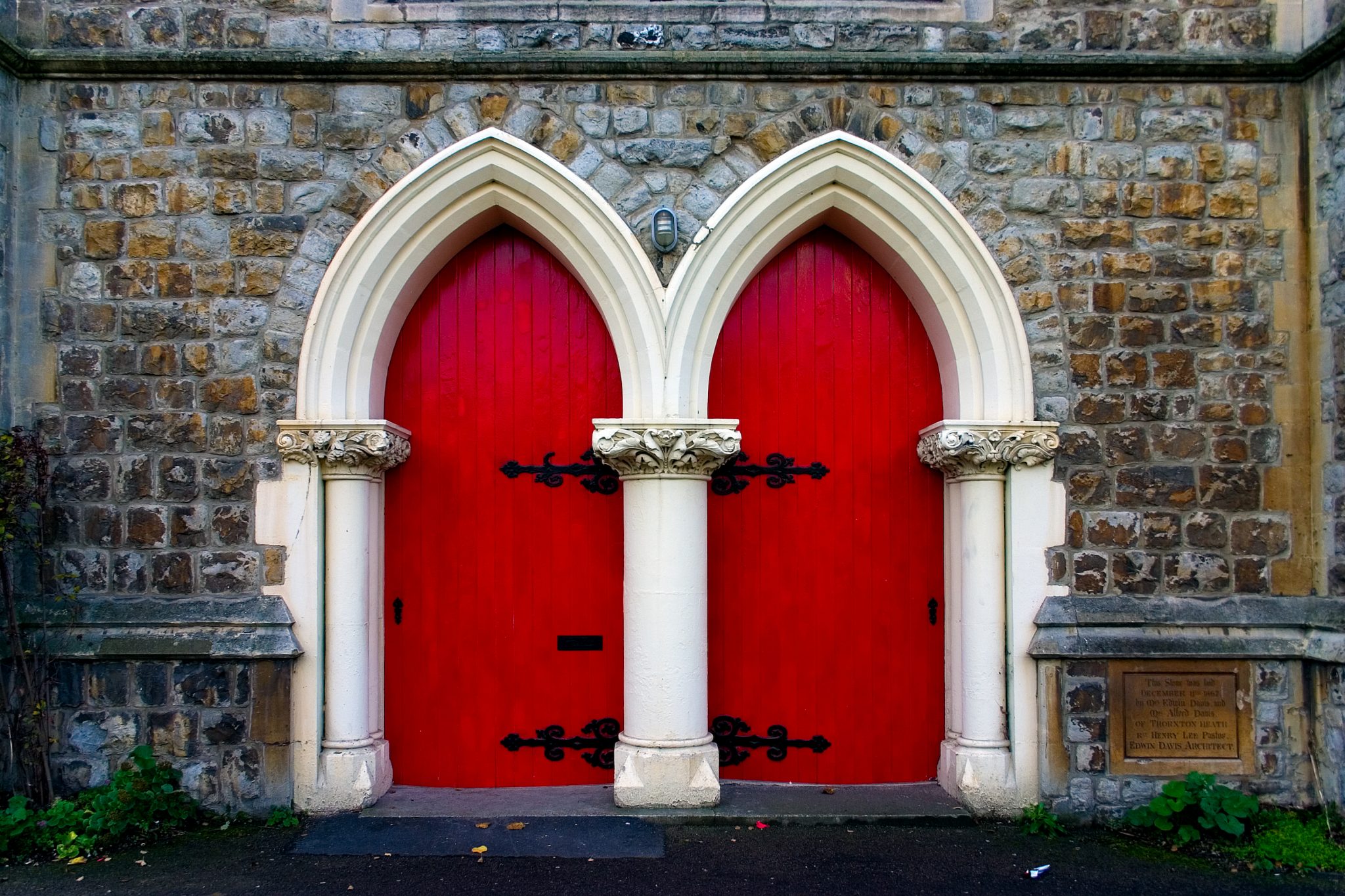
Doors into Faith: Inviting Friends to Join the Big Game

Those who have been in church a long time cannot imagine how intimidating the first encounter with church can be for those who have never tried it before. Using the analogy of a sports fan who invites an inexperienced friend to their first game, Jenny Andison suggests a range of user-friendly activities a church can offer to enable friends to begin to love towards personal faith.
This Wycliffe Booklet is available for sale in print format.
Purchase a print copy for $5 Plus HST and $1 Shipping:
Email sales@institute.wycliffecollege.ca to order
The rest of this article is for registered members only. Log in or register for FREE by clicking here.


Available as a PDFThis Wycliffe Booklet on Evangelism is also available in a fully formatted PDF file to registered members of our site.
Membership is free.  If you cannot see the rest of the article below,
click here to join or login.

The priority of evangelismHow does a parish become an evangelizing community?  How does a congregation structure its life around a desire to share the good news of Jesus Christ? Many parishes want to share the story of Jesus, but they don’t know where to start. This booklet aims to provide a roadmap for moving parishes from where they are now, with the will to share the good news, towards being communities that are fundamentally structured around that desire to share the gospel message of forgiveness and fullness of life.I hope to be able to show how a parish, regardless of its size, can create opportunities for people to investigate who Jesus is, and give these people space in which to explore the fundamentals of the Christian faith.  I will draw frequently on my experience at St. James, Clerkenwell, in London, England, where I have served for four years as the associate vicar.

About eight years ago, St. James had all but died as a Christian community, but through the leadership of the new vicar and a small but dedicated team of Christians, St. James has become a vibrant and evangelising parish.  At the heart of this transformation has been a belief in the overriding principle that to give glory to God a parish needs to share the good news, and that evangelism must be at the heart of the life of a Christian community. St. James attempts to ensure that all decisions the parish takes, whether financial, theological or liturgical, are filtered through the fundamental priority of evangelism.  This is what I mean by an “evangelising community”–a community where evangelism is the air that Christians breathe.


Oh really ?

The belief that evangelism should be the fundamental priority of a parish can immediately be challenged.  Surely the heart of Christian community is worship of the triune God?  That is of course true, but I believe that what flows out of a community genuinely engaged in such worship will be an unrelenting desire to evangelise.

One of the clearest examples of the link between true worship and evangelism can be found at the end of Matthew’s Gospel.  The resurrected Jesus appears to the eleven disciples, and when they see him they worship him.  It is during this moment of worship that Jesus then commissions them to go out and make disciples of all nations.  The desire to share the gospel, to evangelise, is not something that is analysed or discussed by the disciples; it simply flows out of their encounter with and worship of God.

God has also specifically gifted the Christian community for the ministry of evangelism.  While parishes may undertake this ministry in different ways, no parish is left without the gifts from God to accomplish it. In the beginning of the Book of Acts , we read how, just before he ascended to heaven, Jesus promised his disciples that they would receive the gift of the Holy Spirit that would enable them to be witnesses of the good news to the ends of the earth. Jesus did not make this promise simply to individual disciples; he gave this promise to the disciples “when they had come together”.  The gift of the Holy Spirit leads the entire community to evangelise.

The Book of Acts gives a clear description of the how a Christian community can be a community of evangelism.  As the new Christians went about living out their new faith, worshipping in the Temple, breaking bread and praising God, we read that God “added to their numbers.” A community will naturally grow when it is living a life of worship of God.

Evangelism, then, is something that flows out of the entire Christian community as it worships God. As a result, individual Christians need to use their different spiritual gifts to nurture evangelism.  One implication of this is that evangelism should not get relegated to the “evangelism committee” or to one staff member who is “in charge of evangelism”.  A parish that at its very heart is an evangelising community is a place where the question, “Will this help us share the good news ?” is asked at every juncture.


Let’s go to the ballgame !

Very often parishes want to do evangelism and have a love for God that propels them to share what they know about Jesus, but they lack a strategy, a controlling structure for their parish life.  When this is the case, evangelism tends to happen in a piecemeal, haphazard fashion.  What I hope to do is to use the simple image of a sports stadium   to illustrate how a parish can structure itself to maximise opportunities for evangelism in an integrated manner. I will examine four aspects of this stadium image–the Invitation, the Hospitality Tent, the Front of the Stands, and the Playing Field–and will analyze them from a biblical, experiential and practical point of view.

THE INVITATION
Would you like to meet me at…?

Imagine that you have received two free tickets from your boss to go to a baseball game. You decide to take a friend who has never been before, and you call them up to invite them to join you. “Oh I would love to go to the game with you”, they say, “I’ve always wondered what it’s like. Thanks for thinking of me.”

The basic principle behind the Invitation is that we all have the ability to arrange to meet friends and family members for different social events.  For most of us, this is not something that requires special skills or training. “Let’s meet for lunch at 12:30” is something that the vast majority of us would have very little trouble saying.   We each have a “sphere of influence”, maybe one person, a group of friends, a family member, who will listen warmly to an invitation from us, be it to the movies or coming by for a cup of coffee. Just as this sort of inviting is commonplace in our social relationships, so it can be the beginning point for evangelism. At the Invitation, all I am suggesting is that Christians invite a friend to an event being hosted by their church, and that they arrange to meet at a certain time and place. “My church is having a jazz night next week, would you like to come? We could even meet at that new bar we were talking about for a drink first.”

This is of course where what I call the “cringe factor” comes in.  The “cringe factor” is when we realise that we would be embarrassed to bring one of our friends to an event that our church is hosting: we would “cringe” at the thought of their reaction to the event.  Most of us feel comfortable asking a friend to go and see the latest Tom Hanks movie with us, guessing that they will probably enjoy it. We might attend the parish supper ourselves–but we would never dream of bringing a friend to it because we would be embarrassed. I will look at how to deal with the “cringe factor” in the next section, Hospitality Tent, and so for the sake of our argument, let us go ahead and assume that you are happy to invite your friend to a church event without dying of embarrassment.

Christians often do not feel equipped to share the good news, and worry about their inadequate knowledge of the Bible and the fundamentals of our Christian faith. The great thing about the Invitation is that nearly every Christian can take part in this aspect of being of an evangelising community. Some Christians have the specific gift of explaining who Jesus is and others don’t, some have the gift of hospitality and some don’t.  But every member of a parish can be involved in the Invitation, since everyone knows how to invite.

A wonderful illustration of this is when Andrew first meets Jesus and then brings his brother Simon Peter to meet Jesus.   Andrew didn’t explain everything about Jesus to his brother, though he did suspect that he had found the messiah, and that meagre knowledge was enough for him to invite his brother.  Jesus did the teaching, Andrew simply did the inviting. Andrew engaged in Invitation evangelism when he said, “Come and see…….”

The other thing to note in the example of Andrew is that Andrew clearly has a relationship with Simon Peter–they are brothers. The people we invite to a church-sponsored event are normally going to be people with whom we have an existing relationship, people who are within our “sphere of influence”. Simon Peter was most certainly within Andrew’s “sphere of influence”, and Andrew would have presumably felt comfortable inviting his brother to come and meet this compelling person that Andrew had just discovered.  The Invitation principle is not about inviting total strangers to come to church with you on Sunday.

Invitation evangelism often works best when you are inviting your friend to a social event that is hosted by your church. I have a friend who is very proactive about Invitation evangelism and every year hosts a Christmas party at her apartment before the church carol service, telling her friends when she invites them that they are welcome to join her after the eggnog for the carols at the church. The party is successful as a fun and low key event where Christians and their friends can mingle, with the further opportunity for the friends to come along for the carol service. The effort here for my friend, was not the party itself, but the actual inviting of the non-church friends to join her for the carol service after the party.

This illustration calls to mind the story of Levi, the tax collector, who, after having met Jesus and having answered his call to follow him, decides to throw a big party so all his tax collector friends could meet Jesus.   The fact that Levi invites fellow tax collectors, shows that he is operating within his sphere of influence, and by throwing a big banquet with wine and lots of good food, one can assume he has successfully avoided the cringe factor.  By throwing a party, Levi had an opportunity to invite his friends to encounter this man, Jesus, who was turning his life upside down.

On a practical level, in preparation for this aspect of being an evangelising community, it is helpful to pray for the people that you are hoping to invite. You could stick their name(s) on your fridge to help you remember. The Invitation begins at the water cooler at work, over the telephone with a friend, or with an email to a family member. Taking a deep breath, knowing that the Holy Spirit will equip us with the right words , and then extending the invitation means we will have taken the all important first step of evangelism, the Invitation.


THE HOSPITALITY TENT
Thank you, that was a great meal…

Imagine that you have met your friend outside the stadium and that game is going to start in half an hour. Your friend, so pleased that you invited her, is excited by the prospect of the upcoming sports match, her first, but is a little confused about the rules of the game.  The two of you decide to go and sit down before the game starts and grab a cup of coffee together, which will give you the opportunity to explain the rules of the game to her.  This cup of coffee is the Hospitality Tent, a social opportunity created to give our invited friends the chance to relax and enjoy themselves in a non-threatening and fun environment. After the all-important invitation, comes the opportunity to relax together, often over food and drink, and to  talk.

Since fewer and fewer newcomers come through the doors of churches on Sunday mornings, parishes cannot rely on Sunday services as their primary opportunity for encountering people who are seeking to know God.  As the cultural Christian residue in our western society continues to fade, parishes cannot afford to rely on baptisms, weddings and funerals to provide them with opportunities for evangelism.  The Hospitality Tent principle assumes that people who do not go to church generally do not feel comfortable attending church in the first place.  For many such people, church is experienced as being boring, irrelevant, and difficult to participate in.

This being the case, I would argue that a different social setting needs to be created in which people without Christian faith can mingle with Christians and begin to explore the gospel. Jesus knew all about the Hospitality Tent principle.  He did not teach exclusively in the synagogue or the Temple. He taught where people felt comfortable, be it indoors or outside.  Jesus taught Mary and Martha in their own home , he taught at big outdoor picnics , and he encountered people as they went about their daily lives as fishermen and tax collectors.

The principle of the Hospitality Tent requires a parish purposefully to create a number of fun, social events throughout the year to which parishioners feel comfortable inviting their friends or family members.

At St. James, where I ministered for four years, these social events are planned a year in advance. The church usually hosts four different events a year.

1) Once a year they host what they call the Big Supper, which is very similar to an Alpha Supper.  Every member of the 120 strong congregation is challenged to invite just one person to this event and to cover the cost for that one person, and so they host a meal for about 200 people.  Because they know that the neighbourhood is full of young professionals who like to eat out at nice restaurants, they have the meal professionally catered and the hall professionally decorated, and they hire a good jazz band for the evening.

2) The English are soccer fanatics and so each year at the time of the World Cup they rent a huge wide screen TV and set it up in the parish hall for the week of the matches. They then arrange with their local pub that people can buy beer at the pub and come and watch the match in the church hall.  The hall is always packed and members of the parish feel quite comfortable inviting friends to these games.

3) They also help host an outdoor summer festival with other local businesses.  During this week of festivities, they run tours through the church, have chocolate and wine tastings and offer manicures and pedicures.

4) At Christmas they host a mulled wine and mince pie party before the carol service. They encourage parishioners to invite friends to the party, and then invite them to come to the carol service as well if they wish.


I know some parishes which host Valentine’s Day dinner dances, jazz evenings, salsa dancing classes, country western evenings. Another parish I know holds an annual Caribbean dinner dance and yet another hosts an opera evening. The secret is to discover what works for the culture of your neighbourhood, and to tailor your Hospitality Tent events around that.  At St. James, we have a diverse population within our parish boundaries and we put a lot of effort into making sure that our Hospitality Tent events appeal to different sections of the demographic makeup of our parish.

Once you know what kind of person lives in your neighbourhood, the next step is to ensure that the event you host is of a high quality.   The aim is to surprise outsiders with the quality of the event, to surpass their expectations and dispel their misconceptions about Christians and what church events are like.  My experience of such guests has been that while they have mainly positive feelings towards Christians, they see them as being boring, dull, and socially awkward.  A question that is always asked by pollsters in the US presidential elections is, “Which of the two candidates would you rather have a beer with?”  If asked a similar question about spending time with Christians, those who do not share their faith are likely to say that they would have more fun doing something else.  This is a problem that must be tackled head on if a parish is get Hospitality Tent events right.

The aim here is to create a social event where people who do not go to church will feel comfortable and where they will begin to see that Christians are not boring or dull. For these events to be a success, several things need to take place:

1) Questions need to be asked: “What kind of people live within your parish boundaries and how they like to spend their spare time? Where do people in my neighbourhood go to enjoy themselves and how can we offer them that kind of hospitality ?”  This is the critical research question. Clergy should be particularly aware of the demographic breakdown of people within their parish boundaries. Do most people have children? Do the mothers work outside the home? All these are key questions that need to be answered when thinking about Hospitality Tent events.

2) Each event should take place within a yearly plan of parish activities, so that enough time is given between events to dedicate the right amount of time and volunteer effort to making it a success.

3) Effective and professional advertising needs to be obtained, done to a standard that will pleasantly surprise your guests. There may well be members of your congregation in the advertising business or who have contacts with printing and publishing firms.

4) Volunteers will need to be recruited who have the gift of hospitality and ideally who share the particular interest that is being highlighted at your event. If you are hosting a hockey watching evening then it would make sense to find people in your parish who are hockey mad to help arrange it.

5)  Funding needs to be arranged for the event. At St. James, we make every effort to have the cost covered by the parish for each Hospitality Tent event we host, so that we are able to offer it free to our invited guests. This will not be possible at all events, but we find that it is better to host fewer high quality events at no cost to those we have invited.

At the end of your Hospitality Tent event, it is crucial to make space for the all important “invitation to the gospel”.  This is where someone in the parish makes a connection for your guests between the entertainment they are enjoying and the God who wants to lavish them with love.  For example, at St. James when we host our soccer evenings, we have a member of the parish stand up, welcome the crowd and say something like, “At St. James, we know that God loves soccer, and wants us to enjoy life to the fullest. If you want to know more about this God, you are always welcome here. Our services are at 10 a.m.” At our Big Supper, before we offer coffee and dessert, we will show a short video clip from a popular movie that leads in to us being able to talk about the God of love for a brief moment. In a similar vein, for some years Trinity Church, Streetsville, hosted a dinner and dance on the Saturday closest to Valentine’s Day, and at the end Harold Percy would give a short talk about God being the creator of love, and invite people to check out Trinity Church “to learn how to become better lovers.”  The aim is to end the evening by piquing the interest of your guests in God and what God might have to offer their lives.  This “invitation to the gospel” leads on to our next section.


THE FRONT OF THE STANDS
Well, let’s go watch the game…..

As you and your friend finish your cup of coffee and your friend feels a bit more confident with the rules of baseball, you realise that the game is about to begin and you go and take your seats.  You are a bit nervous since you hope that your friend enjoys the game and won’t be bored.

As I mentioned, at the end of each Hospitality Tent event an invitation to the gospel has been offered, and now an opportunity needs to be offered to explore further the central claims of Christianity. In our stadium image, we are now at the Front of the Stands, and it is in the stands of the stadium where the game can be watched, analysed, and hopefully enjoyed.

A Front of the Stands event is where your parish community openly and in an accessible manner sets out the gospel to those who are interested. Jesus made it clear that the priority of his earthly ministry was to preach and teach people about God and the coming of God’s kingdom.  Jesus constantly found himself answering questions, telling stories, and engaging in spirited discussion with people from all walks of life. An evangelising parish community is one that is keen to carry on this tradition of teaching, answering questions, and giving opportunities for discussion. It is the desire to follow this tradition that leads to the hosting of Front of the Stands events where the interested newcomer can find out the basics of the Christian faith and ask their questions in a safe, non-threatening, and enjoyable environment.

It is important to realise that Front of the Stands events do not include Sunday morning worship! In a parish that is hoping to be an evangelising community, Sunday mornings are still primarily about being “church”, about the people of God worshipping God and giving honour to God’s name.  I am not convinced that the most effective place for evangelism is Sunday mornings, although it is imperative that Sunday morning services need to be friendly and welcoming to newcomers and should be clear in their presentation of who we know God to be. The aim of Sunday mornings should be to offer worship of God for the Christian community that is still accessible to a newcomer.  Information should also be readily available for anyone who wishes to explore more about the Christian faith. So Sunday morning worship, while not being a Front of the Stands event, is better seen as a Hospitality Tent event, where newcomers are made to feel welcome and relaxed.

A Front of the Stands event, therefore, will most likely take the form of a course where the fundamentals of Christianity are taught and discussed. There has, thankfully, been a wonderful proliferation of such courses in the past few years, each with its own particular theological flavour—Alpha, Christianity 101, Road to Emmaus, First Steps, Christianity Explored, Via Media, and so on.   A Christian basics course usually is run once a week over the course of four to ten weeks. Most follow a simple structure, with a meal provided by the church, a talk or video presentation on a different aspect of Christian belief, and the opportunity in small groups to then discuss and ask questions.

Much has been written about the many Christian basics courses that are currently on offer and it is simply up to individual parishes to find one that works best with their theological ethos and cultural backdrop. None of these courses is perfect in presenting the gospel, so they often need to be edited and added to as parish leaders feel appropriate. Indeed, there is some evidence to suggest that “home-grown” courses are just as effective in helping people find faith as the mass-produced ones , so the best option for your parish might be devising your own course or adapting a pre-packaged course that it is more suitable to your parish situation. The key thing is actually offering the Christian basics course in the first place, as it is a remarkably successful way to present the gospel to those who are exploring and have questions.

By offering a course of this kind, you are creating a space and time within your parish community for people who do not consider themselves Christians to explore the gospel and to discover for themselves who Jesus is–something that can be hard to do on a Sunday morning.  There are of course other creative ways to introduce people to the gospel in a systematic manner.  Some parishes have exciting and thoughtful catechesis programs for those who are seeking baptism, and other parishes run excellent marriage preparation programs that include the sharing of the basics of Christian belief.

Planning the Year

The need now arises for careful yearly planning within a parish. Alongside the planning of Hospitality Tent events needs to be the planning of Front of the Stands opportunities.  An example of a yearly plan (admittedly a busy one!) might look roughly like this:

September ——————— A Big Supper  (Hospitality Tent)
October to December——— A Christian Basics Course  (Front of the Stands)
December———————– Carols by Candlelight Party (Hospitality Tent)
January to February———– Baptism/Marriage Preparation Program (Front of the  Stands)
February ———————– Valentine’s Dance (Hospitality Tent)
March to April —————– A Christian Basics Course (Front of the Stands)
July —————————— Summer Food Festival (Hospitality Tent)

At the end of your Valentine’s Day dinner or Summer Festival event, you need to be ready to hand out pamphlets advertising your next Christian basics course and invite people to attend this Front of the Stands event.  The hope and prayer is that some of the people who have attended your Hospitality Tent event will have found themselves pleasantly surprised by how much they have enjoyed the evening, and have had their interest piqued as to what makes Christians tick.  At the end of our Big Supper at St. James each year, we find that on average ten per cent of the people attending will decide to take our upcoming Christian basics course.  That means that we will then host two small groups of about 10 people who will investigate who Jesus is and what he could mean to their lives. If, through the grace of God, even two or three people out of those groups come to faith, then we are very thankful.

If you are fortunate enough to have that kind of ministry opportunity twice a year, then you will soon find yourself belonging to a parish that is helping to grow the kingdom through evangelism. The actual moment or process of conversion within these small groups I will look at more closely in the next section.


THE PLAYING FIELD
Can I give it a try…..?

You have both thoroughly enjoyed the game, your friend’s first, and you decide that you will try and get tickets again in a couple of months time to see another game.  In fact, your friend has been so taken with baseball that she signs up for her office’s summer tournament, something she had previously studiously avoided.

During the course of a Front of the Stands event, such as a Christian basics course, we hope and pray that people will encounter God either for the first time or in a new and engaging manner.  This may lead to on the spot conversion or it may be the critical beginning of a long and gradual process of coming to faith in Christ Jesus.  This next step in the life of the evangelising community is what is called the Playing Field.  Here a person is able to “try on” for themselves the Christian life.  The Playing Field is the life that a person can embark upon within your parish community, once they have decided that they believe the central claims of the Christian faith.   This means that your parish community needs to be able to integrate a new Christian into the fabric of parish life, to welcome them with open arms into your community and show them how Christians live together.

If you run one or two Christian basics courses a year within your parish, you may well be blessed with one or two, or maybe even a handful of people, who decide to become followers of Jesus. This of course can happen in a number of ways.  In the Book of Acts, the Ethiopian eunuch was a court official openly seeking after knowledge of God.  Phillip saw this opportunity and empowered by the Holy Spirit, brought the eunuch to a fuller faith in God, and the eunuch was baptised then and there.  This is an example of on-the-spot conversion of a kind I have witnessed in a Christian basics small group.  On hearing for the first time how Jesus died to pay the penalty for sin and offer each person a renewed relationship with God, I have seen the “penny drop” for a young woman with an incredibly complicated life, a life which includes more than one abortion, children by different fathers and a persistent eating problem.  I watched her mouth slowly open wide, and right there and then decide to become a Christian.

For many others, however, conversion is a slow process of engagement, with lots of questioning, often coupled with great reluctance.  In the Gospel of John, we read how Jesus heals a man born blind, but only after he has had several interactions with Jesus and been challenged and attacked by the Pharisees does he come to a full understanding of who Jesus is.   I run a Bible study for young mothers, and many of the women there have come to faith over the course of several years, with no one point, no one Bible study, being the catalyst for conversion.  The Holy Spirit has slowly worked on their lives, gradually answering their questions and eroding their cynicism.  Careful and consistent pastoral care has also meant that they have been loved into the kingdom of God more than anything else. God brings people to faith in a variety of ways and a parish that wishes to welcome people onto the Playing Field of faith needs to be aware of this.

So what is necessary for the Front of the Stands event to lead on to the  Playing Field of Christian faith?   There are some very practical things that can be done to facilitate the process of coming to faith and the maturing in the Christian life that then needs to take place.

1) A team of people in your parish can be praying for each person by name who is attending the Front of the Stands event.

2) A good amount of back up literature on relevant topics should be available to give out as questions arise. For instance people may have questions about the reliability of the New Testament, or about the problems of suffering and evil, and so books that address such issues should be at your fingertips.   It can also be helpful to have modern translations of the Bible available, such as The Message, and supporting literature to encourage daily Bible readings.

3) Small opportunities for people to serve within the life of your parish can be made available.  Women from the Bible study that I run are often invited to help out with the crèche on Sunday mornings or with our Mums and Tots program during the week.  This enables them to start to make friends within the church community and to feel a sense of belonging to the local community.

4) Having someone who is specifically designated to mentor such new Christians is extremely helpful. This is a person who they can call if they have questions about Christian faith or life, or with whom they can chat after church.  People exploring faith are often apprehensive about addressing their questions to clergy, and so having approachable lay people can be invaluable.  Ideally the person’s mentor is someone who has come to faith themselves fairly recently and who can share on an immediate level the cares and concerns of the new Christian.

5) At St. James we have found having a prayer chain to be a helpful way to offer pastoral care to people who are new to the Christian faith or who are still exploring it. Knowing they can call someone (hopefully their mentor) on the prayer chain with any concern or request, can be comforting and encouraging.

6) If a person has come to faith through the ministry of a small group, then they are likely to want to continue meeting in a small group as they grow in their faith.  Having groups that meet weekly or even monthly in people’s homes or at the church can be a wonderful way to nurture and nourish a new Christian.

7) The planning of Sunday morning worship needs to take into account the presence of new Christians, and others who are still exploring Christian faith.

The Playing Field is where a new Christian is able to experience living the Christian life within your parish community. We need to be ready to welcome such new players into our midst.


CONCLUSION
I have season’s tickets to the game now….

Many parishes have the desire to share the good news about Jesus, but they lack a systematic approach with which they can try to engage those who are searching after God.   St. James is a small parish with a small budget, but that has not stopped it from being a place where people encounter the liberating news about a God who loves and forgives them.

With some yearly planning, community research, and effective small groups, any parish of any size can be on its way to being an evangelising community, with all its members playing different and important roles.  There is no more satisfying knowledge than realising that you have played a part in bringing someone out of darkness into God’s glorious light.

Notes:

  1. Matthew 28:16-20
  2. Acts 1:6-8
  3. Acts 2:42-47
  4. For more on this topic, see Wycliffe Booklet on Evangelism #2, Unwrapping All Our Gifts, by Judy Paulsen. This and other Institute of Evangelism resources may be obtained through the Wycliffe College website, wycliffecollege.ca or by emailing wycliffe.college@utoronto.ca.
  5. This image has been developed by the ministry team at St.James, Clerkenwell, under the leadership of Andrew Baughen.
  6. John 1: 35-42
  7. Luke 5:27-32
  8. Matthew 9:19
  9. Luke 10:38
  10. Mark 6:30-44
  11. This refers to the tradition in the Alpha program of people inviting their friends to a nice supper, including wine, at the end of which guests are invited to attend an upcoming Alpha course.
  12. This kind of information about your local neighbourhood is available from Stats Canada at www.statcan.ca, and from Outreach Canada (a church ministry resource) at www.outreach.ca.
  13. E.g. Mark 1:35-39
  14. Alpha: www.alphacourse.org. Christianity Explored: www.christianityexplored.com. Road to Emmaus: www.goodseed.com. From a more liberal theological perspective comes Via Media: www.everyvoice.net/via media.
  15. Mike Booker and Mark Ireland, Evangelism—Which Way Now? An Evaluation Of Alpha, Emmaus, Cell Church And Other Contemporary Strategies For
  16. Evangelism. London: Church House Publishing 2003. Page 35.
  17. One way to do this is described in Wycliffe Booklet on Evangelism #2, Just The Basics: Teaching Christian Faith to Beginners, by Harold Percy and John Bowen.
  18. See also Tim Chesterton’s helpful book, Starting at the Beginning. Toronto: Anglican Book Centre 2004.
  19. Acts 8:26-39
  20. John 9
  21. The Dare Booklets, available from the Wycliffe College Institute of Evangelism, deal with many such questions. For a list of titles, see www.wycliffecollege.ca/institutepublications.php?aid=8&tid=63
  22. An organization like Scripture Union, which introduces people to daily Bible study, will gladly provide free samples. Contact the director, Rob Szo, at www.scriptureunion.ca.

Leave a Reply