Time for a Game Change
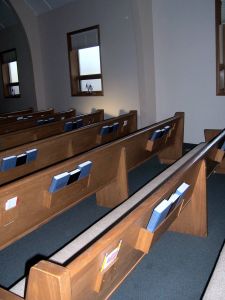
We need to revise the rules of a game which seems to be played out with one active pulpit, before an audience of passive pews. Here’s one way forward
As Canadians wrestle with a shrinking Church and a growing recognition that the God of all ages is not limited to high ceilings, wooden pews, or even Sunday morning, we are beginning to grasp the magnitude of the task ahead. It is huge, and will require more than young priests and ministers eager to enter traditional parishes. We face a revolution in how we do ministry, plant churches, communicate a message, and create community.
Mission Shaped Ministry (MSM) was developed as an advanced training course for teams of lay people planting Fresh Expressions of Church in Great Britain. I wish I could say MSM is a magic formula, creating new churches to replace those that have reached the end of their lifespan.
Instead, it challenges the Church to rethink itself on at least three levels.
How we lead: We have come to think of the Church in terms of pastor and laity — one doing the skilled work and the other supporting in many ways. But Fresh Expressions of Church are as much the formation of ministry teams as the reformation of professional leaders. Thinking back to the Acts of the Apostles or the Pauline Epistles, new ministries were always the work of what I think of as the apostolic AND: Paul and Silas and Barnabbas and Titus and Phoebe and Priscilla and Aquila and Epaphras and Mary and Andronicus and Junia and many more cited by name. The next generation of church leaders will have complementary ands in every leadership team.
How we finance ministry: As much as I appreciate collecting a salary for doing the things I love – and would likely continue doing even if I won the lottery tomorrow — my income comes from the accumulated wealth of generations. People older than myself, for the most part, have paid the mortgage on buildings we could no longer afford to purchase. In the future, I suspect much ministry will be conducted by teams of lay persons; supported, encouraged and blessed by clergy but not restricted by the availability of the ordained and salaried. We can no more afford to launch only churches build by professional church workers than could the early church — or any of the other church planting movements of history. Unless we are willing to send out mendicants with bowls to beg for their supper, Fresh Expressions of Church will often be the work of those who earn their salary and mingle with the working population as others do. Instead of numbing themselves in front of the computer, console, or TV, dedicated Christ-followers will create new Christian communities through networks of relationships inaccessible to parish focused ministers.
Role of pastors: There must be a shift from pastor centred mission to multi-faceted team. The British MSM was designed to aid groups of eager lay people in need of seasoned advice, theology, and structure and to temper a spontaneous church planting. Guiding an unruly outbreak of enthusiastic lay ministry does not seem to be a significant problem in the Canadian Church. But we cannot forget that the early Church was largely a movement of lay persons mentored by followers of Jesus, tied to the teaching of the apostles, but not to buildings or methodologies.
The difference between a laity that cares beyond its friendship networks and one that is ingrown appears to lie in one of the eight measureable quality characteristics of Natural Church Development (NCD). Passionate Spirituality is the ability to apply one’s love for God, one’s knowledge of scripture, one’s experience of the transforming power of God to everyday life and relationships at home, in community and at work. It is that extra “something” that pushes past loving fellowship and a crowded agenda of work and leisure to a life that follows in the footsteps of Jesus — and of the 12 — and the 72, and 500 and so on through to those who mentored the ministries of which each of us are a part.
Does the world need another course to learn how to plant a church or fresh expression of Church? If it does, MSM is a pretty good one.
But I think we must strive for more than more than deepened knowledge. We need to recruit young people and active retirees and persons whose circumstances allow them to live simply in order to serve God’s mission in the world. We need priests and pastors ready to rethink tried and steady patterns of ministry that support a passive laity.
We need to revise the rules of a game which can be played out with one active pulpit, before an audience of passive pews. MSM is a team sport. Gather a gang of two or three or ten, and see what you can do. I can safely say that God is on your side.
The Diaspora Driven Church
If you were to hang out at a Christian bookstore at the edge of many Canadian cities, you might be surprised to see who is there. Ditto if you drive past a packed church parking lot any day of the week, or a bustle of people leaving a newly planted church in an industrial area, commercial space, or home. If you overhear someone speaking openly about faith in Jesus, or offering to pray with another in a public place, there is an excellent chance that the faces you see did not grow up in western Christendom—and those voices carry the cadence of exotic locales, most originating in the Two Thirds World.
Canada is a significant destination for Diaspora Christians around the world, some fleeing persecution, others poverty and war, and some are on the move (I think) because they’ve been called by Christ to missionize the western world—like the Filipino church planter I met in North York who planted an intercultural church in Mississauga which then birthed another congregation in Etobicoke even before the Mississauga church secured their first pastor.
They are not reticent about their faith. Like the Christians of the early Roman Empire serving the established classes, I am hearing anecdotal evidence of children demanding to go church because their nannies have told them about Jesus, personal caregivers leading seniors to faith in Christ, receptionists praying with clients in the waiting room, and other professionals I dare not name in print lest we jeopardize their timely unawareness of the need to compartmentalize faith so it cannot seep into the workplace.
Twenty years ago, I thought God had brought us the nations of the world so we could share Christ. Now I think I had it backward. We are the ones who need to learn that faith is no less a passion than World Cup Football, and spiritual conversations are as natural as discussing the weather. We are the ones who need to forget that our brand of Christianity had its capital in Europe—perhaps temporarily—and remember that the Church has always been the world’s most truly multi-national, multi-ethnic, inter-cultural corporations. We are the ones who must adjust to the new reality beyond our cultural borders where it is more normal to purchase a theatre to turn it into a place of worship than to sell a church and turn it into condominiums—and that others are doing just that in our midst.
Soong-Chan Rah, a 1.5 generation Korean-American scholar in Chicago has it right when he says that the real wave of transformation in the North American church will not be ushered in by hip young white guys with goatees and book contracts with the Christian media juggernaut, but by intercultural ministries. First generation immigrants often arrive with a vibrant faith, but with too many cultural barriers to communicate easily into other people groups. Their children, however, who arrive as young people but grow up with vibrant faith and a Canadian education and accent—these 1.5 generation immigrants are shaping up as a formidable force on the Canadian landscape.
Five years ago, I thought that perhaps 50% of church goers in the Greater Toronto area on any given Sunday morning were in black majority or immigrant churches. No one knows how many unregistered churches there are, but I suspect the percentage of worshippers is much higher today.
Natural Church Development is…Still Developing
Many of us were introduced to NCD as a “survey” that evaluated 8 key ministry areas: leadership, ministry, spirituality, structures, worship, small groups, evangelism, and relationships. 60,000 surveys worldwide have demonstrated the validity of NCD’s initial premise: thriving churches have a similar approach. In healthy churches leadership is empowering, ministry is aligned with spiritual giftings, structures function well, spirituality impassions and guides the rest of life, God inspires in the worship, the whole person is engaged through small groups, evangelism relates to the needs of those beyond the church, and relationships within the parish have a loving quality. The tragedy has been that many parishes have “done a survey” or two and moved on to something else.
While the newly updated survey is still extremely useful for helping parishes diagnose health issues, the process has evolved beyond getting the numbers and attempting to improve the weakest link. Some parishes were able to take the survey results and improve them, but many struggled with the pragmatic reality of implementation.
Bill Bickle, an Anglican layman, management consultant and the new international liaison for NCD in Canada has some good news for parishes struggling to translate analysis into action. He says, “Change has evolved in three key areas. When the Canadian Church adopted NCD in 1999 it was heavily influenced by the big box model of churches south of the border. Parishes used it as a program to boost numbers. I’ve met dozens of people who’ve told me ‘We tried NCD once, and then moved on. . . .’
“We’ve rediscovered a deceptively simple Cycle of gathering information, understanding it deeply, and putting a plan of action into place. A five year old uses the same process figuring out a new route to school. It is deeply imbedded into our everyday processes already, which makes it a natural for parish that doesn’t know what to do next.”
The Cycle is a lifestyle pattern for parishes. After doing the survey, time is spent trying to understand why the results are what they are. A plan is developed out of that understanding, and applied. As the plan is applied the parish pays attention to what they are experiencing and perceiving; whether or not some measure of transformation is underway. A parish might ask if God is guiding them in some area. After a year or eighteen months perceptions are put to the test through another survey, and the cycle begins again.
What makes this process much easier to implement now is a new detailed analysis of how survey respondents answered each survey question, within each category. Called “Profile Plus,” a parish can identify the 10 most vibrant strands of its internal life – across ministry categories – and also the 10 weakest. It is here interesting patterns emerge. A parish may score extremely high on Loving Relationships but find a lowest score for the entire survey is hidden within that category. For instance the survey question asking, “I know of people in our church with bitterness toward others,” could be dampening the experience of God in worship and stifling small group life. It could affect the functioning of Parish Council, hinder evangelism, and create an environment where leaders exercise tighter control. We all know intuitively that there are issues behind the issues that are difficult to identify.
Many parishes tend to get stuck somewhere in the process. They may gather information and jump to action before taking time to reflect on what the information means, or plan without putting into action, or fail to evaluate whether the plan has produced desired results by taking a new survey. The Cycle encourages the doers to slow down and think, the thinkers to speed up and do, and provides a quantified evaluation at the end to launch the next cycle. When a parish has undergone the entire Cycle several times, hidden or undiscussed issues emerge and there is possibility for deep transformational change. We can plan for what we understand. We can experience God’s grace as we work it out. We can gauge whether our efforts have borne fruit and begin again.
One other insight has emerged over the last 10 years, that the spread between highest and lowest scores is significant. If a church is extremely developed in one area and extremely undeveloped in another, there is an instability within that needs to be addressed more urgently than simply bringing up the numbers. A weak athlete with two legs of equal length will respond to training more readily than an athlete with a highly toned right leg, and a left leg half a meter shorter. The gap between strongest characteristic and lowest must be narrowed. It’s not simply a matter of attaining a higher score.
Parish ministry is increasingly challenging in post-Christendom. NCD is a post-Christendom tool which resonates with European and Canadian experience, is parish friendly – and most importantly – relates the task of Church to the work of God in understanding, in action, and in experience.
Churches wishing to learn more about the suitability for NCD in their context should contact Bill Bickle at NCD-Canada@fordelm.com . An “NCD Primer” can be downloaded at www.ncdcanada.com . Churches that did NCD under the former system may wish to try again, using Profile Plus. The NCD Cycle Manual can now be downloaded from the same website, left hand column.
Kingdom without Christendom in Canada
This was a lecture given at the 2008 Vital Church Planting Conference.
![]() |
This audio file is for registered members only. Log in or register for FREE by clicking here. |
Listen to the Podcast:
Part 1:
Part 2:
Podcast: Play in new window
Biodiversity in Church Planting- The Unseen Future
This was a lecture given at the 2008 Vital Church Planting Conference.
![]() |
This audio file is for registered members only. Log in or register for FREE by clicking here. |
Listen to the Podcast:
Podcast: Play in new window
What Connie Offers – Next Steps in Parish Development
| This Article is from the Fall 2005 edition of good idea!, also available here in a fully formatted PDF file. |
Connie was born and grew up in Southern Ontario. One parent was Roman Catholic and the other Christian Reformed, and the family settled into the United Church of Canada as a bridge. It was in the United Church that Connie experienced a spiritual awakening as a teenager. This diversity of background allows Connie to work comfortably and knowledgeably in a broad spectrum of denominations and theological milieus.
A graduate of Emmanuel College within the Toronto School of Theology, Connie also holds a doctorate from Fuller Theological Seminary in Pasadena, California, with a specialty in Church Growth.
Connie was ordained by the Toronto Conference of the United Church in 1980 and has served United Churches in rural Saskatchewan, Saskatoon, London (Ontario), and Toronto.
She has been involved in starting three churches: one suburban United, one multi-cultural Pentecostal, one English speaking congregation within a Methodist Chinese Church. Connie has successfully led church “reboots,” one rural and two suburban, taking congregations which had stalled at a membership of about fifty to 150, 180, and 220. She is also a trainer of coaches for Natural Church Development.
Since 1999, she has been team minister at Alderwood United Church in Etobicoke, Ontario. Aware that the successes of a previous decade may have little relevance in the communities we face today, Connie is in the early stages of working with this congregation to shift from a building-centred ministry to missional thinking, a process that will probably take a decade.
Connie continues to pursue a wide variety of Church Development-related interests. She is a trainer and experienced coach for Natural Church Development, a conference presenter for Alpha Canada, an experienced coach of church planters (particularly during the planning stage and critical first years), a church consultant, conference speaker, and a lecturer in Church Planting at Wycliffe College.
She lives with her husband Doug, the pastor of an ethnically diverse Methodist Church in Bramalea, and two teenagers, in Brampton, Ontario where they are restoring and renovating their century home.
What Connie Offers
Many churches would say they are “doing OK” but confess that they are not growing in either depth or numbers, and do not know how to move forward. Connie brings a broad and sympathetic knowledge of “how churches really work” and a large repertoire of alternatives to the status quo in the form of her Next Steps presentations:
Next Steps for Congregations
For the leadership teams of parishes that have plateaued or are aware of the need to explore other avenues of ministry. Connie is an experienced diagnostician and practitioner who will facilitate discovery of helpful strategies for the individual parish or congregation.
Next Steps for Denominational Leaders
For denominational leaders who would like to broaden the repertoire and improve the morale of their clergy, Connie offers interactive workshops, seminars, and plenary sessions on trends in Canadian Christianity, Natural Church Development, Spiritual Gifts Discovery, and other topics as requested.
Next Steps for New Parishes
Connie will meet with individual church planters or area clusters of church planters for mission strategy and problem solving.
Remembering How Babies are Made
An experienced church planter from the United Church of Canada reflects on what she observes in this issue of good idea!
If Church Planting is simply a matter of finding and operating the right technology, we have entered a new and frightening universe: a world where almost no one remembers how babies are made. Alarmed at the looming spectre of extinction, experts are called, seminars convened, machinery set into motion. In the end a few more of the species are brought into being, but many are sickly and cannot survive without continuous life support: a kind of bubble church.
Of course church planting is not biotechnology–although some denominations spend tremendous resources producing a few new congregations in vitro every year. No: in every time and place, new churches are a creative act of God through people gathered in Christian Community, doing what people in Christian Community have always done–unless we forget how.
Listen to these words:
. . . . First, the church planter has to believe that people out there are lost and need God in their lives. How they express that can take different forms, but they need to have a passion to connect people to God. Kevin Martin
. . . .carefully planned and prayerfully executed . . . . Duke Vipperman
If we wish to continue reaching out to those who need to know Jesus Christ, we have to walk in the faith of the early disciples. We believe that, when we walk in this faith, God will provide for the rest of our needs. Marsha Mundy
We have reorganized parishes again and again–tinkering with the multi-point and team-ministry models. But none of this has effectively stopped the decline. . . . . The real long-term measure of our success will be how well we are able to attract, evangelize, and turn into disciples those who were not previously living for Christ. Vicars Hodge
Do these sentences represent the western church of the 21st Century? To what era do they belong?
New churches cannot be created merely as a matter of priority for dwindling denominations and diminishing dollars. They are born of vibrant faith unable to contain its love for Christ and love of neighbour. Decide for yourself what propels the newest churches in our midst.
The apostles may have been on to something.
What is Natural Church Development?
Natural Church Development (NCD) is a widely-acclaimed program which helps churches in self-understanding and healthy growth. Connie denBok, an Institute Associate and an experienced teacher of the NCD process explains how it works, and why we should pay attention.
Natural Church Development is a systematic approach to a very common process.
A very kind lady in my church donated a flowering plant to brighten my office and within weeks I had to smuggle the wilted skeleton to my compost bin, the victim of misfortune. No green thumb here.
Yet outside my window is a mulberry tree, planted accidentally along the fence by birds, and alive only because the lawnmower blades could never reach it. It is blasted by heat and drought in summer and cold and salt from the driveway in winter, yet it bears fruit in season, and the birds and squirrels delight in it all summer long.
Why does this one thrive on neglect, while the other, a precious gift, the recipient of my care, has died?
Christian Schwarz, a German student of church growth, tried to answer that question through a massive international survey project in the early 1990’s. The question was, “What do churches share in common that transcend language, nationality, culture, and denomination”? And the question that arose from that: “What do healthy thriving congregations share that their declining counterparts do not?”
More than 1000 churches in 32 countries on 5 continents were surveyed and tabulated. The surprise was that churches had a great deal in common, from the village house churches of Indonesia to the historic denominational churches of Norway to mega churches in North America. Every church of every tradition and culture, thriving or otherwise, had the same eight components: Leadership, Ministry, Spirituality, Structures, Worship, Small Groups, Evangelism, and Relationships.
The thriving congregations also shared these eight components, but with an important difference. The quality of each characteristic was higher, based on similar behaviours.
Thus all churches had leadership, but the healthy churches had a different style of leadership, characterized by the sharing and delegation of ministry, leadership through vision, mentoring, and processes for leading change. Empowering Leadership was characteristic of thriving churches.
All churches conducted some kind of ministry, but healthy churches understood ministry in terms of spiritual gifts interrelated through the congregation. People were trained, match-making was done between people and roles, systems were in place to support and challenge lay workers and individuals had an understanding of why their role was important to the whole. These churches had Gift-oriented Ministry.
Spirituality of one kind or another was part of every congregation but the thriving churches practiced personal and corporate disciplines. They had a contagious element to their faith which Schwarz called Passionate Spirituality.
Corporate Worship was universal, but the people of some churches recorded feelings of being inspired, God centered and celebrative worship, life transforming preaching, care in the planning of worship, care for children during worship and receptivity to visitors. These people were likely to identify Inspiring Worship as characteristic of their church.
Some churches have more structure, some have less. Thriving churches shared Functional Structures as a common denominator. Organizations and systems were interrelated with one another. Clear lines of support, accountability and oversight were built into the systems. Vision, goals, and planning together with creativity in managing change moved these churches beyond tradition, even in very traditional churches.
Every church has small groups, some formal and some informal. Holistic Small Groups were the mark of healthy congregations. The groups had a spiritual orientation but also emphasized authentic relationships and community. They were sensitive to guests and had built in processes to multiply believers, leaders, and groups.
Evangelism happens in every church, sometimes positively and sometimes negatively. Persons in churches with Needs-based Evangelism developed relationships beyond the church, were trained to articulate their faith, were sensitive to the presence of spiritual seekers, and worked hard at incorporating new believers into the life of the church.
It is no surprise that thriving congregations were more likely to report Loving Relationships. People reported an atmosphere of trust and affirmation. They related to each other outside of formal church occasions and valued intentional conflict resolution.
When the survey results were collected, a surprising pattern developed. Where 50 was the median, every church that scored above 65 on each of the eight quality characteristics was also a growing or reproducing church. Ten years later, with many more thousands of churches surveyed, the pattern remains unchanged. There is an undisputed correlation between the quality of those eight characteristics within a congregation and its numerical growth. In other words a congregation does not get better by getting bigger, but as it become healthier, it is very likely to include and keep new people.
Mark 4:26-28 quotes a parable of Jesus:
The kingdom of God is as if someone would scatter seed on the ground, and would sleep and rise night and day, and the seed would sprout and grow, and he does not know how. The earth produces of itself, first the stalk, then the head, then the full grain in the head. But when the grain is ripe, at once he goes in with his sickle, because the harvest has come.”(NRSV)
The Greek word translated here as “of itself” represents the Greek word automaton, meaning “all by itself.” Evidently the sower does not understand how the process works. But the sower does know that the God who created the heavens and the earth has decreed that fertile ground will always grow something. Our choice is what it will grow. And when that appropriate choice is made and followed by appropriate nurture, the development is “all by itself.”
Many church people have pondered, “Why is church so often hard work with little result? How can it be that we lavish our beloved churches with time, money, and effort and see so little fruit? Are the leaders of healthy churches particularly lucky to have found a good one? Or are they rare geniuses? Or perhaps their success is because they’ve sold their souls to darker motives.”
Schwarz argues convincingly that as God’s creation the Church contains the same “automaton” principle as the seed of Jesus’ parable. The missing component is not the dedication and hard work of our people, or luck or genius or conspiracy theory. The missing link is our own understanding of the ways of God in the world, and how we partner with God in God’s work, the Church of Jesus Christ. Same people, same components, same God. Yet one situation is clearly empowered and propelled by the Holy Spirit in more dynamic ways.
The operative question is: Where to begin?
Using a survey developed by Schwarz, it is possible for any congregation to measure the quality of the eight characteristics named above. The pastoral staff and 30 lay persons with a leadership stake in the congregation fill in a four page survey. The data is entered into a special computer program normed to a national standard. In other words, Canadian churches are compared to other Canadian churches. The result is a profile of how each characteristic stands in relation to the others.
If we were to imagine each of the quality characteristics as staves of a barrel, some would be higher and some lower.
The question is: which stave of the barrel determines the water level of the whole? Obviously the shortest one.
The task of bringing a church to health in all eight areas is overwhelming. The good news, however, is that all a congregation needs to do to change the overall quality is to identify and improve its weakest component, the “lowest stave of the barrel.” Unexpected areas of the church will then improve “all by themselves.” Armed with this information, a congregation is able to focus on the one thing that will make the biggest difference. After an implementation process that lasts about a year the survey measurement is done again, the new “lowest stave of the barrel” identified, and work is underway to raise the quality level of the church.
One minister commented: “In less than two years we made the gigantic leap from dreadful quality to average. In two more years we have moved from average in all things to very good quality in some. It may take years, but our goal is to bring the lowest stave of our barrel all the way to 65.”
Information about NCD, including its publications and ordering information, is available at www.ncdcanada.com