The quiz below is meant to help you assess your congregation, but also to show how the Institute can provide you with help. Make sure you click the submit button at the end to get suggestions on how the Institute can help in areas relevant to you.
Evangelism
Thriving as an Evangelistic Community
Your answers indicate you are doing well as an evangelizing community. That’s wonderful!
We would be grateful if you would email the Institute and tell us some stories of what you are doing by way of evangelistic activities. We will then post your message on the website, so that others can learn from your experience.
You could address the specific issues these questions raise:
- adult and teen baptisms
- programs for exploring Christian faith
- church publicity in the neighbourhood
- newcomers returning to church
- your approach to welcoming
- your congregation’s enthusiasm for evangelism
- your members’ ability to share their faith
- “easy access” events in and through your congregation
- your budget allocation for evangelism.
You could also tell us anything else you have learned about being an evangelizing community that you think would be of benefit to others.
Since there is always room for improvement, you might also like to check out the suggestions in the section, Growing as an Evangelizing Community
What does an evangelizing community look like?
 The Vision of the Wycliffe College Institute of Evangelism is “every church an evangelizing community.”
But what exactly is an evangelizing community?
If “Evangelism is co-operating with the Holy Spirit to help people take steps towards faith in Christ”, then an evangelizing community is one which allows for, encourages, and nurtures that process of people taking steps towards Christian faith, recognizing that this is what the Holy Spirit asks of them.
In practice, this means a church where:
1. The community is enthusiastic about helping evangelism happen: evangelism is preached about, discussed among leaders, incorporated into the church’s mission statement, prayed about, and enthusiastically embraced by the membership.
2. There are deliberate attempts to publicize the activities of the church in the neighbourhood, so that those who are exploring their spirituality and moving towards Christian faith know that this church can help them.
3. Activities are planned to provide “easy access” for new people—on Sundays (the Blessing of the Animals, a Mother’s Day service) or at other times (a wine and cheese evening, a popular guest speaker, or whatever is appropriate for the context).
4. Newcomers are welcomed and made to feel at home from the moment they approach the door to the moment they leave.
5. Those leading Sunday services are aware of newcomers who may not know the liturgy or Christian language, and make allowances accordingly.
6. Programs such as Alpha or Christianity 101 are regularly advertised and run for those who want to explore Christian faith.
A church that takes these lessons seriously will find itself engaged in evangelism. It will grow and experience joy!
 To take a simple survey to discover whether your church is an evangelizing community, click HERE.
>>> Next: How can the Institute help?
How to Invite a Friend to Church
 You’re thinking of inviting a friend to church? My first piece of advice: Don’t.
At least, don’t do it on an average Sunday. Unless, of course, your friend has said, “You know what? I would just love to see how an Anglican church operates on a typical Sunday when you’re not making special allowances for visitors. That would really be my idea of a good time.” That would be different.
In general, however, that is not the attitude of the Canadian non-church-going public. To the majority, the idea of going to church is not high on their checklist of goals to fulfill before they die. So there needs to be some reason why, if you were bold enough to invite them, they might be bold enough to say yes. What kind of reason might that be? Let me suggest two:
1. There is something special going on at church which they might be interested in:
• Carol Services are great for this. Everybody loves a carol service. The tunes are familiar—if only because we’ve been hearing them at Shopper’s since the day after Halloween.
• The Blessing of the Animals, liturgical challenge though it may be, is intriguing to someone who doesn’t normally come to church.
• In St. Matthew’s Cathedral in Dallas, Dean Kevin Martin does an annual service to thank workers in the food industry in the city. They come in their droves. They have never been thanked publicly like that—let alone by the church.
• A sermon series can be of interest to people. At the local street festival a year ago, my own church invited passers-by to write on a flip chart the questions they would most like to ask God, promising that the sermons in the following months would address those questions.
2. If our hope is that our friends will find something attractive about the expression of Christian faith they find at church—might there be other settings where they could experience that more easily than in the unfamiliar setting of a church service?
What about “half-way house” events, where the spiritually curious can encounter Christians and their spirituality outside the context of as Sunday service? Jenny Andison, in her helpful booklet, Doors into Faith: Inviting Friends the Join the Big Game (Wycliffe Booklet on Evangelism #4), has great suggestions. Here is a sampling of some possibilities churches have tried:
• What about forming a group of friends—Christians and others—who meet to watch movies with spiritual themes and discuss them?
• How about a nice dinner to which you invite a Christian speaker known in the community—an athlete, perhaps, or a local MP—to talk about their work and their faith?
• Many Canadians would like to make a difference to this country’s problems. I heard recently of a man who had first encountered followers of Jesus when he offered to help with the food bank at their church, and then gradually found his own way to faith.
Having said we need suitable events, of course, we want to be sure that if we take the risk of inviting someone, they will be well-received. To be honest, I’m simply not going to risk their feeling alienated and my being embarrassed unless the greeting system is warm, competent and genuine. Unfortunately, this doesn’t always happen, and the horror stories are legion. (I have written more about the art of welcoming in the Wycliffe Booklet #6, From Visitor to Disciple: Eight Ways Your Church Can Help.)
Let’s assume then that (a) there is a suitable event that our neighbour might actually be interested in and that (b) as far as we can tell, it will be a positive experience. What then?
Here are three practical things I find helpful myself:
• I like to have an official invitation card or flyer about the event to give. Apart from anything else, it saves me explaining every single detail, and provides a reminder after the conversation is over.
• I want to be fairly sure there really is a natural connection between my friend and the event. My neighbour’s 10-year old bought a goldfish bowl from us during the local garage sale in the summer. In September his mother told me he had now bought a goldfish to live in the bowl. So I said, “I wonder if he’d like it to bring it to church for St. Francis’ Day when we bless people’s pets?” “Wow, that sounds neat!” she replied. Without the goldfish connection, the invitation would have sounded a little forced. With the goldfish, it was the most natural thing in the world.
• I always try to give people an out—“Of course, I know that’s a busy time of year” is a fairly safe one—which makes it easy for them say no. I might even say, “Personally, I hate pushy religious people, so I’m a bit nervous to suggest this . . .” Usually that reassures people, because you’ve shown consideration for their feelings—and clearly you’re not pushy!
Will it still be scary? Probably. Hey, I’m a Professor of Evangelism, and I certainly find my heart beats a bit faster when I’m inviting someone to a church event. But fear is not the worst thing that could happen. Some of the most rewarding things we ever do were scary once. I find I am encouraged by that book title which says, Feel the Fear and Do It Anyway. It’s not bad advice.
(This article first appeared in The Anglican, newspaper of the Anglican Diocese of Toronto, in February 2008.)
What Is Evangelism?
 What is evangelism?
In one sense, evangelism is simply preaching the Gospel.
That accurately pinpoints the responsibility of the preacher. But evangelism is not accomplished solely by a preacher with a message.
Here is a fuller suggestion:
Evangelism is
co-operating with the Holy Spirit
to help people
take steps
towards faith in Christ.
- That makes it clear what the goal of evangelism is: that people should put their faith in Christ. Christians believe that Christ is the key to what God is doing in the world, that in Jesus are to be found forgiveness, new life, and joy. So we want others to discover what we have found.
- This definition also makes it clear also that coming to faith in Christ is a process, involving many steps, over a period of time that may be months or even years.
- Lest we think that evangelism is a purely human responsibility, the definition says that evangelism—helping people to faith in Christ—is ultimately the work of the Holy Spirit. It is God who wants people to have new life in Christ, and by the Holy Spirit, God draws them towards faith.
- So if evangelism is the work of God, what is the role of ordinary Christians in this process? Two words describe it: to “co-operate” with the Holy Spirit, and to “help” the person who is taking steps towards faith in Christ. We open ourselves on the one hand to the Holy Spirit and on the other hand to people seeking faith, and we do (or say) whatever may be helpful to them at this particular point in their journey.
We may be the person who helps them come to the point of saying, “Yes, I want to be a follower of Jesus.” But our role may equally well be to show hospitality, to lend a book, to answer a question, to say a prayer, to share our own faith story. Any of these may represent a step forward towards Christian faith. And the outcome depends on all of us being faithful!
Some people seem to have unusual gifts of evangelism, and are good at helping people take that final step to faith. But the whole process of evangelism leading up to that point actually requires the involvement and commitment of everybody in the Body of Christ, whether or not we consider ourselves “evangelists” in a special sense.
Evangelism in the Augustine’s Confessions: Ancient Light on a Contemporary Subject
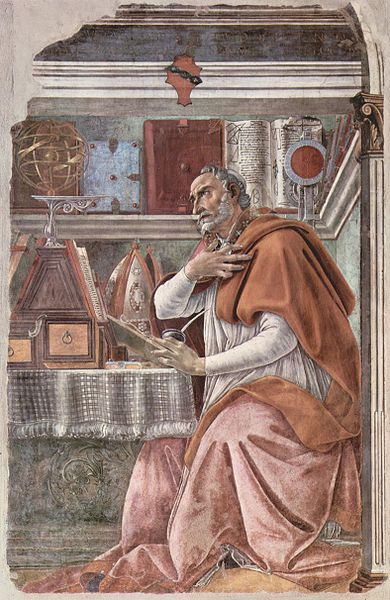 Evangelism has been a preoccupation in many mainline denominations over the past twenty years or so. On one level, this may simply have been a panic reaction to declining numbers and the feeling that evangelism is one way to “get people back to church. My own church, the Anglican Church, was not untypical in proclaiming the 1990s a Decade of Evangelism.
On a more substantial level, the renewed interest is a reflection of the gradual reinstatement of evangelism as a legitimate aspect of the mission dei over the past fifty years. David Bosch in his magisterial Transforming Mission has traced the development of this new understanding of mission, attributing it to changes both on the ecumenical side and on the evangelical side:
[A]n important segment of evangelicalism appears poised to . . . embody anew a full-orbed gospel of the irrupting reign of God not only in individual lives but also in society. A similar turning of the tide, but in the opposite direction, has been in evidence in ecumenical circles since the middle of the 1970s.On the one side, evangelicals have softened their suspicion of the “social Gospel”, so that an evangelical leader such as John Stott, interacting with ecumenical concerns about evangelism, could write as long ago as 1975 that:
“Mission” describes . . . everything that the church is sent into the world to do. “Mission” embraces the church’s double vocation of service to be “the salt of the earth’”[social concern] and “the light of the world” [evangelism].
This has served to reduce the caricature of evangelism which frequently exists in mainline churches that evangelism is necessarily an insensitive, hypocritical verbal exercise.
On the other side, a writer like Lesslie Newbigin, not an evangelical, but in a book published (significantly enough) jointly by Eerdmans and the World Council of Churches, has also written of the place of evangelism in the broad scope of the missio dei:
[T]he [New Testament] preaching is an explanation of the healings. . . . [T]he healings . . . do not explain themselves. They could be misinterpreted . . . The works by themselves did not convey the new fact. That has to be stated in plain words: “The kingdom of God has drawn near.
Thus there has been a remarkable move away from the polarization of a previous generation and a convergence of opinion that the missio dei embraces both word and action (Bosch says simply, “Words interpret deeds and deeds validate words” ) and that both are the responsibility of the church.
These two impulses “the one to seek new church members, and the other a theological convergence” have led in recent years to a flood of books on the subject of evangelism, with authors as surprising as Walter Brueggemann , and titles as startling as The Celtic Way of Evangelism. Many seek to define evangelism, and, while there are variations, most are summed up by John Stott’s simple definition: “Evangelism is to preach the Gospel.”
Of course, the idea of “preaching the Gospel” is hardly new. The use of the term “evangelism” itself may be a relatively recent innovation (the first recorded use of the term is in the writings of Francis Bacon in the 16th century), and the methodology of evangelism has since the nineteenth century often been modernist, but the impulse to evangelism is as old as Christianity itself.
This article will consider how Augustine in the Confessions describes his own experience of evangelism–or, rather, of being evangelized–and will then compare Augustine’s understanding of this experience with contemporary definitions of evangelism, and consider what the church today (not least the mainline church) can learn from this ancient example. I will consider the topic from three points-of-view: Augustine’s own (his theological interpretation of what happened to him), what I can only call a theocentric view (as Augustine understands God’s part in his conversion), and the church’s view (since the church is the locus of the work of evangelism, as of other aspects of the missio dei).
(a) Augustine’s point-of-view
Augustine’s story illustrates what has almost become a cliché in contemporary discourse about evangelism–that evangelism is a process – in the case of Augustine, a process that took over eleven years. Several factors were involved in the process, beginning with his turning away from childhood faith.
Augustine’s departure from Christian faith was similar to that of many people from a church background: a combination of growing up and experimenting with new things in life on the one hand, and, on the other hand, not finding adequate intellectual and spiritual nurture in his “faith of origin.” Thus, at the age of seventeen, he left home and went to Carthage. There, he says:
I had not yet fallen in love, but I was in love with the idea of it . . . I had no liking for the safe path without pitfalls. (3:1, 55)
In Carthage, he left “the safe path” and discovered the “pitfalls” of love and the theatre. To a casual observer, this might just look like a young man sowing his wild oats. With the benefit of hindsight, however, Augustine reads this period differently, arguing that what he was doing was far more serious than that: he was in fact doing what all sinful human beings tend to do: putting the creature in place of the Creator:
[M]y sin was this, that I looked for pleasure, beauty and truth not in [God] but in myself and his other creatures, and the search led me instead to pain, confusion, and error. (1:20, 40)Because the essence of his leaving the faith was the desire to be his own God, the heart of the return will be a reversal of this, in other words, allowing God God’s rightful place in his life.
However far Augustine drifted from his childhood faith, a spiritual hunger was never far below the surface. When he said, “Our hearts are restless till they find their rest in you” (1:1, 21), he spoke from personal experience. His first attempt to assuage that hunger was with the Manichees, which whom he experienced what Peter Brown calls “his first religious conversion.” Before long, however, he found he had doubts about the Manichees’ claims, and his spiritual hunger remained unsatisfied:
I gulped down this [the Manichees’] food because I thought that it was you. . . . And it did not nourish me, but starved me all the more. (3:6, 61)
He describes two blows in particular to his faith in Manicheism. Firstly, Firminus advised him to reject Manichean astrology as irrational:
In a kind and fatherly way he advised me to throw [the books of astrology] away and waste no further pains upon such rubbish, because there were other more valuable things to be done. (4:3, 74)
Then, secondly, at the age of 29, he met Faustus, reputed to be a great authority on Manicheism, whom he had hoped would answer all his questions, but Augustine was disappointed with Faustus’ superficiality, and said: “I began to lose hope that he could lift the veil and resolve the problems which perplexed me” (5:10, 104). In terms of the parable of the sower (perhaps the source of all understanding of evangelism as process), Augustine’s disillusionment with Manicheism broke up the ground in which the seed of the Gospel could be sown, or rather revived.
The next step in the process was that Augustine needed to hear the Gospel in a different form from that in which he had heard it in his youth. Under the influence of Ambrose’s preaching, Augustine “discovered how different Christian faith is from what he had supposed.” (Chadwick xx) (It is interesting that even today new converts, for example, through the Alpha program, will often speak of having discovered a Christianity that is quite different from what they had thought.) Some of this was the unlearning of his misconceptions about orthodox Christianity. For example:
I learned that your spiritual children . . . do not understand the words “God made man in his own image” to mean that you are limited by the shape of a human body. (6:3, 114)
Augustine describes this stage of learning what the church does not in fact teach thus:
Though I had not yet discovered that what the church taught was the truth, at least I had learned that she did not teach the doctrines which I so strongly denounced. (6:4, 115)
He also heard better explanation of scripture than he had encountered in Africa:
As for the passages which had previously struck me as absurd, now that I had heard reasonable explanations of many of them, I regarded them as of the nature of profound mysteries. (6:5, 117)
Thus the good seed of “the word” was sown into ground that had been well-prepared.
The turning point itself took place through the reading of a verse of scripture which he interpreted as exactly suited to his circumstances:
“Not in reveling and drunkenness, not in lust and wantonness, not in quarrels and rivalries. Rather, arm yourself with the Lord Jesus Christ; spend no more thought on nature or nature’s appetites.” (Romans 13:13-14) (8:12, 178)
The verse describes two ways of living, one in self-indulgence, the other in relationship to Christ: he chose the latter. The movement from this point towards baptism is apparently straightforward and lacking in the kind of emotional angst that has accompanied his journey so far, and described with far more economy. Later, he will describe this series of events in terms of giving up his freedom and yielding control of his life to his Creator:
You know how great a change you have worked in me, for first of all you have cured me of the desire to assert my claim of liberty . . . [Y]ou have curbed my pride by teaching me to fear you and have tamed my neck to your yoke. (10:36, 244)
For Augustine, if the essence of sin is putting ourselves in the place of God, then the heart of conversion is acknowledging the rightful place of God in our lives. This is the substance of what happens to Augustine as the process of evangelism leads to his conversion.
Although Jesus’ parables of sowing and reaping suggest the idea of process in the life of faith, Augustine, perhaps surprisingly, does not use agricultural imagery, but prefers a different image for process, that of the journey. At various points in the Confessions, he interprets his life as “the road to conversion” (6:4, 115):
So, step by step, my thoughts moved on from the consideration of material things to the soul. (7:17, 151)
From time to time, the parable of the prodigal son is clearly in the background of this image. Twice Augustine casts himself in the role of prodigal:
The path that leads us away from you and brings us back again is not measured by footsteps or milestones. . . . [The prodigal’s] blindness was the measure of the distance he travelled away from you, so that he could not see your face. (1:18, 38)
Where were you in those days? How far away from me? I was wandering far from you and I was not even allowed to eat the husks on which I fed the swine. (3:6, 62)
He further understands that the Christian life itself (when he finally adopts it) will be a road on which the believer follows Jesus. For instance, when he goes to ask advice of Simplicianus, he wants to enquire “how best a man in my state of mind might walk upon your way.” (8:1, 157) Picking up Jesus’ own language of “the narrow way,” he adds:
[I]n my worldly life all was confusion. . . . I should have been glad to follow the right road, to follow our Saviour himself, but I could not make up my mind to venture along the narrow path. (8:1, 157)So much for Augustine’s own mature reading of how the road led him by a circuitous route to Christian faith. The story looks somewhat different, however, when viewed from what Augustine understands to be:
2. A theocentric point-of-view
Augustine is deeply convinced that the work of drawing people into the Kingdom of God is the work of God. Evangelism is something only God can do. It is God who wants reconciliation with sinners, God who pursues them, God who draws them into relationship. Augustine’s convictions about the sovereignty of God mean that he understands God’s grace to precede any human activity: “My God, you had mercy on me before I had confessed to you” (3:7, 62) and knows from experience that “Man’s heart may be hard, but it cannot resist the touch of your hand.” (5:1, 91)
So how, from Augustine’s point-of-view, does God bring evangelism about? How does God bring people into the Kingdom? Augustine offers several clues in the Confessions.
One is that a sovereign God works through circumstances. As Augustine looks back, he sees God at work, even when he (Augustine) was not aware of it, to create situations that would move him towards faith. Thus, for instance, when Augustine moved from Carthage to Rome because he had heard that the students were quieter:
It was . . . by your guidance that I was persuaded to go to Rome. . . . [I]t was to save my soul that you obliged me to go and live elsewhere. . . . You applied the spur that would drive me away from Carthage and offered me enticements that would draw me to Rome . . . In secret you were using my own perversity . . . to set my feet upon the right course. (5:8, 100)
Augustine uses the metaphor of a ship helpless before the wind being steered by the helmsman to illustrate this sense of being moved irresistibly towards faith:
In my pride I was running adrift, at the mercy of every wind. You were guiding me as a helmsman steers a ship, but the course you steered was beyond my understanding. (4:14, 84)
Chadwick comments:
Decisions made with no element of Christian motive, without any questing for God or truth, brought him to where his Maker wanted him to be.
One aspect of this providential overseeing of circumstances is expressed in Augustine’s conviction that God allows difficulties in order to draw people like himself to faith. Thus Augustine found that his road of independence from God was not an easy road. At every turn, he found difficulty. On one level, Augustine sees this as simply the “natural” effect of moving away from God. He says: “[E]very soul that sins brings its own punishment upon itself.” (1:12, 33)
Yet he also attributes these difficulties to the direct hand of God, as a spur or goad to drive him back onto the right road. Even in his relationship to his concubine, which appears to have been a loving and generally satisfactory relationship, he observes that God “mixed much bitterness in that cup of pleasure.” (3:1, 55) We know that his mother prayed for him, and “Her prayers reached your presence, and yet you still left me to twist and turn in the dark.” (3:11, 68) Maybe the answer to her prayers was that he should twist and turn in the dark he had chosen—at least for a time. God’s love, in Augustine’s experience, is not soft!
It almost seems as though, the nearer he approaches to the truth, the more intense his suffering becomes. Although by the time he reaches Milan he begins to “prefer the Catholic teaching” (6:5, 116) and discovers the neo-Platonists, he is still miserable, finding he has less joy in life than a poor beggar. He attributes this too to the hand of God, seeking to turn him in the right direction, and, as so often, turns to the Psalms for a template through which to interpret his experience:
My soul was in a state of misery and you probed its wound to the quick, pricking it on to leave all else and turn to you to be healed. . . . [Y]ou broke my bones with the rod of your discipline. (6:6, 118)
Augustine observes also that he was moved towards faith through those who themselves do not have faith, and interprets this as a further sign of God’s sovereign power. Thus the influence that set him on the road that would eventually bring him back to Christian faith was his discovery at the age of 19 of Cicero, who “altered my outlook on life. It changed my prayers to you, O Lord, and provided me with new hopes and aspirations” (3:4, 58). It was Cicero [106-43 BC], not any Christian or biblical writer, who first caused Augustine to take his soul seriously, and to seek wisdom as a means to nurturing that soul.
The second example comes from much later, when he was relearning Christian faith, and he discovered Plotinus, the neo-Platonist, and was amazed to find much that was compatible and indeed fulfilled in Christianity. As Simplicianus explained to him, “In the Platonists . . . God and his Word are constantly implied.” (8:2, 159) The difference is that while Platonism sees the goal, it does not see how to get there:
It is one thing to descry the land of peace from a wooded hilltop and, unable to find the way to it, struggle on through trackless waters . . . It is another thing to follow the high road to that land of peace, the way that is defended by the heavenly Commander. (7:21, 156)
Plotinus, however, like Cicero before him, points Augustine in the right direction, and thus serves as a proto-evangelium. Augustine is at this point somewhat like C.S.Lewis, who, having been convinced by J.R.R.Tolkien that pagan myth merely foreshadowed Christian truth, described himself as “a man of snow at long last beginning to melt.”
As Augustine later realized, this was why the Apostle Paul’s evangelistic strategy with the pagans of Athens had not been to argue from the Old Testament, but to begin with their own poets (Acts 17):
Through your apostle you told the Athenians that it is in you that we live and move and have our being . . . And, of course, the books that I was reading were written in Athens.” (7:9, 146)
God, then, works through unbelievers, sometimes those who are seeking truth (like Cicero, Plotinus, and the Athenian poets of Acts 17), sometimes those who are indifferent or even (like those who encouraged Augustine to go to Rome) “whose hearts were set upon this life of death.” (5:8, 100)
Yet Augustine knows that his movement towards faith is not merely the existential wrestling of one man with his God, and his description makes clear that others are involved in the process. Thus he sheds light on what we might call:
3. The Church’s point-of-view
C.S.Lewis somewhere suggests, perhaps whimsically, that God does not do anything alone that God is able to delegate to human beings , and as the Confessions unfold, it is clear that Augustine encountered many people who helped him along his path. While he acknowledges that a sovereign God speaks and works through unbelievers who do not realize their instrumentality, he finds that God also speaks and works through believers in the Christian community. Monica provides the earliest instance of this. Thus, when he reached adolescence and relative independence, she:
earnestly warned me not to commit fornication and above all not to seduce any man’s wife. . . . the words were yours, though I did not know it. I thought that you were silent and that she was speaking, but all the while you were speaking to me through her, and, when I disregarded her, . . . I was disregarding you (2:3, 46)
Not surprisingly, when Augustine later moved from Carthage to Rome, he tricked Monica into not coming with her. Yet the Hound of Heaven was able to find other mouthpieces. For example, when Firminus sowed seeds of disillusionment with Manicheism, Augustine recognized later that once again God was speaking to him:
This answer [of Firminus] which he gave me, or rather, which I heard from his lips, must surely have come from you, my God. (4:3, 74)
God also speaks through the testimony of converts. Particularly as Augustine’s story moves towards its climax, there is a flurry of people whose experience finally catalyzes his conversion. First, when he goes to consult Simplicianus, “spiritual father of Ambrose”, Simplicianus tells him the story of the conversion of Victorinus, also “a professor of rhetoric, an admirer of the pagan Platonists, at best, merely tolerant of Catholicism.” (Brown 103) Augustine is no fool, and he knows exactly what is happening:
I began to glow with fervour to imitate him. This, of course, was why Simplicianus had told [the story] to me. (8:5, 164)
Shortly afterwards, Ponticianus tells Augustine and Alypius the story of Antony; then of two other converts who became Christians through reading the story of Antony. (8:6) Through these stories, his heavenly pursuer closes in:
[W]hile he was speaking, O Lord, you were turning me around to look at myself. . . . I saw it all and was aghast, but there was no place where I could escape from myself. (8:7, 169)It is not only the words Christians speak, however, which move Augustine in the direction of faith. Witness is normally by life as well as by words: indeed, the life gives credibility to the words and the words interpret the life. Thus Augustine first experiences the love of God through God’s servants. Monica, of course, is the outstanding example for Augustine of one who lives out the teaching of Christ, and what he says of her influence on her husband Patricius he could equally have said of her influence on him:
[T]he virtues with which you had adorned her, and for which he respected, loved and admired her, were like so many voices constantly speaking to him of you. (9:9, 194)But Monica is the not the only one whose quality of life struck Augustine. On arriving in Milan, he met Ambrose, who:
received me like a father and, as bishop, told me how glad he was that I had come. My heart warmed to him, not at first as a teacher of the truth . . . but simply as a man who showed me kindness. (5:13, 107)
As Chadwick comments, Ambrose was “was everything a bishop ought to be.” (Chadwick xxv) As for so many people, it was not only the ideas of Christianity which attracted Augustine, but also those truths incarnated in the flesh of real human beings.
Augustine comes to believe too that God works through the prayers of the church. Monica is a woman who prays, and in particular, she prays for her son. When he moved away from the practice of his faith, he says:
[M]y mother . . . wept to you for me, shedding more tears for my spiritual death than other mothers shed for the bodily death of a son. (3:11, 68)This too can be understood as human partnership with God. As Pascal put it, God gives us prayer so that we may have the dignity of causality. Certainly prayer was one of the ways in which Augustine believed Monica influenced him. He was impressed by the elderly bishop who assured her, “It cannot be that the son of these tears should be lost.” (3:12, 69)
Conclusion
Augustine’s experience of coming to faith suggests that while Stott’s definition of evangelism as “preaching the Gospel” is not untrue (Augustine did hear Ambrose preach the Gospel, after all), it is unhelpful in that it masks the complexity of the process.
Another author, who offers a broader definition which comes closer to encompassing the many facets of Augustine’s experience, is William Abraham. He suggests that evangelism is:
that set of intentional activities which is governed by the goal of initiating people into the kingdom of God for the first time. . . . [Thus] evangelism is . . . more like farming or educating than like raising one’s arm or blowing a kiss.
The evangelizing of Augustine is certainly not a single activity: it is spread over many years, and involves a wide variety of friendships, difficulties, conversations, prayers, encounters, readings, disagreements, self-examinations, mentors, false starts, scripture, and (in the end) a dramatic conversion. “Farming” and “education” might indeed be suitable metaphors for this process.
Even now, however, there are problems with the definition. Would it be right, for example, to call what happened to Augustine “a set of intentional activities”? Certainly Monica is clear about her intentions for her son; certainly Simplicianus is intentional in pointing Augustine towards Christ (even Augustine could see that); and Ambrose was undoubtedly aware in his sermon preparation of who was going to be listening. They all have, as it were, evangelistic intentions. But if there is an overarching intention, linking all these influences, it can only be (to speak Augustine’s language) in the mind of God, who oversees this process from beginning to end. Certainly the resources of the church are brought to bear on him—prayer, counsel, witness, and preaching, for example—but the human evangelists can claim no more than that they are co-workers together with God in God’s work of evangelism.
In light of Augustine’s experience and his reflection on that experience, then, we might expand Abraham’s definition to suggest that:
Evangelism is the work of God through people, specially the church, and circumstances, whose goal is the initiation of people into the Kingdom of God. Evangelism is like farming or educating, a process taking place over time and through countless and varied influences, whose effect is cumulative, and all of which point to faith in Christ. Evangelism is therefore the work of the church as it co-operates with God the supreme evangelist.
Augustine’s Confessions thus provides a salutary corrective for a contemporary theology and praxis of evangelism. In particular, the Confessions point us away from any sense that evangelism is a matter between the individual and God alone, that the key is in an existential and instantaneous “decision”, or that the church’s activism will bring it about. In fact, what the Confessions offers is a pre-modern corrective to a modernistic distortion of evangelism—an understanding that will, ironically enough, equip the church for evangelism in a postmodern world.
The Toronto Journal of Theology, Spring 2007
Notes:
- To paraphrase Don Posterski, evangelism has been brought out of the red light district of the church and onto the main street of church life. John P. Bowen, Evangelism for ‘Normal’ People (Minneapolis: Augsburg Fortress 2002), 16.
- David J. Bosch, Transforming Mission: Paradigm Shifts in Theology of Mission (Maryknoll: Orbis 1991), 408. His Chapter 12, “Elements of an Emerging Ecumenical Missionary Paradigm”, from which this is taken, is illuminating both historically and theologically.
- John R.W.Stott, Christian Mission in the Modern World (Downers Grove: InterVarsity Press, 1975), 30.
- Lesslie Newbigin, The Gospel in a Pluralist Society (Grand Rapids: Eerdmans and WCC 1989), 132.
- Bosch 420.
- Walter Brueggemann, Biblical Perspectives on Evangelism: Living in a Three-Storied Universe (Nashville: Abingdon, 1993).
- George G. III Hunter, The Celtic Way of Evangelism: How Christianity can reach the West . . . Again (Nashville: Abingdon Press, 2000).
- Stott 39.
- A superficial survey reveals that this is a theme for a wide range of writers including William J. Abraham, The Logic of Evangelism (Grand Rapids: Eerdmans 1989), Becky Manley Pippert Out of the Saltshaker (Downers Grove: InterVarsity Press, 2nd edition, 1999), George G. Hunter, The Celtic Way of Evangelism (Nashville: Abingdon 1999), Richard V. Peace Conversion in the New Testament (Grand Rapids: Eerdmans 1999) and John P. Bowen, Evangelism for ‘Normal’ People (Minneapolis: Augsburg Fortress 2002).
- David Lodge, using the language of semiotician A.J.Greimas, would have us describe Augustine’s process of moving away from Christian faith and then returning to it, as a “disjunctive journey,” which he defines as “a story of departure and return . . . In this kind of story, the hero and his companions venture out, away from secure home ground, into foreign and hostile territory . . . then return home, exalted or chastened by the experience.” David Lodge Write On (London: Secker and Warburg, 1986), 157.
- Actually, as Peter Brown points out, in spite of his description of Carthage as a “hissing cauldron of lust” (3:1, 55), within a year he had settled down with a mistress to whom he was faithful for fifteen years. Peter Brown, Augustine of Hippo (Berkeley and Los Angeles: University of California Press, 1968), 39.
- Brown, 39.
- This imagery of “steps” does not sit well with Karl Barth, who demands: “Is the function of the revelation of God merely that of leading us from one step to the next within the all-embracing reality of divine revelation?” Emil Brunner, Natural Theology: Comprising “Nature and Grace” by Professor Emil Brunner and the reply “No!” by Dr. Karl Barth (London: Geoffrey Bles, 1946), 82.
- He uses the image of the spur or goad twice more: “[Y]our goad was thrusting at my heart, giving me no peace . . .” (7:8, 144); “[Y]ou tamed me by pricking my heart with your goad.” (9:4, 185) In all three instances, his word stimulus is the same as that used in the Vulgate of Acts 26:14, Paul’s account of his conversion: “it hurts . . . to kick against the goads.”
- Cf. “You were my helmsman when I ran adrift” (6:6, 118)
- Augustine, Confessions, ed. Henry Chadwick (Oxford: Oxford University Press 1998), xxi.
- This is consistent with the theology of such biblical writers as Isaiah, who has Yahweh refer to the pagan King Cyrus as “my servant” (Isaiah 45:1), and makes use of him to accomplish God’s purposes.
- C.S.Lewis, Surprised by Joy (London: Fontana Books 1959), 179. He explains elsewhere that what Tolkien showed him was that “the Pagan stories are God expressing Himself through the minds of the poets, using such images as He found there, while Christianity is God expressing Himself through what we call ‘real things’.” Walter Hooper, ed. The Letters of C.S.Lewis to Arthur Greaves (New York: Collier Books 1979), 427.
- “Creation seems to be delegation through and through. He will do nothing simply of Himself which can be done by creatures.” C.S.Lewis, Prayer: Letters to Malcolm (London: Geoffrey Bles 1964; London: Fontana Books 1988), 73.
- Jesus seems actually to have foreseen this kind of connection: “Whoever listens to you listens to me, and whoever rejects you rejects me.” (Luke 10:16)
- cf. Bowen, chapter 4.
- cf. “[A]ll the time this chaste, devout and prudent woman . . . never ceased to pray at all hours and to offer you the tears she shed for me. . . . Her prayers reached your presence.” (3:11, 68)
- “Why God has established prayer. 1. To communicate to His creatures the dignity of causality.” Blaise Pascal, Pensees in The Harvard Classics, volume XLVIII, ed. Charles W. Eliot (New York: P.F. Collier & Son, 1909–1917).
- William Abraham, The Logic of Evangelism ( Grand Rapids: Eerdmans 1989), 95, 104.
Evangelistic Preaching Today: What to Say When People Don’t Know What You’re Talking About
Preaching when people knew the Bible stories and Christian language was one thing. Preaching today has to start further back and take less for granted in the minds of our hearers. How does one connect with people who come to church to “explore their spirituality” but knowing nothing of Christian tradition?
Where we are now
I recently read that Google is scrambling to hire the most talented math and science graduates, in a bid to secure its global dominance as a search engine provider. Google now uses billboards bearing a mathematical problem: solve it for the telephone number to call for a job interview. With that exclusive entry way, Google is assured of only the cleverest job applicants.
Sometimes I think that modern preaching is like a Google billboard: if you can decipher what I am saying, then you are welcome in our exclusive club. In our post-Christian culture, sermons are increasingly incomprehensible for people who are exploring Christian faith for the first time. I was recently given an orchid by a young man as a thank you present. Growing up, he had been taught that Jesus was rather like Santa Claus, not an historical figure but harmless enough. “Thank you” he said, “for showing me that Jesus is a real person. I had no idea.” This young man is not the exception to the rule: he represents the mission field in which we now serve.
What does it mean to preach when our congregations will have even just one person present who is like that young man? Since this is the place we now find ourselves in, I would argue that all preaching must be evangelistic preaching. The congregations in which we all serve have a mix of believers, seekers, church members who may not necessarily believe, and everyone in between. This is where preaching evangelistically becomes both a challenge and an opportunity.
Where we would like to be
In the congregation where I serve, I have a clear sense each Sunday morning that God is passing us the ball and saying, “Here they are: these people have come to church. Make sure you tell them about me!” Research suggests that when a “seeker” comes to church and is genuinely searching for God, they are likely to give church one try and one try only. That being the case, our preaching has to create a space for them in which they can encounter the truth about God. Tim Keller, pastor of Redeemer Presbyterian Church in Manhattan, has determined that every time he preaches he will encapsulate the Gospel in some form, no matter how brief, so that everyone who has come that day can say, “Yes, I have heard about God’s love and what Jesus has done for me.”
It would be wonderful if our preaching could not only nourish faithful followers of Christ, but also pique the interest of seekers and show them glimpses of what a relationship with God in Christ could mean for their lives. Some will say that evangelistic preaching on Sunday mornings does not spiritually nourish the Christians in the congregation. But this need not be the case. A sermon that is sensitive to the seeker will, by its very focus on who God is and what God has done for us in Jesus, nourish a faithful believer. In any case, a Christian also has the opportunity for spiritual nourishment in small group settings and through personal prayer and Bible study. These opportunities are not likely to exist yet for the seeker who has shown up on Sunday.
How we might get there
Preaching with the seeker in mind is a wonderful opportunity and here are a few simple things to remember.
1) It is helpful to start where the seeker is in their life and then bring them to the truth about God revealed in the Bible. At a parish that I used to serve in, each week the rector would take his video recorder into the local pub and interview people about the sermon topic that would be coming up. He would then use clips of these interviews on Sunday mornings as a way of letting people speak for themselves, of bringing the thoughts, doubts, beliefs and fears of the average seeker into the service. He would then use these clips as jumping off points to look at the Biblical text for the week. This approach is similar to that of Paul at Athens in Acts 17. Rather than starting with scripture, Paul begins with things in their culture: their altar to an unknown God and their poets. Then, at the end of his sermon, he takes them to Jesus.
2) If we are to preach on things that people are actually interested in, then we will need to be students of our culture. That means we need to know what the current top movies are (and preferably have seen them), what are the most popular books (and have at least glanced at them), who is at the top of the billboards (and be able to pronounce their names). Knowing what was current ten or even five years ago simply won’t do. It is not by chance that as Paul begins his sermon in Athens, he says, “As I walked around your city, I looked carefully at the objects of your worship.”
3) We need to be aware of the depth of Biblical illiteracy in our culture. Remember that young man I mentioned who was unaware that Jesus was an historical figure. We will therefore watch our language when we preach and take very little for granted. It takes longer to explain that Pontius Pilate was a Roman governor, or that the word gospel means “good news”, but it is worth it.
4) Our congregations need to know that modern preaching also needs to be evangelistic. They need to be shown why and how an effective sermon will be sensitive to the seekers present, and that preaching is not only for their benefit. The good shepherd left the ninety nine sheep to go and look for the one that was lost.
5) I find it helpful to write and pray through my sermon with one specific seeker in mind. It may be a friend or a family member, or a person who actually came to your church recently. So as I am writing and praying, I will be thinking, “Will Terry understand this? What would he make of this?”
I am only beginning to grasp the complexities of evangelistic preaching myself, and so have much to learn, but I do know that there is no greater thrill in ministry than finding out that your sermon brought someone closer to the fullness of Christian faith.
The Difficult Journey to Faith: How the Church can Provide Stepping Stones
Moving toward Christian faith is seldom easy. There are intellectual, ethical and relational issues to be worked through, to name but three. Churches which seek to practice evangelism will try to offer help at every step for those who wish it. There are many such “stepping stones” churches can offer: classical music is one of them.
Coming to Christian faith is often a long and complex process involving many steps.
Take Dave, for instance. Though his parents never went to church, his grandmother had a reputation for being “religious” and told him stories of Jesus. At university, he had been intrigued to discover in a history of science course how many of the great scientists were also thoughtful and articulate Christians-Kepler, Newton, Boyle, and Maxwell, for example. When he got a job with an innovative high tech firm, he found that one of his colleagues was a person of quiet but firm Christian faith. They talked sometimes about the historic connection between science and faith, and Sam invited Dave to a lecture by a leading physicist on “Why I am a Christian.” Dave found it thought-provoking.
Dave and Sam hung out together sometimes on the weekends. Dave was impressed by Sam’s integrity and enjoyed his sense of humour. So after six months or so, when Sam invited him to a Sunday afternoon discussion group about the Bible for young singles who were figuring out their spirituality, Dave was interested to go. Then he checked out Sam’s church, to which some of the group also went, on a Sunday when they were doing a jazz mass, and, to his surprise, he liked it. A year later, he decided to be baptized.
Dave, as you may have guessed, is a composite of many people, but I have heard enough stories of this kind to know it is a pattern: a long-term friendship with someone who is genuine in their faith, plus a special event or two, plus plenty of time for reflection and asking questions, some experimentation with church, and then a thoughtful commitment.
This edition of good idea! looks at one place where churches often fail to help people who are taking that kind of step towards Christian faith: the special event. We often assume that if we make our churches friendly enough, and the liturgy contemporary enough, new people will flock in. Well, that may be true for some.
But there are many for whom a regular Sunday service is unlikely to be an accessible door through which they can move towards faith. For Dave, the lecture by the physicist was on a Thursday evening on a local university campus. The Bible study was on a Sunday afternoon, over a glass of wine in a young couple’s apartment. And his first Sunday service was a little out of the ordinary. Each event was a stepping stone on the way, and each was more user-friendly than a “regular” Sunday for a non-churchgoer like Dave.
There are many forms this kind of bridging event can take.
- I know one family who every summer invite their neighbours to watch a thought-provoking current movie on a wide-screen TV in their back yard. Significant conversation about big issues of life and death always follows over hot chocolate.
- Many churches in the past thirty years have invited hockey legend Paul Henderson to be an after-dinner speaker, to talk about his hockey, his life and his faith.
- I recently heard of two clergy in England who have begun running regular discussions about spiritual issues in their local pub: the program is called “Pints of View.”
- And Jenny Andison, in a recent Wycliffe Booklet on Evangelism, Doors into Faith: Inviting Friends to Join the Big Game, gives more examples to stimulate our creativity.
Future editions of good idea! may feature some of these events. This edition, however, examines two churches, one in Eastern Canada and one in the West, who have made classical music just such a stepping stone towards faith. As it happens, both have run their programs in the church and on a Sunday. But in neither case is it in the form of a regular Sunday service. St. John’s Shaughnessy, Vancouver, has experimented with performances of Bach Cantatas, which were originally composed to be performed in the context of a church service, with a sermon on the relevant texts. And Stone Church in Fredericton NB has offered evening concerts of sacred music entitled The Great Composers Tell a Great Story, highlighting the Christian narrative that underlies much classical music.
If evangelism is helping people take steps towards faith in Jesus, and if those steps can take several years, we need to be sensitised to how we can help. A lively and welcoming church is often a piece of the puzzle. A friendship with a Christian is usually a key part of the process. But between the friendship and the normal life of the church there is often a great gulf fixed. Probably the journey to faith will never be an easy one, but the church can at least remove some of the unnecessary difficulties. One way to do that is by creating the sort of stepping stones which special events provide along the way.