For some people, understanding comes before experience; for others, Christian faith begins with an experience for which we do not have the words. The church helps us name what we have felt, and to move forward in faith.
The images of God that I learned as a child came mostly from Sunday school, to which I went to occasionally while my parents slept in. There I learned that God could be hateful and make us all drown. I knew I’d never be as perfect as Jesus, and I definitely wasn’t comfortable with the idea that he died for my sins.
In my twenties, I discovered that God was something I didn’t understand or believe in but was able to feel. In Sunday School there’s not much talk of how it feels when the Holy Spirit fills you and grows inside of you, or what spiritual energy feels like, or how it reacts on your human form. I was spiritually illiterate.
During this part of my spiritual journey, nobody bothered to point out that religious conversion could sometimes be marked with panic attacks, and that sometimes being filled with the Holy Spirit is so awesome, so huge, that it makes you weep from the pit of your soul. I had no spiritual language to explain what I could feel growing in me. I could not deny the intellectually impossible construct that could make my stomach do flip-flops and pushed at my ribs till my breath got short and shallow.
Around August of 1995 I wanted to get my daughter baptized. So I caught a ride to church with a friend who was the music director in an Anglican church. He had long hair and looked scruffy, and I figured that, if they let him in, then they’d let me in. They did let me in.
Every single Sunday I would bring a book and sit in the chair farthest away from everybody else and closest to the exit. I’d keep my nose in the book until church started, too painfully shy to speak to anyone. I’d go over the bulletin carefully to make sure I knew what was going to happen and when, so that I could go to the bathroom just before the Peace and return just after the Communion. I could not bring myself to participate. It was just too intimate an act to do in front of a whole congregation of people. I would hyperventilate just at the thought of it.
No-one ever made me feel the slightest discomfort for keeping my nose in a book. Not one of the regulars ever took “my chair”. No one ever made me feel uncomfortable for leaving during the Peace and Communion. I continued to attend regularly.
When it’s time for the child to come and eat at the adults’ table, no one expects the child to know all the rules of etiquette. That’s what it was like for me: the people at my church let me sit at the big table but didn’t expect me to behave any particular way. I was, and still am, proud to be invited to sit at the big table.
Well, almost seven years have passed. I now lecture on Children’s Ministry, I am on staff at the Niagara Youth Conference, and I am attending McMaster Divinity School. If, at this point, my faith was tested, I couldn’t lie. I am a practising Christian. I have found the kind of spiritual journey that I could not have asked for or imagined.
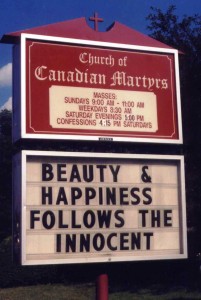
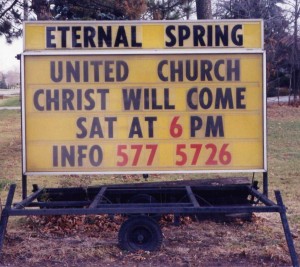 E—SAT. AT 6PM If this doesn’t make you laugh, it should make you cry. Church readers understand: an Advent celebration, a theme for the evening. Normal stuff for the time of year. Is the unchurched reader likely to show up? Unless they have some faint liturgical memory around the meaning of Advent, the sign won’t even make a lot of sense, let alone appear as a warm invitation. Sounds like a headline from The National Enquirer. They’ve got better things to do with their Saturday nights.

 Our student son said to us recently, “By the way, I was talking to some street kids in Toronto the other day, and I gave them our phone number in case they needed it. I hope that’s OK?” So far our mettle has not been tested, but it raised an interesting question. To welcome or not to welcome? Which is kinder . . . to everyone?
 ED: Before I began at Christ Church in 1995, I asked my bishop for three months leave, and took that time to research congregational development. I read widely, and attended Harold Percy’s “Beyond Survival” conference at Wycliffe. The most helpful book I read was Andrew Weeks= Welcome! published by the Alban Institute.
 Soon a system had developed. Whenever a visitor showed up on a Sunday, I would write a letter of welcome on the Monday, and then, on the Thursday or Friday of that week, two parishioners would make a Adoorstep visit@ to the newcomer–taking a homemade loaf of bread.
 Jesus went to a lot of parties. In fact, he went to too many of them–at least, according to the religious people. Yet for him, far from being an excuse to eat too much and drink too much–though that was the accusation–parties made a crucial theological point. His point? The kingdom of God is like a party.