Building a Musical Bridge
![]()
My wife Marci and I were sitting at a table in a crowded restaurant in our city of Edmonton. It was a Sunday evening, and we were attending a regular Sunday night ‘open mike’ – an opportunity for local musicians to get up in front of a microphone, sing their three songs, and then sit down again and listen to the efforts of their fellow musicians. We had been attending this particular open mike for a couple of years, and had gotten to know quite a few of the musicians, including the host, a bubbly and gregarious aging hippy who, I had discovered, was also a recovering alcoholic. She had come to sit at our table while one of the musicians was playing, and we were chatting about another musician who was causing her some grief at the open stage. “What do you think I should do?” she asked. And then she surprised me; “I guess what I’m really asking”, she continued, “is, ‘What would Jesus do?’”
Reflecting on this conversation later on, I couldn’t help remembering how flabbergasted this woman had been when she had first discovered that I was a pastor. A friend and I were helping her set up the PA system one night, and my friend made some comment about me being a man of the cloth. “Cloth?” the host exclaimed; “What cloth is that – a tablecloth?” And then, as it gradually dawned on her that my friend was serious, I saw a look of absolute horror flash across her face. Her attempts to backpedal were so funny, I wished I’d had a camcorder with me.
I’ve been playing folk music all my life, but in the last three years, for the first time, I’ve stepped out of my Christian bubble into the live music community here in Edmonton. I started playing at a Monday night open stage run by Chris Wynters (of the Edmonton band ‘Captain Tractor’); from there I discovered other events, in pubs and coffee shops, and I began to make a whole new community of friends. I was not doing this out of any overt evangelizing agenda; I simply wanted to find a way to relax in the city, and music seemed like a good way to do it. But it has been interesting, as I’ve gotten to know people in the music community, to see how many opportunities I’ve had to be a witness, or simply a caring Christian presence.
A local songwriter hosts a monthly songwriter circle at his house; I’ve participated in it fairly regularly for a couple of years, and we’ve become good friends. He says he is an agnostic, but I often kid him that he seems to write a lot of songs about the God he’s not sure is there! Sometimes he asks me for my thoughts on lyrics he’s writing – usually when the lyrics have references to God in them. These conversations lead in some really interesting directions. Last year this friend agreed to participate in a fundraising concert for Habitat for Humanity which was held at our church. This was very good for our concert – it brought in a few people who wouldn’t have been there otherwise. But I think it was also good for my songwriting friend; he has a pretty low opinion of organized religion in general and clergy in particular, and I think his participation in the concert gave him an alternative view.
Another new friend and I have started playing gigs together; he is a very fine lead guitarist and has also helped me record some of my songs at his home studio. I asked him to help out this past December with a special musical number we were doing at our Nine Lessons and Carols service at St. Margaret’s Church; he and his girlfriend came to the service, and afterwards she commented on how much she enjoyed it and how she was hoping to be able to drop by on an ordinary Sunday sometime, when we weren’t doing a ‘special’ service. Last time my wife spoke to her, she had bought a daily devotional book and was finding real inspiration in reading it every day.
What’s the secret? I don’t think it’s especially complicated. I think you need to find something that you are really interested in doing, and then find some non-Christian people to do it with. And the objective, at the beginning, can’t be overtly evangelistic; people seem to sense instinctively when you are only there to convert them, and they don’t tend to respond well to that approach! I didn’t begin to attend open mikes to evangelize; I went because I wanted to play music. But, once I was there, I decided to be myself: not just a musician, but also a follower of Jesus. And because I’d earned the right to be heard – both in terms of being a credible musician, and also in being genuinely interested in other people’s lives and willing to listen to their stories – well, then the opportunities for witness gradually began to come my way.
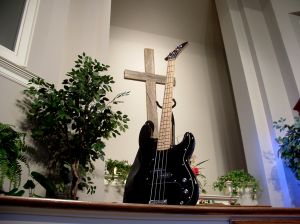
One thing I have resisted is the temptation to sing ‘evangelistic’ songs. I’ve been at the open mics when others have done that, and I can almost feel the audience’s resistance rising. To me, the songs I sing are simply a bridge I build into the lives of the people who are listening. Afterwards, when we’ve become friends over a few months’ worth of coffees and hours of listening to music together, I can use that bridge to speak a word of witness at the right time.
I don’t think I’ve got it quite right yet; I can’t report any spectacular conversions, and I suspect that at times I’m still a bit too backward about speaking about my faith. But for the first time in my life, I feel like I’m really engaging in regular relational evangelism. And I’m excited to see what the Holy Spirit is going to do with it.

What Tim Offers: Christian Basics
| This Article is from the Fall 2005 edition of good idea!, also available here in a fully formatted PDF file. |

One of the crucial needs for a congregation wishing to grow in the area of evangelism is to offer a course where the “basics” of the Christian faith are taught in a way that is accessible, winsome and challenging. For many churches, Alpha has filled this niche; for others, Harold Percy’s Christianity 101 series has been very helpful. Yet there is evidence that churches which offer their own homegrown courses of this kind see very similar levels of response to those offering the better known programs.
Tim Chesterton has been teaching Christian Basics courses since 1997. Currently, St. Margaret’s runs three Christian Basics courses a year, two on weeknights and one on a Friday night and Saturday; the courses are four sessions long, and are designed for inquirers, for new Christians, for new church members, for long-time members who need a refresher course in the basics, and for baptismal candidates or parents bringing children for baptism.St. Margaret’s also runs a six-session follow-up course, Growing and Living as a Christian, designed to help people who have accepted the invitation to become followers of Jesus and who want help on the next step in their journey.
The material from these two courses has recently been published as Starting at the Beginning (Anglican Book Centre, 2004). Bishop Victoria Matthews says, “I especially recommend this book for seekers and those wondering what becoming more serious about the Christian faith would mean.”
Harold Percy adds, “The time has long since come for the church to reclaim its primary ministry of making disciples—intentional followers of Jesus who are learning to live to the glory of God. For congregational leaders who want to help people grow into spiritual maturity, this book will be a helpful tool.”
Tim is excited to make the material in Starting at the Beginning available to a wider audience through the Institute of Evangelism, so that more congregations can begin to create and teach their own Christian Basics program. He is able to offer two slightly different weekend workshops.The first workshop simply presents the Christian Basics course within that time frame. This leaves participants to work out how they might create a similar course for their own context. Some prefer this approach.
The second presents the Christian Basics workshop but also gives guidance about how to run Christian Basics courses in a parish setting. Tim’s parish experience has been in small congregations in the ‘Family’ and ‘Pastoral’ size categories, but the principles are applicable to all sizes of congregations.
Tim is no longer available as an Associate of the Institute. Please contact the Director, John Bowen for help teaching Christian Basics.
Teaching the Gospel in a Smaller Parish
By Tim Chesterton and Greg McMullin
Two clergy, one in St. John, New Brunswick, the other in Edmonton, Alberta, describe how they have written their own courses, making creative use of already existing materials, and adapting them to the local situation. The results have been profoundly encouraging.
How did you come up with this program?
Tim: Like many Anglican clergy, I spent years preparing parents for the baptism of their children in ineffective ways. I desperately wanted these parents to keep coming to church, and so I would hammer away at the solemn obligation they were making before God and his church. Looking back on this now, I wonder why it never occurred to me that this was not particularly compatible with my commitment to share the Good News of God’s free gift of salvation, rather than the demands of the Law!
My practice was revolutionised in the mid-1990’s when I first encountered Harold Percy’s “Christian Basics” course. I quickly saw that the course would be very effective as a baptismal preparation tool: it made a lot more sense to proclaim the Gospel to people than to bludgeon them with the baptismal promises!
I also saw the potential of the course for many other people–the spiritually curious, new believers, lifelong Anglicans who had never experienced a personal connection with God, not to mention long-time Christians who needed a refresher course. And so I began to adapt the course, adding in material from other sources, such as Nicky Gumbel, Rico Tice, John Bowen, the Emmaus program, and others.
Greg: It’s always exciting to see newcomers in the pews and to be approached by people seeking baptism, confirmation or marriage. The first question that always comes to my mind is, “How can we as a church provide these people with an opportunity to explore what it means to be a Christian?” And, secondly, “What are some of the basics they need to know if they ‘sign up’ to become disciples of Jesus?” For me, as a parish priest, these are the two most compelling concerns. Hence, after months of gathering materials and ideas, I drafted my own program.
Who is the course for?
Tim: We require all baptismal candidates (or parents of baptismal candidates) to attend it. But we also encourage newcomers, inquirers and long-time members to take the course.
Greg: Although newcomers are encouraged to attend, the course is open to all–anyone wanting to investigate Christianity, or those wanting to revisit the basics of the Faith.
How is the course structured?
Tim: In the past four years, “Christian Basics” has become a central feature of our parish life. We run the course twice a year, in the Fall and in Lent, and a follow-up course called “Growing and Living as a Christian” at least once a year. We are not a large congregation and so our courses tend to be small–six to eight participants sitting around a table together. This makes our presentations much more interactive than would be the case in a larger setting, and it encourages a deeper sense of community within the group.
Greg: A typical New Beginnings evening is held on a Sunday evening. We set it up like this:
7:00 p.m. Meet and greet.
7:15 p.m. Presentation
8:00 p.m. Small Group Discussion
8:30 p.m. Wrap-up
8:45 p.m. Home
Because much of the information presented builds upon previous presentations, we ask those who register to do their best to come each Sunday evening, so that they will get “the big picture”.
What is the content of your introductory course?
Greg: Our first course, “New Life in Christ,” consists of five parts:
1. What in the world is going on? The hunger for something new. There is something drastically wrong with the world–and with each of us. Is there a God who is for real and who is good who can help us?
2. The weight of morality: Whose values anyway? Here we look at films such as Dead Poets Society and A Few Good Men to observe people’s natural sense of right and wrong. Where does this quest for what’s right come from? Answer: we are made in the image of a God who is good.
3. Divine Intervention: Myth or Miracle? We talk about God’s self-revelation by exploring the identity of Jesus Christ–the Incarnation and the claims of Christ.
4. What Matters to God?–Bridge-Building. We know people matter to God because of the Cross. We watch the crucifixion as portrayed in the Jesus film and then explore the meaning of the Cross.
5. Head Belief and Heart Faith. People are challenged to consider where they would plot themselves on a “Spiritual Growth Graph”–either committed to Christ or still on the way. At the end, we invite those who are ready to turn from sin and trust Christ to do so.
Tim: “Christian Basics” as we offer it has a four-part structure:
1. Finding a God to Believe in, Finding a Story to Live By. This is an overview of the Christian story as a play in six acts, and of our place in the story.
2. Why Should I Consider Jesus? This session focuses on Jesus’ life, death and resurrection and what they mean for us today.
3. Making a Connection with God. This session summarises the Gospel as it deals with the Kingdom of God and reconciliation with God. It invites the response of faith, baptism, and the gift of the Holy Spirit. The session ends with an opportunity for people to make a decision about the next step in their journey.
4. Where is Jesus Leading Me? This session introduces people to Christian disciplines and the challenges of Christian living.
What goes into your follow-up course?
Greg: Our second five-week journey, New Growth, focuses on discipleship:
1. New Joy: What about worship? We look at what the Bible says worship ought to look like, and why public worship ought to be the priority of every Christian.
2. New Food: Why come to the Lord’s Table? We stress the importance of the Eucharist, underscoring the fact that it brings the Cross of Jesus even closer to the believer, ands helps us grow in Christian character.
3. New Character – How can I become more like Jesus? This session is about issues of Christian living and lifestyle. We also explain the importance of daily prayer and Bible study, and how such spiritual disciplines help us not just “talk the talk” but to “walk the walk.”
4. New Traditions: Who are the Anglicans? Here, without making things too “churchy,” we talk about the meaningful and unique traditions that every denominational family has, and how we do things in the Anglican branch of the family.
5. New Family: Where do I fit in at church? The focus here is on every member ministry, putting the right people in the right places for the right reasons. Here, in this final week, we present our vision for our local church.
Tim: Our follow-up course, called “Growing and Living as a Christian,” lasts six weeks, and covers the topics of Prayer, the Bible, the Church and the sacraments, the Christian way of life, money in the life of a Christian, and “making a difference for God.”
What is the effect of these courses?
Tim: We have not seen hundreds of people added to St. Margaret’s because of “Christian Basics.” However, we have seen God touch people’s lives in very real ways. One man who had been a churchgoer for about three years commented, “This is the first small group Bible Study or spiritual learning course that I have taken. It has inspired me to go out and practice my faith. I never expected this!” A young woman bringing her child for baptism said, “Over the years I feel that I have lost my faith, and I have enjoyed starting the journey back, even though I have a long way to go.” A lifelong churchgoer said, “The most significant learning for me on this course was understanding, finally, why Jesus died on the Cross.” A teenage girl shared that “I’d like to have a closer relationship with God, and this course has helped me to realise that, and showed me ways to achieve it.”
However, my favourite story from “Christian Basics” concerns a woman in her forties who was preparing for her own baptism. During the third session, I had introduced the idea of a “response grid,” a line from zero to one hundred, with fifty representing the point at which we accept that Jesus is the key to knowing God and so we put our lives in his hands and become his followers. In a private chat the week before her baptism, I asked this woman where she would place herself on the response grid. She replied, “Right now I’m at 49, and after Sunday I’ll be at 51!”
Greg: New Beginnings has in fact been a “new beginning” for us as a parish. Having been Rector for less than a year, I am already seeing the fruits it has borne. I consider it to be both a thrilling privilege and an awesome responsibility to help people discover a new direction in life–the narrow path of following Jesus in newness of life. As a pastor, this is what makes it all worthwhile.
The Rev. Greg McMullin is Rector of St. Mary & St. Bartholomew’s Church in Saint John, New Brunswick.
The Rev. Capt. Tim Chesterton is an Anglican priest and a member of the Church Army. He currently serves as Rector of St. Margaret’s Anglican Church in the city of Edmonton. Tim’s book, Starting at the Beginning: Christian Basics for Faith and Life, which includes material on how to teach both his courses, is to published by the Anglican Book Centre this summer.