Harold Percy spoke at an annual Institute of Evangelism dinner at Wycliffe College. This is the text of the talk he gave that evening.
It is no secret that our churches across this country are generally having a difficult time connecting with people and attracting them into the lives of their worshipping communities. It seems to be mystifying and bewildering to many that forms of worship, church life, and governance that worked effectively for generations no longer do so.
George Hunter, in one of his books on church life and North American culture, offers the picture of a corn farmer whose family has been successfully raising and marketing corn for generations. He ask us to imagine that one morning, as this farmer and his crew wake up to go into the fields to harvest the corn, they discover to their amazement that overnight the cornfields have turned to vineyards. Instead of acres and acres of rich, ripe corn waiting to be harvested, instead there are vines dropping with juicy grapes waiting to be picked. A preposterous picture to be sure, but go with it for a minute. Hunter says that in this situation there are a number of options open to the farmer. Of all these options, surely the most disastrous would be to think, “There can’t be that much of a difference between corn and grapes, so let’s just start up these corn pickers and drive into the fields and harvest the grapes.” This could not possibly end well! In fact, the harder they worked at this, the more damage they would be likely to cause.
Hunter says this is the situation facing churches (for our purposes, particularly mainline churches and especially the Anglican Church) in North America. For generations we had a way of “doing and being” church that fit perfectly into the surrounding culture and so was very effective. But in recent years the changes in the culture have been rapid and significant. The result is that the churches are much like the corn farmer, surrounded no longer by corn but by grapes. The harvest has changed, and changed dramatically. And, if we as the church are going to be effective in what we are called to do, we must change as well. To insist that we can continue to do just exactly what we have always done, and hope that our results will eventually change, is folly. Corn pickers can’t harvest grapes. We need to rethink what we are doing and how we are doing it.
Dallas Willard wrote, concerning church life in America, that “your church is perfectly designed to get the results you are presently getting.” If we want to get different results we need to do some serious thinking about what needs to be changed, and what we need to be paying attention to. The following acrostic on the word VITAL provides a convenient framework for me to make a few observations about some of the things I think we need to be paying attention to if we are going to revitalize our congregations and carry on effective ministries.
Visionary Leadership
The “V” stands for visionary leadership. We need visionary leadership at every level because the nature and scope of the changes required go far beyond simply tinkering a little bit with what we already have. It is clear that the traditional parish model which is organized around liturgy and pastoral care simply doesn’t work anymore. No matter how good we get at these, it won’t help. What we need is new DNA, and leaders who get this, and can model and communicate it.
The number one job of leadership is to explain why the organization exists and to communicate this clearly and effectively. We have congregations all across this country who don’t know why they exist, with leaders who are unable to tell them.
I read somewhere that the two most radical questions any organization can ever ask itself are these: Why are we doing what we are doing? And why are we doing it the way we are doing it? These are questions that have to be asked on a regular basis in every congregation, parish, and diocese across the country. It is hard to know just what to do if you aren’t clear on precisely what it is that you are trying to do. What should be the result of all this work and effort we are putting into church life?
For my money the answer to the first of these questions would be something like, “The church exists (or this parish exists) to let the whole world (or this particular community) know that Jesus is Lord; to explain what this means, to live what it looks like, and to invite everyone within our sphere of influence to become an intentional follower of Jesus and learn to live the new life of his Kingdom.
Again, for my money, the worst possible answer to the second question (why are we doing it this way?) is “Because we have always done it this way.” A better answer is “because we have tried and experimented in all kinds of ways and currently this is what seems to be most effective, but we are always looking for ways to get better at this.”
The leadership in a vital congregation needs to be able to inspire the people of that congregation with a vision of who they can become as they work this out, to dream of what such a community of people might look like in their particular context, and to nurture such a community into being. That is always an exciting journey for everyone involved.
The challenge is that our systems of formation and oversight do not produce and nurture such leaders. In fact, they probably weed them out more often than not in the early stages. We send clergy out into the field, full of passion and dreams and hope, but without the necessary training and ongoing coaching in the transformational leadership skills required to take hold of a parish and lead it through a process of transformation to vitality. So, as they try or suggest various things, they get beaten up, discouraged, tamed, even skittish, and often end up simply trying to hang on and survive. This is an issue that needs to be addressed.
Inspirational Worship
The key here is simply to remember that people mostly prefer parties to funerals. Over the years I have come to the conclusion that we put far too much emphasis on the set texts and forms of our liturgical worship and expect far too much of the liturgy in return. We need to get over our obsession with “doing liturgy properly”—not that we should strive to do it badly, but because there are more important things to be thinking about. We simply overplay this in terms of its importance and what it can do.
One of the problems with the way we think about liturgy is that it is rationally driven. It is explained by means of logic and reason: “this piece goes here, because we have just done so and so, and this is what should follow.”
I don’t have a problem with this, except to say that of much greater importance is the tone and pace and feeling of what is happening, no matter how the pieces are linked together. It simply is a fact that the majority of our churches bore the pants off people with the tone and pace of the service. It is just quiet, somber, and weary. I have often marveled at how Anglicans can be such jolly, life loving, vibrant people on the parking lot or in the coffee hour, but so totally dull and dreary at worship. There is nothing in scripture to suggest that worship needs to be a funeral march. So much of what we do and how we do it is just lacking in imagination and energy.
When the people we are hoping to connect with do eventually come to church to check things out, most of them aren’t asking whether the pieces of the service fit together theologically, nor even, “What did I learn?” The first and most important question for them is usually, “How did I feel?” Did I feel that I was in a community that is life-filled and loving? Did I feel welcome? Did I sense that in some way I was actually in God’s presence, and that God and I were connecting? Did God speak a word into my life in that service? Was I touched? Was I challenged? Did I get excited? Did I leave with a new or renewed sense of purpose or hope; a new or renewed perspective on my life and its possibilities? Was I convicted of things in my life that need changing? Do I feel that I have been forgiven?
They aren’t asking if the priest adopted the proper postures or stood in the right places or if the hymns were proper hymns, or if their grandmother would have been pleased with the way the service was conducted.
Training In Discipleship
This has to do with the teaching and coaching that enables people to make an intentional commitment to be followers of Jesus and to learn to live the new life of his kingdom. I believe that this is at the very heart of the life of a vital congregation, but for various reasons we have let this slip badly. In fact, in many of the churches I have visited across this country most of the members have never even heard that this shot is on the board.
This work has been badly neglected. We have life long parishioners who don’t know how to pray with their families or in their churches, and life long parishioners who are functionally biblically illiterate. And these are just the basics.
I think this might be the result of thinking that this work is done by the liturgy, or that it is done as we breathe in the air of a Christian culture, or that people have just learned these things somewhere else.
But most parishes make the mistake of starting in the middle: simply assuming the people in the pews are already mature, well formed, holistic followers of Jesus, and know how to make the connections between faith and life on a daily basis. This is not a good assumption. We need to get back to the absolute basics of the faith, and take it from there, helping people to grow through a deliberate process of personal transformation.
Again, for my money, my hunch is that we put far too much effort into what we call pastoral care and not nearly enough into discipleship training. I believe that our clergy need to be delegating most of the pastoral care to gifted and trained care givers in the congregation who are longing for ways to make a difference, and to spend their own time working at developing the processes by which disciples are formed and nurtured in their congregation. “Pastoral care” should be changed to “congregational care”, and in the seminaries I believe that the departments of Pastoral Care should be changed to Departments of Congregational Leadership.
Authentic Community
I am not talking here about churches that seem more like comfortable Christian clubs, but about communities of growing disciples who are meeting together to encourage each other in their journeys of discipleship, caring for each other deeply and tenderly, and learning what it means to “love one another, to weep with those who weep, and to rejoice with those who rejoice.”
Loving Outreach and Evangelism.
All of this brings us to point where we are prepared to begin seriously thinking about how we will reach out in the name of Jesus to serve our communities and to invite others to join us in the adventure of learning to follow Jesus. The means and ways to this are limited only by our imaginations. I believe that Jesus would still say today, in our parish neighbourhoods, “the harvest is plentiful”.
But in order to be effective in this, we require visionary leadership, inspirational worship, training in discipleship, and authentic community. When we have these, we will be able to do this, as an authentic expression of who we are; ministering out of vibrant, life filled, dynamic congregations in which the message of Jesus is modeled and shared: “Come and see, join us in Christ’s mission, learn to follow Jesus with us.” Such congregations, and only such congregations, are ready for sustainable evangelism, whether “attractional” or “fresh expressions” or whatever. Without these, all our efforts will be hit and miss—like playing pin the tail on the donkey, with the tail ending up all over the place.
I love the thought of communities of Christ followers meeting together for prayer, bible reading, holy communion, and then going out to walk through their neighbourhoods asking “how can we help”—and thinking seriously about what it would mean to share Jesus in that place.
My friend Tom Bandy said it well, I think: “Love your church, of course: but love Jesus more.”
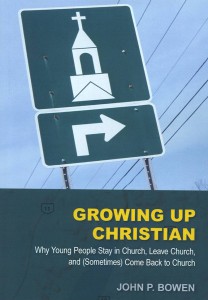 Some highlights from John Bowen’s book, Growing up Christian: Why Young People Stay in Church, Leave Church and (Sometimes) Come Back to Church
 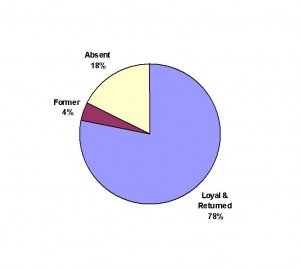 “You still call yourself a Christian and are involved in church.” There were 251 who chose this survey, 75% of the respondents. I refer to these as Loyal Believers.Roughly one third of these (eighty-three), although they are active Christians today, had a time of six months or more when they were away from church and/or faith. This is a distinctive group, so I call them Returned Believers.
 Growing up Christian: Why Young People Stay in Church, Leave Church and (Sometimes) Come Back to Church is published by Regent College Publishing (2010), and is available online from Amazon
  On Sunday afternoon, February 28th, 2010 – God willing – the Canadian Men’s Olympic Hockey Team will be going for gold. There’s no question that this event will be the highlight of Vancouver’s games, and that the vast majority of us – the faithful – will be there, on the edges of our couches, glued to our sets, with our hearts in our throats. For a couple of hours we’ll be caught up in the ecstasy of it all, nothing else will matter. Filled with religious fervour, we’ll fully engage this sacred event; our very identities on the line. And all we’ll need to do is believe.

 If we are to become a church shaped by and for God’s mission in this world, the last thing we need is a fresh expression of amnesia. 233 variations of the word “remember” appear in Old and New Testaments. As poet and philosopher George Santayana has it, “Those who cannot remember the past are condemned to repeat it.” So as we immerse ourselves in talk of being sensitive to the multiplicity of different contexts and cultures around us in Canada, and of the need to connect appropriately with those contexts and cultures, it is salutary to be reminded that we haven’t always thought, much less acted, in this way.